
.svg)
.png)


.png)


.svg)


.svg)
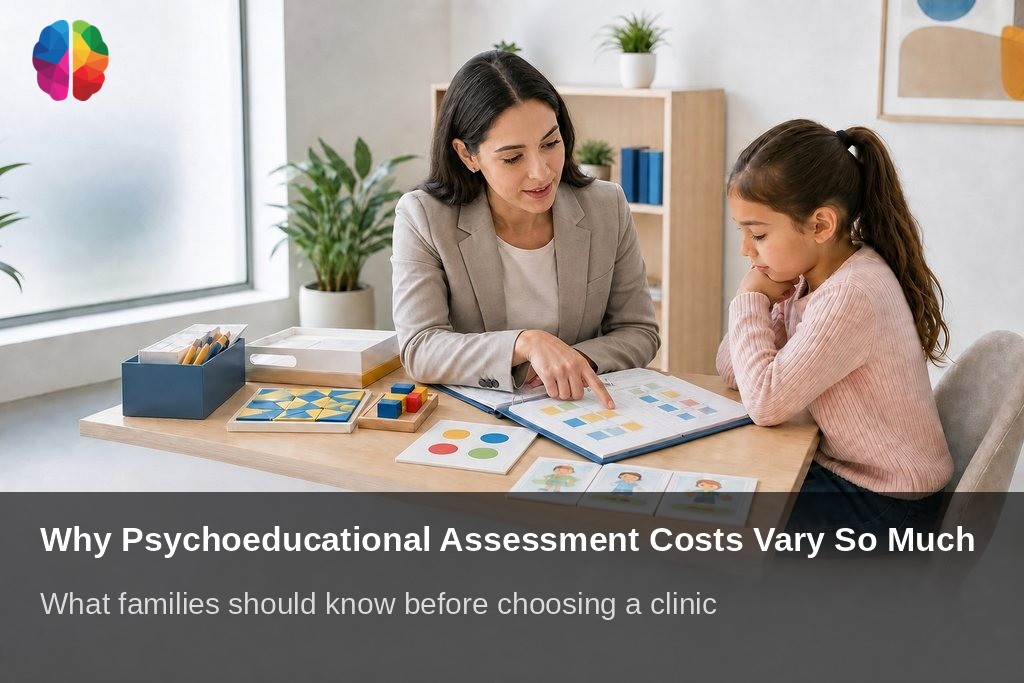
When families start looking into psychoeducational assessments, one of the first things they notice is that quoted fees can differ dramatically. One clinic may list a fee well below $2,000, while another quotes over $4,000 for what sounds like a similar service. Without understanding the key cost factors involved, it is easy to assume the price gap is arbitrary, when in reality it often reflects meaningful differences in what each assessment actually includes.
For families in Vancouver navigating school placement timelines or accommodation decisions, this matters more than finding the lowest number on a list. The quality, scope, and format of an assessment can determine whether a school accepts the results. This article explains the main variables that shape what families pay, what is often left out of a quoted price, and what to verify before booking.
What Families Are Usually Told About Assessment Fees
Most clinics publish a fee or price range, and that is often where the explanation ends. A family sees a number, compares it to another from a different provider, and is left wondering what accounts for the difference. Higher fees do not automatically mean better quality, but lower fees do not always mean equivalent service either.
The missing piece is context: what hours, specialists, tools, and deliverables are included in that figure, and what might be billed separately. Psychoeducational assessments in British Columbia typically range between $3,000 and $4,500 for a complete evaluation, with fees in Metro Vancouver reflecting the city's higher cost of living. Yet even within that band, two assessments priced the same can look very different in scope, personnel, and report format.

The Core Psychoeducational Assessment Cost Factors
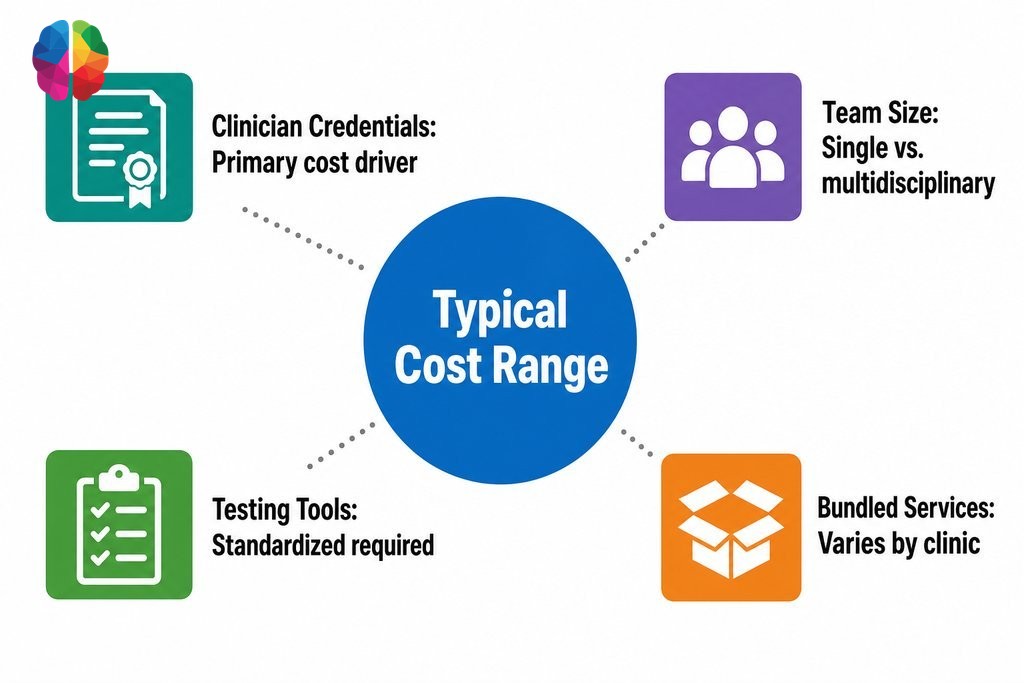
A comprehensive psychoeducational assessment is not a single test administered in one sitting. It is a multi-stage process that includes intake consultation, standardized testing, observation, collateral interviews, scoring, interpretation, and written reporting. Each stage requires professional time, and professional time is the primary cost driver.
The Toronto Neurodevelopmental Centre notes a base cost of approximately $4,500 for a comprehensive psychoeducational assessment, reflecting roughly 15 to 18 clinical hours of work. When families understand that the fee is essentially paying for skilled professional hours rather than a product, the variation in pricing starts to make sense.
Clinician credentials also play a significant role. Registered psychologists with specialized training in neurodevelopmental conditions charge higher rates than supervised graduate students working through university training clinics, where assessments may be available at a substantially lower cost. The tradeoff involves turnaround time, depth of experience, and the level of specialization that complex cases require. For school-age children where results will directly inform placement or support plans, clinician expertise often justifies a higher fee.
How Many Specialists Are Involved
A single psychologist working independently will charge differently from a multidisciplinary team where a psychologist, speech-language pathologist, and psychiatrist each contribute to the same assessment. When multiple specialists are involved, families receive a more complete picture of how their child learns, communicates, and functions across different areas.
This is especially valuable when more than one condition is suspected, such as learning differences combined with ADHD or autism, because those cases require additional testing time, collateral input, and more detailed reporting. Each of those factors adds to the total fee, but they also reduce the chance that something important is missed.
Multidisciplinary assessments tend to produce reports that are more useful to schools, as they address a wider range of functional areas with input from multiple professional perspectives. Families weighing how to choose a psychoeducational assessment should ask directly how many specialists contribute and what each one's role is before comparing prices.
The Standardized Testing Tools Used
The specific tools used in an assessment are another important cost factor. Standardized testing kits such as the WISC-V and WIAT-4 can cost hundreds to thousands of dollars per kit and must be updated periodically. Those materials costs are embedded in clinic fees.
Beyond the financial side, the choice of tools matters because schools and disability services offices require results from recognized standardized measures when making placement or accommodation decisions. A lower-cost assessment that relies on informal observation or non-standardized tools may not produce results a school will accept, which means families could end up paying twice.
Why Assessment Prices Vary Between Vancouver Clinics
One of the clearest illustrations of why prices vary is the difference between provider types. Private registered psychologists, multidisciplinary clinics, public school board psychologists, and university training clinics each operate under different cost structures and service models. Scope and specialization independently drive pricing variation, and this holds true across Metro Vancouver, whether a family is based in Kitsilano, Burnaby, North Vancouver, or the Fraser Valley.
Geography adds another layer. Vancouver consistently shows higher assessment fees than smaller British Columbia communities, primarily because overhead and professional fee norms differ. Families in the city can generally expect fees to reflect both the local cost of living and the depth of service being offered.
Price differences between clinics often reflect genuine differences in scope rather than one clinic simply charging more for the same work. A guiding question when evaluating options should always be: will this report meet the school's requirements?

What Affects Learning Assessment Fees Beyond the Test Itself
When families receive a quote, the figure often covers the testing component but may or may not include everything surrounding it. The following components can be billed separately depending on the clinic:
- Intake consultations: Clinicians gather background information from parents and review relevant records. Some clinics include this in the quoted fee; others bill separately.
- Feedback sessions: Results are explained to families after the assessment. Inclusion varies by provider.
- Written reports: A brief summary letter and a comprehensive psychoeducational report with school-ready recommendations are very different documents. The time required to produce them will show up in the fee.
- Post-assessment support: Some clinics offer follow-up sessions to help families understand results and next steps. Others consider the process complete once the report is delivered.
Asking what is included before booking prevents unexpected charges and helps families assess whether a higher quote actually represents better overall value.
Budgeting With Vancouver School Timelines in Mind
For families whose primary goal is school placement or securing in-class accommodations, budgeting for an assessment is inseparable from planning around deadlines. Many Vancouver schools and the Vancouver School Board have fixed timelines for receiving assessment documentation, and a report delivered after an admissions or accommodation window closes may be too late to act on.
When consulting with clinics, ask specifically about turnaround time from the first appointment to report delivery, and whether the report format and the assessing clinician's credentials meet the target school's requirements.
It is also worth exploring insurance coverage for psychoeducational assessments before committing to a private provider. Some extended health benefit plans cover part of the cost when an assessment is deemed medically necessary. For families who need additional support, funding options for learning assessments may be available through provincial programmes or community organisations in British Columbia, though eligibility criteria vary by programme.

Questions to Ask Before You Book
Before confirming any booking, asking a few direct questions helps families compare providers on meaningful grounds rather than price alone. These are reasonable steps that any reputable clinic will welcome and answer clearly:
- What are the credentials of the psychologist or specialists conducting the assessment?
- Which standardized tools are used, and are they accepted by the school or district?
- What is included in the quoted fee, and what might be billed separately?
- How long does the process take from intake to report delivery?
- Does the report format meet the requirements of the specific school or programme?
These questions surface any gaps between what a clinic offers and what a particular school requires, which is far better to discover before a deposit is paid than after a report has been delivered.
How All Brains Clinic Approaches Assessment Pricing and Support
At All Brains Clinic in Vancouver, psychoeducational assessments are conducted by a multidisciplinary team that includes psychologists, speech-language pathologists, kinesiologists, and psychiatrists working collaboratively on each case. This means families receive a more complete picture of their child's learning profile than a single-assessor evaluation typically provides.
Every assessment at All Brains Clinic includes a full psychiatric evaluation covered by MSP, British Columbia's provincial health plan, which directly reduces the out-of-pocket cost for families. Complimentary post-assessment support sessions are also included, so families leave with a clear understanding of the results and a personalised plan for next steps.
Transparency about what is included in the assessment fee is central to how All Brains Clinic supports Vancouver families from the very first conversation. If you are navigating school placement timelines in Vancouver and want to understand exactly what a comprehensive assessment involves, the team at All Brains Clinic is ready to walk you through the process and answer every question before you commit. Reach out today to start that conversation.
Frequently Asked Questions About Psychoeducational Assessment Costs
What is the typical cost of a psychoeducational assessment in Vancouver?
In Metro Vancouver, a comprehensive psychoeducational assessment generally costs between $3,000 and $4,500. Fees vary depending on the number of specialists involved, the standardized tools used, and what is included in the quoted price, such as intake consultations, written reports, and feedback sessions.
Why do psychoeducational assessment fees differ so much between clinics?
The main reasons are differences in clinician credentials, the number of specialists involved, the depth of testing, and what services are bundled into the quoted fee. A multidisciplinary assessment involving a psychologist, speech-language pathologist, and psychiatrist will cost more than a single-assessor evaluation, and typically produces a more comprehensive report.
Does insurance cover psychoeducational assessments in British Columbia?
Some extended health benefit plans cover a portion of the cost when an assessment is deemed medically necessary. Coverage varies significantly between plans and employers. Confirm your plan's specific terms before booking, as reimbursement is not guaranteed and may require a referral or pre-approval.
Will a lower-cost assessment be accepted by Vancouver schools?
Not always. Schools and districts typically require results from recognized standardized measures conducted by a registered psychologist. An assessment that relies on non-standardized tools or is completed by an unregistered clinician may not meet school requirements, potentially requiring families to pay for a second evaluation.
How long does a psychoeducational assessment take from start to report delivery?
The full process from intake to written report typically takes several weeks, though timelines vary by clinic and caseload. Families with upcoming school placement or accommodation deadlines should ask each clinic for a specific estimated turnaround time before booking.
Are there funding options for families who cannot afford a private psychoeducational assessment?
Some provincial programmes, community organisations, and university training clinics offer assessments at reduced cost. Eligibility criteria vary and waitlists can be lengthy. Families in British Columbia should explore available options early, particularly if a school deadline is approaching.


