
.svg)
.png)


.png)


.svg)


.svg)

When a teenager is approaching the end of high school, the pressure of what comes next can feel overwhelming for the whole family. Questions about college applications, program selection, and whether the right supports will be in place often surface at once. A learning assessment for high school students brings meaningful clarity to this transition, identifying how a teen processes information, where they excel, and where they may need additional support before entering a more independent academic environment.
For families in Vancouver and across British Columbia navigating this stage, a comprehensive psychoeducational assessment is not simply a diagnostic tool. It is a practical roadmap that shapes accommodation requests, informs study strategies, and helps students arrive at post-secondary education with a clear, well-documented understanding of their own learning profile.
Why High School Is the Right Time for a Learning Assessment in BC
The teen years are a critical window for identifying learning differences, precisely because structured support is still available. In secondary school, students have access to resource teachers, school counsellors, and formal accommodation processes that become significantly harder to navigate once they leave. Identifying a learning difference during high school gives a student time to practise self-advocacy, develop compensatory strategies, and understand their own needs before they are expected to manage independently on a university campus.
A student who understands that they process written information more slowly, for example, can begin requesting extended time in Grade 11 rather than struggling silently through their first university exam. The years between Grade 9 and graduation offer enough runway to put meaningful plans in place without the pressure of immediate high-stakes consequences. This is particularly relevant for students in Vancouver and the surrounding Lower Mainland, where pathways to institutions such as UBC, SFU, Langara College, and BCIT are competitive and accommodation documentation requirements are clearly defined.
It is also worth noting that when families research the best age for psychoeducational assessment, the high school window is often underestimated. Many parents associate formal assessment with younger children, and while a learning assessment for elementary students addresses developmental foundations, adolescent assessments serve a distinct and equally important purpose. They measure more complex cognitive and academic skills that only become fully testable in the teen years.

What a Psychoeducational Assessment Measures
A comprehensive psychoeducational assessment goes well beyond a classroom quiz or standardised school test. For high school students, it typically evaluates cognitive processing speed and working memory, verbal and nonverbal reasoning, phonological awareness, reading fluency and writing mechanics, mathematical reasoning, and attention regulation alongside executive functioning.
These areas directly influence how a student manages workload, deadlines, and multi-step tasks, all of which become more demanding in post-secondary settings.
It is important to distinguish between a school-based screening and a private comprehensive assessment. School screenings can flag students who may need further evaluation, but they are rarely detailed enough to satisfy the documentation requirements of post-secondary institutions. A private psychoeducational assessment administered by a registered psychologist uses standardised, norm-referenced tools and produces a formal report recognised by universities, colleges, and professional regulatory bodies in BC.
As noted in a study published by The American Statistician (Taylor and Francis), most student assessments focus narrowly on graded task performance rather than the full cognitive profile of the learner. Leading educators argue for multi-dimensional frameworks that capture understanding, reasoning, and individual learning differences, which is exactly what a comprehensive private assessment is built to deliver.
How Results Build a Complete Learning Profile
The most meaningful outcome of a psychoeducational assessment is not simply a diagnosis. It is a detailed description of how a teenager thinks, learns, and processes different types of information. Results reveal relative strengths alongside areas of difficulty, giving families and educators a nuanced picture rather than a single label.
A well-written report answers practical questions such as why a student who reads slowly still scores highly on comprehension tasks, or why someone with strong verbal skills struggles with written expression under timed conditions. This level of detail makes the report genuinely useful for accommodation requests, individualized education planning, and personalised study strategies.
How High School Accommodation Assessments Work
A high school accommodation assessment is the formal mechanism through which students gain access to supports such as extended time on tests and exams, assistive technology, alternate test formats, reduced-distraction testing environments, and modified assignment structures.
In British Columbia, these accommodations must be supported by documentation that meets specific evidentiary standards. A comprehensive psychoeducational report from a qualified assessor is the most commonly accepted form of evidence for secondary school accommodation requests, provincial examinations, and post-secondary transitions.
Many schools and colleges will not process an accommodation request based on a teacher's observation or a general practitioner's note alone. The report must identify specific areas of need, link them to measurable data, and recommend concrete supports. Without this documentation, students may be turned away from accommodations they genuinely need and qualify for.
Planning Ahead: Assessment Before College Applications in Vancouver
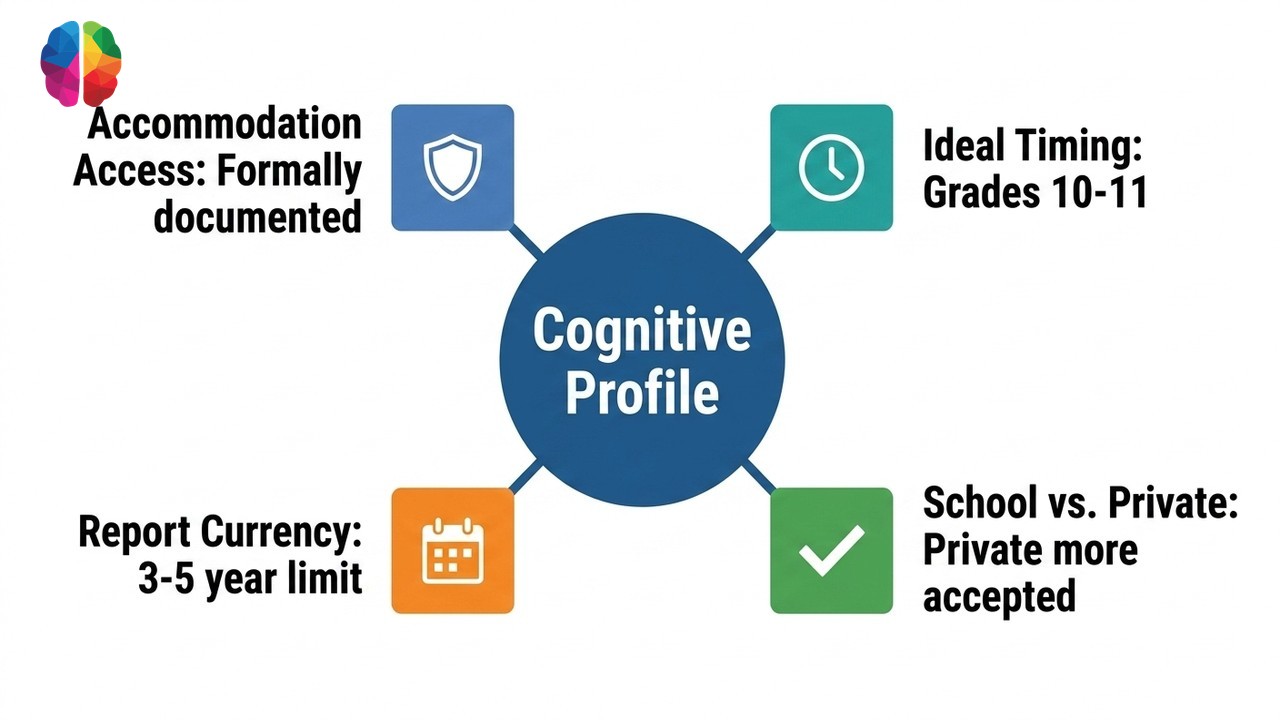
Families arranging a learning assessment before college planning are often surprised by how specific universities' requirements can be. Most Canadian post-secondary institutions, including those in the Greater Vancouver area, require assessment reports that are no more than three to five years old at the time of the accommodation request. Some programmes, particularly in health sciences, education, or law, may apply even stricter timelines. A report completed in Grade 9 may not meet the currency requirements for a first-year university accommodation request. Timing matters significantly.
Wide variability in academic readiness among secondary students is well documented. A cluster-randomised study published in the International Journal of Educational Research (ScienceDirect) found that proficiency rates across schools ranged from 6 to 87 per cent, with a mean of 47 per cent, demonstrating that standardised instruction alone does not address individual learning differences. This variability makes a personalised learning evaluation far more valuable than relying on group-level assumptions about readiness.
Data from the National Center for Education Statistics (NCES) also shows that average scores for 13-year-olds declined 9 points in mathematics compared to the 2019 to 2020 school year, signalling measurable gaps in academic readiness at a population level. For students already navigating learning differences, these broader trends make proactive secondary school support testing even more critical before entering post-secondary study.
What to Verify Before Choosing an Assessment Provider in BC
Not all assessments are equal. Before booking, confirm the following with any provider:
- Is the assessor a registered psychologist or registered psychological associate with experience in adolescent psychoeducational evaluation?
- Does the clinic use standardised, norm-referenced tools accepted by BC post-secondary institutions and provincial examination bodies?
- Will the report meet the documentation standards of the specific universities or colleges your teen is considering?
- Is post-assessment support included to help your family understand the results and identify next steps?
That last point matters. Receiving a detailed report is only useful if families understand what it means and how to act on it. Clinics that include a post-assessment debrief give families a real advantage when communicating with schools and preparing accommodation documentation.

Teen Academic Testing at All Brains Clinic
All Brains Clinic takes a genuinely multidisciplinary approach to teen academic testing. Psychologists and specialists collaborate on each case, drawing on perspectives from psychiatry, psychology, and related disciplines, to produce a comprehensive report that schools and post-secondary institutions recognise. This collaborative model reduces the risk of an incomplete picture, particularly when a learning difference co-occurs with ADHD, anxiety, or another condition shaping academic performance.
Every assessment at All Brains Clinic includes a full psychiatric evaluation, which is covered by MSP, British Columbia's public health plan. Following the assessment, families receive complimentary post-assessment support sessions where clinicians walk through the results in plain language, explain what the profile means in practical terms, and help families understand next steps for accommodation requests, school communication, or referrals to additional support.
Research published in Humanities and Social Sciences Communications (Nature Portfolio) found that student attitudes significantly influence academic performance, and that early identification of learning barriers can reshape academic trajectories. At All Brains Clinic, this insight shapes how results are communicated: with honesty, compassion, and a focus on what is possible rather than what is difficult.
What a Learning Assessment Cannot Do
A psychoeducational assessment is a powerful planning tool, but it is important to understand its limits. It identifies a student's learning profile and informs accommodation planning. It does not replace ongoing therapeutic support, tutoring, or clinical intervention.
If a teen is experiencing significant emotional distress, school refusal, or severe anxiety alongside their learning challenges, assessment alone will not resolve those difficulties. It can, however, clarify whether a learning difference is contributing to the distress and guide families toward the right kind of help.
Families who suspect a co-occurring condition such as ADHD, autism, or anxiety may be influencing their teenager's academic performance are encouraged to raise those concerns directly with a qualified assessor before the evaluation begins. Sharing that context allows the assessor to select appropriate tools, ask relevant questions during the clinical interview, and ensure the final report addresses the full picture. A learning evaluation for older students is most useful when it is tailored, thorough, and grounded in a real understanding of the individual.
If your family is ready to take the next step, the team at All Brains Clinic in Vancouver is here to help you understand your options, ask the right questions, and move forward with confidence. Reach out to begin a conversation about what a comprehensive assessment could mean for your teenager's future.
Frequently Asked Questions About Learning Assessments for High School Students
What is the difference between a school-based screening and a private psychoeducational assessment?
A school-based screening identifies students who may need further evaluation, but it does not produce the detailed, norm-referenced report required by most post-secondary institutions. A private psychoeducational assessment administered by a registered psychologist documents a student's full cognitive and academic profile in a format accepted by universities, colleges, and provincial examination bodies in BC.
When is the best time during high school to get a learning assessment?
Grades 10 or 11 are generally the most practical window. This timing allows enough runway to put accommodations in place before graduation, while keeping the report current enough to meet most post-secondary documentation requirements, which typically require assessments completed within the past three to five years.
Can a learning assessment help a student who is doing reasonably well academically?
Yes. Many students achieve passing grades by working significantly harder than peers or by avoiding tasks that expose their difficulties. An assessment can reveal why a capable student is exhausted, inconsistent, or underperforming under pressure, and identify supports that make their effort more sustainable at the post-secondary level.
Does a psychoeducational assessment diagnose ADHD or autism?
A psychoeducational assessment evaluates learning and cognitive functioning, and results may point toward ADHD, autism, or other conditions as contributing factors. A formal diagnosis typically requires a broader clinical evaluation. At All Brains Clinic, each assessment includes a full psychiatric evaluation, which supports a more complete clinical picture.
Will BC universities and colleges accept the report from a private clinic?
Yes, provided the report is produced by a registered psychologist using standardised, norm-referenced tools and meets the institution's documentation standards. Before booking, confirm with your chosen clinic that their reports are accepted by the specific post-secondary institutions your teenager is considering.


