
.svg)
.png)


.png)


.svg)


.svg)

When a child enters the early elementary years, parents often begin noticing things that teachers may be flagging as well — difficulty keeping up with reading, trouble staying focused during lessons, or a general sense that something is not clicking the way it should. For many Vancouver families, these observations mark the beginning of a search for answers, and a learning assessment for elementary students is frequently the most important step they can take. Understanding what this process actually involves — from the first conversation to the final report — helps families move forward with confidence rather than uncertainty.
Early questions are almost always worth pursuing. Research consistently shows that identifying learning difficulties early through structured evaluation, combined with targeted instructional support, produces meaningful improvements in student achievement across primary grade levels. Waiting to see whether a child simply catches up can cost valuable time during a developmental window when support has the greatest impact. The right assessment does not just confirm a concern — it opens a door to a clearer, more empowering path forward.
Why Vancouver Parents Start Asking Questions in the Early Grades
Most families do not arrive at a learning evaluation by accident. There is usually a pattern — a note from a teacher, a child who dreads reading time, a bright child who cannot seem to get thoughts onto paper, or a growing gap between what a child seems capable of and what they are producing in class. These signs are not reasons to panic; they are invitations to understand a child's learning profile more fully.
Attention difficulties are another common trigger. Parents may notice that their child struggles to complete tasks, acts impulsively, or becomes overwhelmed in structured settings. School feedback about behaviour, focus, or effort — especially when it conflicts with what families observe at home — can leave parents feeling confused. A standardised assessment replaces guesswork with a detailed, objective picture. Acting on these concerns in the primary grades is always the right instinct, and it aligns directly with questions families often have about the best age for psychoeducational assessment.
What a Psychoeducational Assessment Measures
A psychoeducational assessment is not a single test — it is a structured evaluation across multiple cognitive and academic domains that together paint a complete picture of how a child thinks and learns.
Core areas typically assessed include cognitive ability, academic achievement in reading, writing, and mathematics, working memory and processing speed, language comprehension and phonological processing, and attention and executive functioning.
No single test can fully capture a child's learning needs, which is why a thorough evaluation goes well beyond what classroom observation or school-administered quizzes can reveal. The resulting learning profile identifies both strengths and areas requiring support. A report that only identifies difficulties, without articulating strengths, gives families and schools an incomplete and often discouraging picture.
Reading Assessment in the Primary Grades
Reading is one of the most critical skills assessed in the early years. Difficulties with phonological processing — the ability to hear and manipulate sounds in words — are among the earliest and most reliable indicators of conditions such as dyslexia. A primary-grade reading assessment examines decoding, fluency, phonemic awareness, and reading comprehension using standardised tools designed specifically for young children.
Identifying a reading difficulty at age six or seven, rather than waiting until grade four or five, can fundamentally change a child's academic trajectory. Early intervention targeting the right skills at the right time is generally far more effective than remediation attempted years later.
Cognitive and Attention Testing: Why the Distinction Matters
A child who is inattentive, impulsive, or disorganised in class may be experiencing ADHD, a learning difficulty, anxiety, or some combination of these — and each calls for a different kind of support. Cognitive and attention testing in the primary grades uses standardised tools to evaluate executive functioning, working memory, and sustained attention in a controlled setting.
Getting this distinction right from the start protects a child from being misunderstood for years. The interventions that help a child with a processing difficulty are not the same as those that help a child with attention regulation challenges.
How the Assessment Process Works
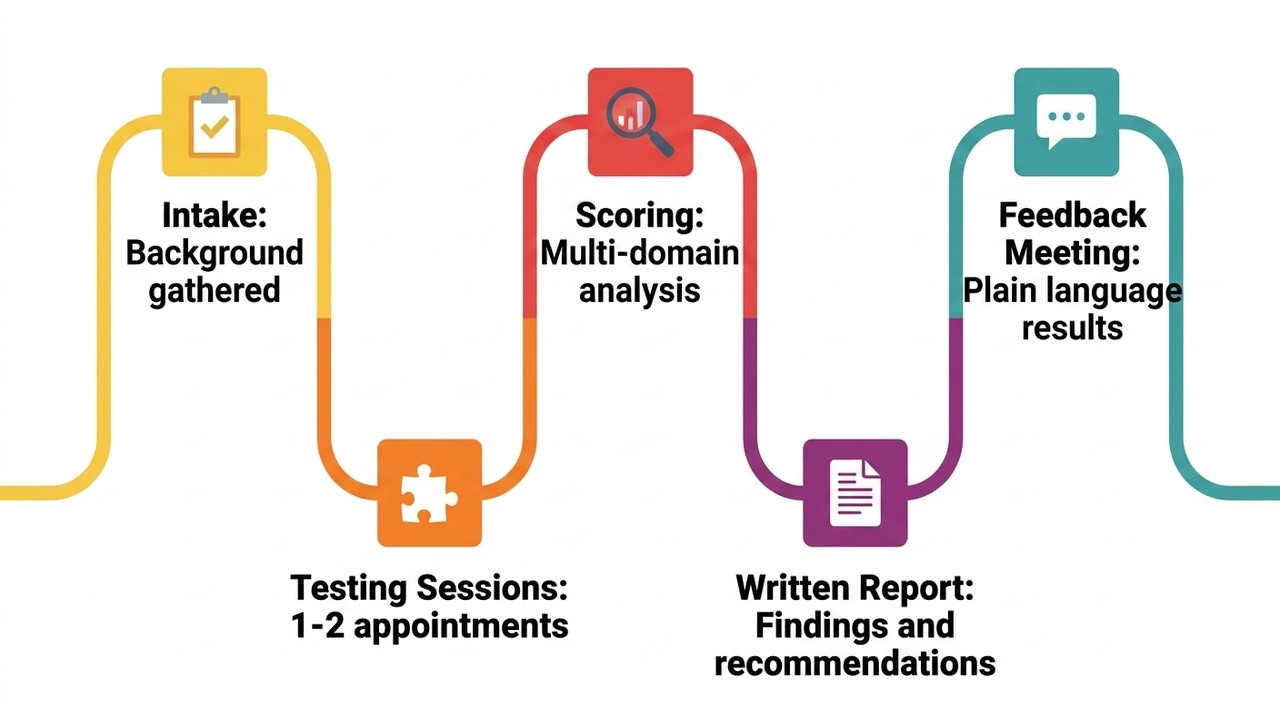
Knowing what to expect reduces anxiety considerably. A typical psychoeducational assessment unfolds in five stages:
For Vancouver families navigating school placement or admissions timelines — whether at a local public school, an independent school in West Vancouver or North Vancouver, or a French immersion programme — discussing turnaround times with a provider early in the process is a practical priority. Aligning the assessment with a school's intake or accommodation request deadline is something a good provider will help you plan around.
What BC Schools Accept and Why Report Quality Matters
A psychoeducational report produced by a registered psychologist carries a specific kind of authority that school-based observations alone do not. Schools and independent admissions offices across British Columbia — including those within Vancouver, Burnaby, Richmond, and the North Shore — typically require a clinician-signed report that documents standardised test scores, diagnostic impressions, and specific recommended accommodations.
This documentation is what allows a school to put a formal support plan in place — whether that takes the form of extended time on tests, modified assignments, a learning assistance designation, or an individualised education plan.
Report quality, clinician credentials, and the tools used all influence how schools respond to submitted documentation. A report generated through a rigorous, standardised process and signed by a registered psychologist carries far more weight in admissions and accommodation conversations than informal screening results. The National Center for Education Statistics has documented meaningful declines in academic performance among school-age children in recent years, which has sharpened schools' focus on identifying and supporting students through verified evaluation data.
What Happens After Assessment Results Are Received
Receiving a psychoeducational report is not the end of the process — it is the beginning of a plan. An early academic support assessment is most useful when it translates directly into action: specific recommendations for tutoring or intervention, guidance for teachers, referrals to additional services, and a clear framework for how a child's strengths can be harnessed alongside targeted support.
Research from East Texas A&M University found that data-driven professional learning interventions were associated with reading comprehension improvements with effect sizes ranging from d = 0.24 to 1.68, suggesting that assessment results can meaningfully shape outcomes when they are used to guide instruction.
At All Brains Clinic, every assessment is followed by complimentary post-assessment support sessions, giving families space to ask questions, revisit findings, and work through what the recommendations mean in practical terms. A learning profile should never feel like a label applied and left behind — it should feel like a map that helps families, educators, and clinicians work together toward a genuinely better outcome for the child at the centre of it all.
When a Multidisciplinary Evaluation Is the Right Fit
Some children's needs cannot be fully captured by a single assessment type. A child who has significant language delays alongside learning difficulties may benefit from having a speech-language pathologist involved. A child with coordination challenges, sensory sensitivities, or motor development concerns may need occupational therapy as part of the picture.
In these situations, a multidisciplinary evaluation — where specialists from different disciplines contribute assessments and then collaborate on findings — produces a far more complete and actionable understanding of the child's needs.
All Brains Clinic is structured specifically for this kind of integrated work. The clinical team includes psychologists, psychiatrists, speech-language pathologists, and kinesiologists who collaborate on each case. When a broader evaluation is warranted, it happens within a single coordinated care environment rather than across disconnected providers — which matters not just for efficiency, but for the quality and consistency of the recommendations Vancouver families receive.

Key Questions to Ask Before Choosing an Assessment Provider in BC
Choosing the right provider is a decision worth taking seriously. A report that a school does not recognise — because it was not produced by a registered psychologist using accepted standardised tools — creates delays and frustration at exactly the moment when a family needs clarity.
Before committing to a provider, consider asking whether the assessment is conducted by a registered psychologist whose report will be accepted by BC schools, what standardised tools are used and whether they are appropriate for the child's age and concerns, whether the provider offers post-assessment support, and what the expected timeline is from intake to final report relative to any school deadlines.
Families with older children exploring a learning assessment for high school students will find that many of the same questions about credentials, report quality, and school recognition apply — though the evaluation scope and academic domains shift with age.
At All Brains Clinic, the team is available to help Vancouver families at any stage understand what kind of assessment fits their child's age, profile, and goals. If you have questions about the process or want to explore whether an assessment is the right next step, we warmly invite you to reach out — your child's strengths are worth understanding fully, and we are here to help you do exactly that.
Frequently Asked Questions About Elementary Learning Assessments
What is a learning assessment for elementary students?
It is a structured psychoeducational evaluation conducted by a registered psychologist that measures a child's cognitive abilities, academic achievement, attention, and processing skills. The goal is to identify how a child learns, where support is needed, and what strengths can be built upon — resulting in a written report with practical recommendations for school and home.
At what age should a child have a learning assessment?
Most children benefit from assessment as soon as consistent concerns emerge, often between ages five and eight. Earlier identification means earlier support during the developmental window when intervention tends to have the greatest impact. There is no single right age, but waiting until late elementary grades can limit the effectiveness of targeted interventions.
Will a psychoeducational report be accepted by Vancouver public and independent schools?
Yes, provided the report is produced by a registered psychologist using standardised tools. BC schools and independent admissions offices typically require this credential and format before implementing formal accommodations, learning assistance designations, or individualised education plans. Informal screening reports generally do not meet this threshold.
How long does a psychoeducational assessment take?
Most assessments involve one to two testing sessions with the child, followed by scoring, report writing, and a feedback meeting with the family. The full process from intake to final report typically takes several weeks, depending on the provider's schedule and the complexity of the evaluation.
What is the difference between a learning assessment and an ADHD assessment?
A comprehensive psychoeducational assessment evaluates both learning and attention, and can assess for ADHD alongside learning difficulties. A standalone ADHD assessment focuses more narrowly on attention, impulsivity, and executive functioning. Because learning difficulties and attention challenges often co-occur, a combined evaluation is often the most informative approach for elementary-aged children.
Can a learning assessment identify dyslexia in young children?
Yes. A reading-focused assessment examines phonological processing, decoding, fluency, and comprehension — the key areas affected by dyslexia. Standardised tools designed for primary-grade children can reliably identify these patterns at ages six or seven, allowing families and schools to begin evidence-based reading intervention before difficulties compound.


