
.svg)
.png)


.png)


.svg)


.svg)
Receiving your child's psychoeducational assessment report can feel like opening a document written in a foreign language. Pages of scores, clinical terminology, and diagnostic impressions sit between sections you were not expecting, and an upcoming school placement meeting makes it all feel urgent. Understanding psychoeducational assessment reports is not about becoming a psychology expert overnight. It is about knowing enough to advocate confidently for your child, ask the right questions, and use the findings when it matters most.
This guide walks you through each part of the report in plain language, explains what the scores actually tell you, and helps you prepare for conversations with educators. Whether you are navigating a school placement decision in British Columbia or working toward formal accommodations through your child's school district, a clear grasp of the report gives you a genuine advantage throughout the psychoeducational assessment process.
What a Psychoeducational Assessment Report Contains
A psychoeducational assessment report is not a single test result. It is a structured clinical document that weaves together multiple sources of information to create a complete picture of how your child thinks, learns, and functions. According to LD@School (Learning Disabilities Association of Ontario), these reports typically include tests of intelligence, cognitive abilities, memory, academic achievement, and behaviour, along with clinical observations gathered across the assessment sessions.
A typical report moves through six main sections: the reason for referral, which explains why the assessment was requested and what concerns it aimed to address; background history, covering developmental milestones, medical history, and school experience; behavioural observations, describing how your child engaged during testing; test results, presenting formal scores across cognitive, academic, and behavioural measures; diagnostic impressions, which contain the psychologist's clinical conclusions; and recommendations, outlining specific supports, accommodations, and next steps.
Emotional functioning, including anxiety or low mood, is often assessed as well, because emotional factors can significantly affect academic performance. Knowing how these sections connect helps you read the document as a coherent story rather than a collection of disconnected numbers.

How to Read Test Scores in an Assessment Report
For many parents, the score tables are the most intimidating part of the report. The core concepts behind them are straightforward once you know what each score is designed to show. Research published in the Canadian Journal of School Psychology (SAGE Publications, 2011) found that parents and teachers have specific informational needs that differ significantly from those of clinicians. The gap between what reports contain and what parents can easily use is a well-recognized challenge, not a reflection of your ability to understand your child.
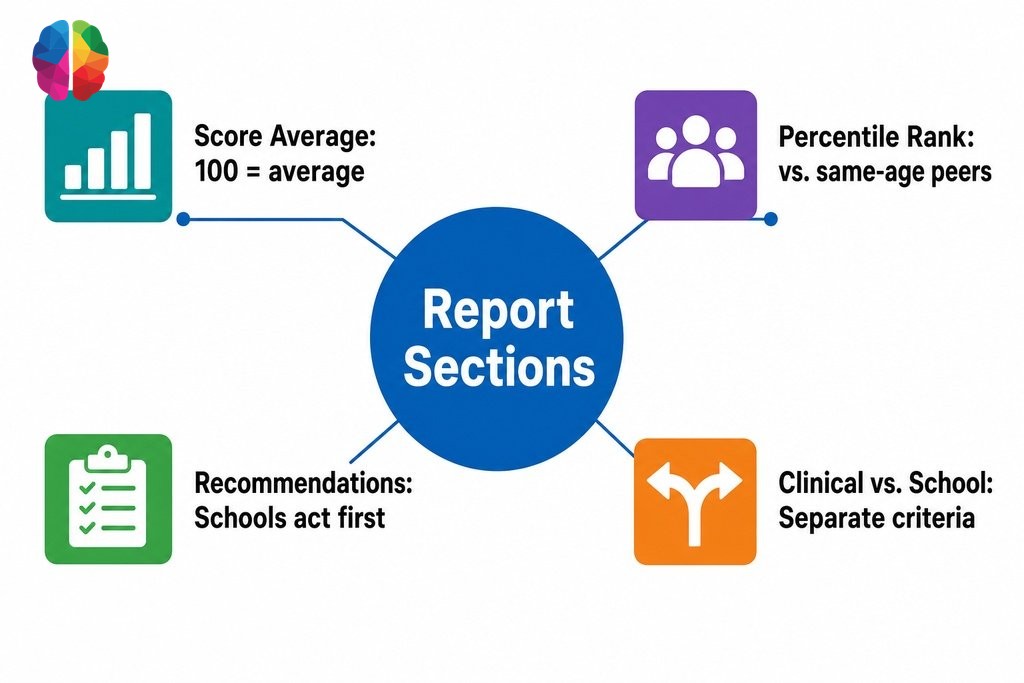
The three score types you will encounter most often are standard scores, percentile ranks, and confidence intervals. Standard scores are calculated so that 100 represents the average for a child of the same age, with most children scoring between 85 and 115. Percentile ranks show how your child performed compared to peers: a percentile rank of 63 means your child scored as well as or better than 63 percent of children the same age. Confidence intervals are presented as a score range rather than a single number, reflecting that no test is perfectly precise and that your child's true ability likely falls somewhere within that band. One number alone rarely tells the full story, and a skilled psychologist interprets these results together rather than in isolation.
Composite Scores Versus Subtest Scores
Composite scores, such as a Full Scale IQ or a General Ability Index, are broad summary scores built by combining several narrower subtests. Think of a composite score as the headline and the subtest scores as the supporting details. A composite score in the average range can mask meaningful variation underneath, where a child scores very highly on some subtests and considerably lower on others. The composite gives educators a general orientation, while the subtest profile reveals the specific strengths and challenges that should shape classroom supports and individualized plans.
When Scores Look Inconsistent
It is common for scores to vary noticeably across different areas, and this variability is not a mistake. Psychologists are trained to identify when a gap between two areas is large enough to be clinically meaningful rather than the result of normal test variation. A significant discrepancy between verbal reasoning and processing speed, for example, can point to specific learning differences that affect how a child performs under timed conditions at school. When your psychologist flags a gap between scores, pay close attention to that section because it often connects directly to the most important recommendations.
How to Read Each Section of the Report
Reading the report from beginning to end, in order, is the most useful approach, even though many parents instinctively skip ahead to the scores or the diagnosis. The reason for referral sets the frame for everything that follows and reminds you of the specific questions the assessment was designed to answer. The developmental and school history section gives the psychologist's findings real-world context by connecting test performance to your child's lived experience, and reading it carefully often explains why certain scores look the way they do.
The behavioural observations section captures how your child approached tasks, handled frustration, sustained attention, and responded to prompts, adding qualitative depth that numbers alone cannot provide. The test results present the formal scores across each area assessed. Finally, the diagnostic impressions synthesize everything into clinical conclusions. Note any diagnostic terms here so you can ask the psychologist what they mean in practical terms for the classroom.

Making Sense of the Recommendations
The recommendations section is often where schools focus first, and it is where parents can most directly influence outcomes for their child. According to research published by PMC / National Institutes of Health, translating assessment data into actionable educational recommendations requires skilled examiner interpretation rather than direct score application: "Assessment data do not automatically yield specific educational recommendations. Skilled examiners interpret the data and make research-based recommendations." If any recommendation is unclear, you have every right to ask for an explanation.
Recommendations are typically grouped by setting and may include classroom accommodations such as extended time or reduced-distraction settings, instructional strategies for reading or writing, referrals to other specialists such as speech-language pathologists or occupational therapists, and formal identification pathways such as an Individual Education Plan in British Columbia. Note the exact wording of each recommendation. Schools are more likely to act on language that is specific and grounded in the report's findings, and that precision matters when you sit down with a resource teacher or school-based psychologist.
How Recommendations Support School Placement in British Columbia
In British Columbia, psychoeducational assessments play a meaningful role in school identification and placement processes. The Ontario Human Rights Commission has documented that assessments support formal identification processes such as the IPRC in Ontario, and comparable frameworks guide placement and designation decisions across other provinces, including BC. A well-documented recommendations section gives school teams, including resource teachers, learning support staff, and district psychologists, the evidence they need to design appropriate support plans. When recommendations connect clearly to specific findings in the report, they are far more persuasive and actionable for teams working against tight timelines at the start of each school year.
How to Prepare for a School Meeting Using the Report
Treat the report as a working document rather than a file you hand over and step back from. Before any school meeting, read through each section and write your questions alongside the relevant passages. Identify two or three findings you want the team to address directly, especially anything in the diagnostic impressions or recommendations with clear classroom implications. Look up any unfamiliar terms so you can discuss them confidently; understanding what do psychoeducational test scores mean in your child's specific profile will help you explain those findings if educators are unfamiliar with a particular measure.
During the meeting, refer to the report by section when raising a point. This keeps the conversation grounded in documented findings rather than general impressions. After the meeting, note which recommendations were accepted, which were deferred, and what follow-up actions were assigned. Knowing how to use an assessment report at school effectively means staying engaged beyond the initial meeting, following up on commitments, and revisiting the report if your child's needs change. LD@School notes that parents and students can request a review or updated recommendations at any stage of a student's school career, an important right many BC families are not yet aware of.

Limitations of a Psychoeducational Assessment Report
A psychoeducational assessment report is detailed and valuable, but it is also a snapshot taken at a specific point in your child's development. The findings reflect how your child performed on a particular set of tasks on the days of testing. Factors such as fatigue, anxiety, and the rapport between your child and the examiner can all influence results, and no single report should be treated as a permanent or complete definition of your child's abilities.
There is also an important distinction between a clinical diagnosis in the report and what a school formally designates or funds. In British Columbia, a psychologist can diagnose a learning disability or ADHD based on assessment findings, but school districts apply their own criteria when determining eligibility for formal designations, programs, or resources. Some children whose reports contain clear findings still need an additional advocate at the school level. Where the report identifies concerns in areas such as speech and language, motor development, or complex emotional needs, it may also recommend referrals for speech-language pathology or occupational therapy assessments to complete the picture.
How All Brains Clinic Supports BC Families After Assessment
At All Brains Clinic, we understand that receiving a report is only one part of the journey. Every assessment at our Vancouver clinic is followed by complimentary post-assessment support sessions, where our clinicians walk families through the results in everyday language, explain each finding in context, and help translate recommendations into clear next steps. You will never be handed a document and left to interpret it alone.
Our multidisciplinary team includes psychologists, speech-language pathologists, and other specialists who collaborate on each case. When the report identifies concerns beyond the scope of a single assessment, we can coordinate follow-up evaluations and support without requiring families to navigate referrals from scratch. We also include a full psychiatric evaluation as part of each comprehensive assessment, covered by MSP for eligible families in British Columbia. As Mastoras, Climie, McCrimmon, and Schwean noted in the Canadian Journal of School Psychology: "Understanding and effectively addressing the concerns, questions, and needs of the referring individual, whether that is a teacher or parent, will support the value and ongoing relevance of psychoeducational reports within the school system." That belief shapes everything we do after assessment day. If you have questions about a report your family has received, or if you are preparing for an upcoming school meeting in the Lower Mainland or elsewhere in BC, we invite you to reach out to our team.
Frequently Asked Questions
What is a psychoeducational assessment report?
A psychoeducational assessment report is a structured clinical document evaluating how a child thinks, learns, and functions. It combines cognitive, academic, and behavioural test scores with clinical observations and developmental history to produce specific educational recommendations and, where applicable, a diagnosis.
How long does it take to receive a psychoeducational assessment report in BC?
Timelines vary by clinic and complexity, but families in British Columbia typically receive a completed report within a few weeks of the final testing session. At All Brains Clinic, a post-assessment support session is scheduled alongside delivery so families can review findings with a clinician rather than reading the report on their own.
What do standard scores mean in an assessment report?
Standard scores place your child's performance on a scale where 100 is the age-group average. Most children score between 85 and 115. Scores outside that range indicate performance that differs meaningfully from age-level expectations, either as an area of challenge or a notable strength.
Can a school refuse to act on a psychoeducational assessment report?
Schools in BC are not automatically bound to implement every recommendation in a private report, as districts apply their own designation criteria. A well-documented report with specific, research-based recommendations gives families a strong basis for advocacy, and families can request meetings with resource teachers or district psychologists to discuss the findings directly.
How is a clinical diagnosis in a report different from a school designation in BC?
A registered psychologist can diagnose a learning disability or ADHD through assessment, but BC school districts use separate criteria to determine eligibility for formal designations, funding, or specialized programs. A clinical diagnosis supports the case for school designation but does not guarantee it automatically.
How often should a psychoeducational assessment be updated?
There is no fixed rule, but assessments are often revisited when a child transitions to a new school stage, when existing supports no longer appear effective, or when new concerns arise. Parents and students can request updated recommendations at any stage of a student's school career.

Dr. Ali Eslami, Chief Editor
Dr. Ali Eslami is a child psychiatrist at BC Children’s Hospital and All Brains Clinic with a PhD from Brown University. With expertise in neurodevelopmental disorders, autism assessment, and AI research in mental health, he ensures every article meets the highest standards. His sharp editorial eye guarantees clarity, accuracy, and credibility in all our content.


