
.svg)
.png)


.png)


.svg)


.svg)
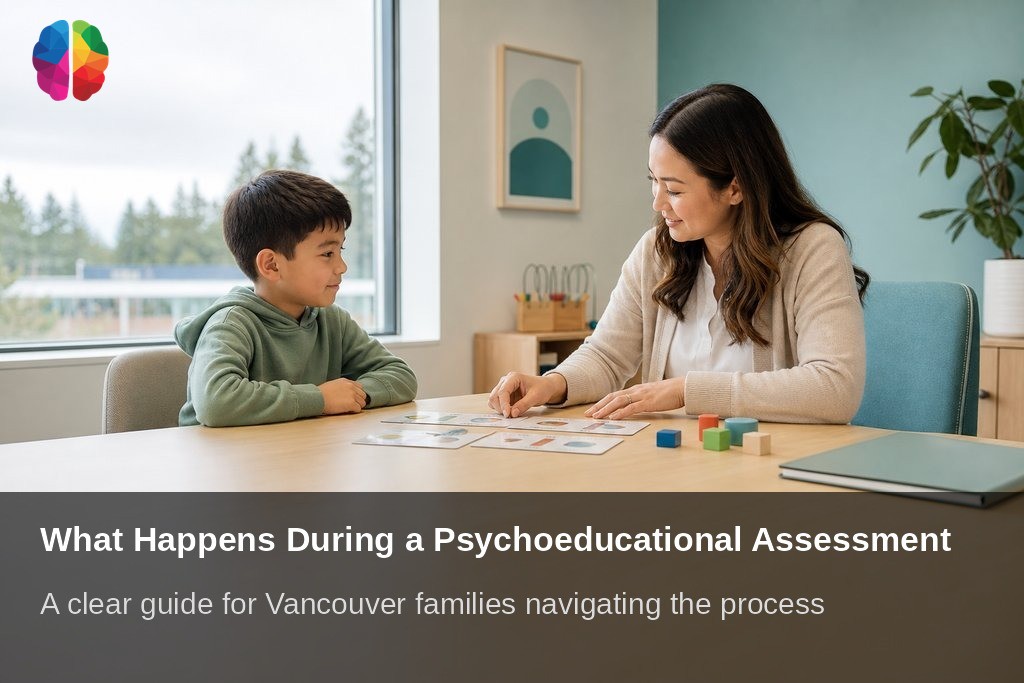
When a family first considers a psychoeducational assessment, the process can feel opaque. What exactly happens at each appointment? How long does it take? Will the results be accepted by the school? These are completely reasonable questions, and they deserve straight answers. Understanding the process from start to finish helps families feel prepared rather than anxious, and makes it far easier to plan around school registration timelines, admissions deadlines, and accommodation requests.
This article walks through each major stage of the process as it is delivered at All Brains Clinic, a multidisciplinary mental health clinic in Vancouver. Whether you are pursuing a Psychoeducational Assessment Vancouver families rely on for independent school entry, a public school accommodation plan, or a learning disability diagnosis, the same core stages apply. Families across Vancouver, from the North Shore and Burnaby to Richmond and the Tri-Cities, go through this same structured process. The goal is to give you a clear, honest picture of what to expect so you can move forward with confidence.
What Is a Psychoeducational Assessment?
A psychoeducational assessment is a structured, clinical evaluation of how a child thinks, learns, and processes information. It uses standardised tests to measure cognitive abilities, academic skills, language processing, attention, and other areas relevant to school performance. The result is a written report that identifies a child's strengths and challenges, provides a formal diagnosis where applicable, and outlines specific recommendations, such as accommodations or individualised education plans, that schools can act on directly.

Why Vancouver Families Feel Uncertain Before the First Appointment
Most parents arrive carrying a mixture of concern, hope, and uncertainty. They may have spent months noticing something feels off for their child at school, or they may have been referred directly by a teacher who flagged a potential learning difference. Either way, the gap between suspecting a challenge and getting formal answers can feel enormous. It is entirely normal to worry about what the results might mean, or whether the report will carry enough weight with the school your family has in mind.
There is also genuine practical confusion around timelines. Families in Vancouver planning around school admissions cycles, whether for independent schools or for accommodation requests within the public system, often do not know how far in advance to book, or what happens if testing runs longer than expected. A well-structured assessment is designed to answer specific questions rather than pass judgment. The process is thorough precisely because thoroughness protects your child's interests at every stage.
The Psychoeducational Assessment Process, Step by Step
Step 1: Intake Appointment
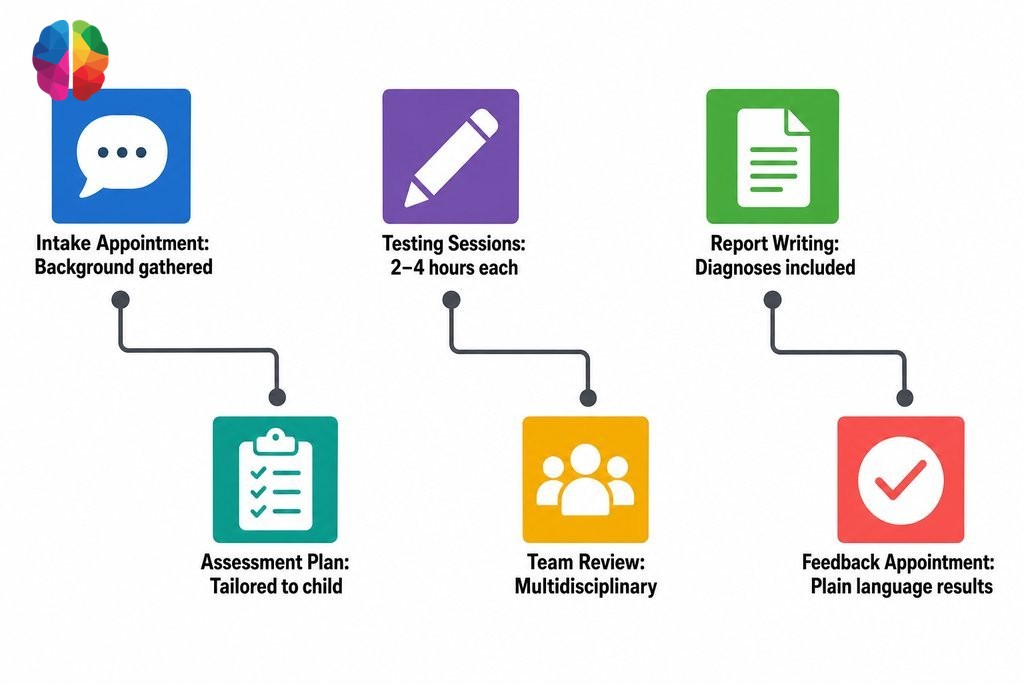
The process begins with an intake appointment, a structured conversation rather than a testing session. A clinician gathers detailed background information about your child's developmental history, early milestones, medical history, family context, and current academic functioning. This is where parents do most of the talking, and where the clinical team begins to understand the full picture.
Come prepared with any existing school reports, previous assessment results, teacher observation notes, or report cards. That documentation gives the intake team important context before standardised testing begins. Learning how to prepare for a psychoeducational assessment before this first meeting can make a meaningful difference. Writing down your key questions and noting specific situations where your child struggles, at home or at school, will help the clinician ask more targeted questions.
The intake is not a test of your parenting or your child's readiness. It is a collaborative conversation designed to focus the work that follows.
Step 2: Tailored Assessment Plan
Once the intake is complete, the clinical team uses that information to design an assessment plan suited to your child's specific needs. Not every child requires evaluation in exactly the same areas. A child referred for reading difficulties may need more emphasis on phonological processing and language. A child referred for attention and executive function concerns will have a differently weighted plan.
Established instruments such as the Wechsler Intelligence Scale for Children and the Woodcock-Johnson Tests are commonly used across most evaluations, as confirmed by research published in the Journal of Intelligence (MDPI), because these standardised batteries are widely recognised by schools and admissions offices. Choosing which combination of tools to apply is a clinical decision based on intake findings, not a one-size-fits-all checklist.
Step 3: Psychoeducational Testing Sessions
Understanding what happens during psychoeducational testing removes much of the mystery around learning evaluation appointments. Testing typically unfolds across one or more sessions, each lasting between two and four hours depending on the child's age, stamina, and the scope of the evaluation.
During these appointments, a clinician works one-on-one with your child through a series of structured tasks, including answering questions verbally, arranging visual patterns or shapes, completing reading, writing, and mathematics activities, and working through attention and processing speed exercises. The experience is designed to feel more like engaging problem-solving than a formal exam, though concentration is expected.
A common parental question is whether a child needs to study beforehand. The answer is no. Practising test-like activities can actually interfere with standardised results. What matters most is that your child arrives rested, has eaten, and feels calm. If your child becomes tired or upset during a session, trained clinicians know how to adapt the pacing, offer breaks, or reschedule tasks without compromising the integrity of the data. Results are confidential, shared only with the family and, with written consent, the relevant school or professionals.
Step 4: Multidisciplinary Review
One of the clearest markers of a high-quality assessment is whether it is conducted by a single clinician or a coordinated team. At All Brains Clinic in Vancouver, psychologists, speech-language pathologists, and other specialists contribute their individual expertise to build a complete learning profile for each child.
A speech-language pathologist may identify subtle language processing difficulties that would not surface in a cognitive battery alone. A psychologist's interpretation of attention and executive function data becomes richer when cross-referenced with observations from another trained professional. This collaborative structure means no significant area of a child's functioning is overlooked, and it produces recommendations that schools can act on directly.
Step 5: Report Writing
After testing is complete, the clinical team interprets the results and prepares a written report. This takes time, because careful analysis and clear writing are both essential to producing a document that schools and admissions offices will accept and act on.
According to the American Psychological Association, professional psychological assessments must adhere to established measurement standards. When a school reads a psychoeducational report, they are looking for evidence that the evaluation was conducted rigorously, using instruments validated for the child's age group and the specific difficulties being assessed. A report built on recognised tools carries the authority schools need, which matters especially when families are working toward firm admissions deadlines.
Before submitting any report to a school or admissions office, confirm it includes the assessor's registration details, the assessment dates, and recommendations clearly aligned with the school's intake requirements.
Step 6: Feedback Appointment
The process concludes with a dedicated feedback appointment where results are explained in plain, accessible language. Rather than handing over a technical document and leaving families to interpret it alone, the clinical team walks through the findings, explains what each score means in practical terms, and outlines the recommendations that follow.
Understanding psychoeducational assessment reports is genuinely easier when a clinician guides the conversation in person. As Suzanne Pellarin, M.A., Psycho-Educational Consultant with the London Catholic District School Board, noted in LD@School: "Psychologists write these reports for parents, teachers, and even the students themselves in the hopes that the information will be helpful in understanding how the student learns and what strengths you can draw on to circumvent any processing deficits."
The written report includes a formal diagnostic summary, standardised score profiles, and specific recommendations for school accommodations or individualised education plans.

How Long Does a Psychoeducational Assessment Take in Vancouver?
The full process, from intake through testing to the written report, typically spans several weeks. The exact duration depends on the complexity of the evaluation, the number of domains assessed, the clinic's scheduling availability, and the time required for careful interpretation and report writing.
Vancouver families planning around school admissions deadlines should book as early as possible and ask the clinic directly about current wait times and anticipated report delivery dates. If a school has a firm submission deadline for accommodation requests or admissions documentation, share that date at the intake appointment so the team can factor it into scheduling. It is far better to communicate those constraints early than to manage a tight turnaround at the report stage.

What Happens After a Psychoeducational Assessment?
A psychoeducational report is a starting point, not a final verdict. What happens after a psychoeducational assessment depends on what the report identifies. Attention concerns may lead to a referral to a psychiatrist for further diagnostic evaluation. Speech and language processing difficulties may call for continued work with a speech-language pathologist. Sensory or motor coordination challenges may point toward occupational therapy as the most appropriate next direction.
All Brains Clinic includes post-assessment support sessions to help families make sense of what comes next. These sessions are designed to ensure the report drives meaningful action, whether that means preparing a package for a school admissions office, connecting with the right specialists, or understanding how to advocate for your child's accommodation needs. Research published through LD@School confirms that assessment recommendations should be revisited and updated as a student progresses through different stages of schooling, which means the relationship with your assessment team does not end when the report is delivered.
Ready to Take the First Step?
If your family is navigating school placement decisions in Vancouver and you want a team that will guide you through every stage of this process with clarity and care, All Brains Clinic is here to help. Reach out to book an intake appointment and take the first step toward understanding your child's learning profile with confidence.
Frequently Asked Questions About Psychoeducational Assessments in Vancouver
Who can conduct a psychoeducational assessment in Vancouver?
In British Columbia, psychoeducational assessments must be conducted or supervised by a registered psychologist. At multidisciplinary clinics like All Brains Clinic, speech-language pathologists and other specialists may contribute to specific components of the evaluation, but the overall assessment and final report remain the responsibility of a registered psychologist.
At what age can a child receive a psychoeducational assessment?
Psychoeducational assessments are most commonly completed for school-age children, typically from age five or six onward. The tools used are age-normed, meaning results are interpreted relative to a child's peer group. Clinicians select instruments appropriate to the child's developmental stage and the specific concerns being evaluated.
Will a psychoeducational report be accepted by Vancouver-area independent schools?
Most independent schools in the Vancouver area accept psychoeducational reports prepared by registered psychologists when the report includes standardised test scores, a clear diagnostic summary, and specific accommodation recommendations. Confirm the school's documentation requirements before the assessment begins so the report can be structured accordingly.
Does extended health insurance cover psychoeducational assessments in Vancouver?
Coverage varies by provider and plan. Some extended health plans cover a portion of psychological assessment services when billed by a registered psychologist. Families should contact their insurer directly to confirm eligibility and whether a referral or pre-authorisation is required before booking.
How is a psychoeducational assessment different from a psychiatric assessment?
A psychoeducational assessment focuses on how a child learns, measuring cognitive abilities, academic skills, and processing differences to inform school accommodations and individualised education plans. A psychiatric assessment is conducted by a psychiatrist and focuses on diagnosing and treating mental health conditions, including medication management where applicable. The two serve different purposes and may be recommended together.
Can a psychoeducational assessment identify ADHD?
A psychoeducational assessment can identify attention and executive function difficulties and contribute meaningful data to an ADHD diagnostic process. A formal ADHD diagnosis in British Columbia typically requires evaluation by a physician or psychiatrist. The psychoeducational report provides essential supporting information that clinicians use alongside other assessments when making that determination.
Dr. Ali Eslami, Chief Editor
Dr. Ali Eslami is a child psychiatrist at BC Children’s Hospital and All Brains Clinic with a PhD from Brown University. With expertise in neurodevelopmental disorders, autism assessment, and AI research in mental health, he ensures every article meets the highest standards. His sharp editorial eye guarantees clarity, accuracy, and credibility in all our content.


