
.svg)
.png)


.png)


.svg)


.svg)
Booking a learning assessment for your child is one of the most meaningful steps you can take to support their education, but it can feel overwhelming if you are not sure what to expect or what to look for in a provider. Families across British Columbia often arrive at this decision with urgency, especially when school placement deadlines are approaching. Knowing which questions to ask before a learning assessment can make a genuine difference in how smoothly the process unfolds and how confidently your family moves forward.
This article focuses on the questions to raise before you book and throughout the process. It sits within the broader topic of how to prepare for a psychoeducational assessment, and while related subjects like documents needed for psychoeducational testing are covered separately, the questions here are about choosing the right provider and understanding what you are committing to before testing begins.
Why Asking the Right Questions Matters Before You Book
Many families approach psychoeducational assessments with a general sense of what they need but limited clarity on what they are entitled to ask. The result is often a passive experience, where parents wait to be told what happened rather than actively participating in shaping how the process unfolds. Recognising that you are a partner in this process, not simply a recipient of results, changes the dynamic entirely.
Families who come prepared are better positioned to choose a provider whose approach matches their child's needs and to stay aligned with critical school admissions timelines. Whether you are navigating the intake process at a Lower Mainland independent school or coordinating with a district resource teacher in the Interior, clarity at the outset leads to more useful outcomes for everyone involved, including the school teams and admissions coordinators who will eventually rely on the report.

Questions About the Testing Process to Ask Your Assessor
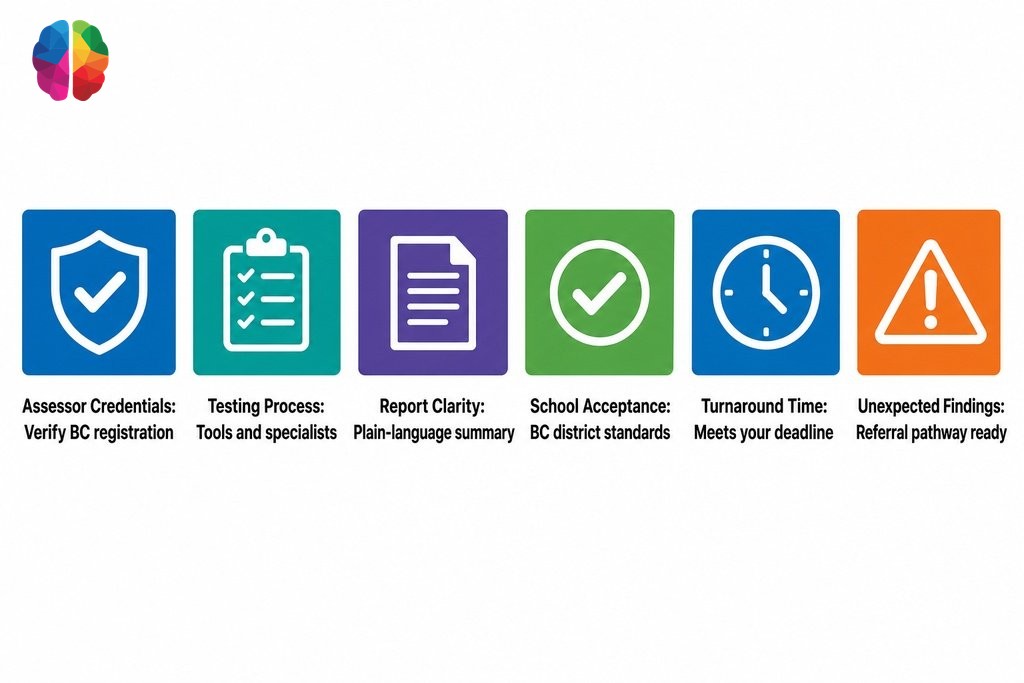
Before committing to a provider, it is worth understanding exactly how they conduct evaluations. Start with the tools and structure they use:
A reputable clinic will welcome these questions as a sign that your family is engaged and informed.
Multidisciplinary Versus Single-Clinician Assessments
The distinction between a single-clinician evaluation and a multidisciplinary process is worth exploring directly with any provider you are considering. A single assessor may be highly qualified, but a collaborative team brings multiple professional perspectives to the same child, which can surface patterns one clinician working alone might not identify. At All Brains Clinic, psychiatrists, psychologists, speech-language pathologists, and kinesiologists work together on each case. Ask any provider how findings from different specialists are integrated and whether the report reflects a team consensus or a single professional's interpretation.
What to Ask If Your Child Is Under Six
Early childhood assessments require a different approach than evaluations for school-age children. Confirm whether the provider has experience with young children, which developmental domains will be covered (emotional, social, cognitive, language, and motor development), and how they adapt their approach for a child who may be less responsive to structured testing formats. Younger children often need more flexible, play-based methods, and confirming this in advance helps you make a more informed choice.
Questions to Ask About the Assessment Report
The report your family receives is only as useful as its clarity and completeness. Raise these questions before you book:
- Will the findings be written in language that your family and your child's school team can understand, not just clinical terminology?
- How long does it take to receive the report after testing is complete, and in what format will it be delivered?
- Is there a follow-up session where the assessor walks you through the findings in detail?
A report full of clinical terminology without a plain-language summary is difficult to act on, especially when families are navigating admissions decisions under time pressure.
Will the Report Be Accepted by BC Schools and Admissions Committees?
Not every assessment report meets the documentation standards expected by BC school districts, independent school admissions committees, or the Ministry of Education and Child Care's funding and designation processes. Ask your provider directly whether their reports are consistently accepted by local schools and district teams in British Columbia, and whether they have experience producing documentation for independent school placements specifically. If the assessor cannot answer this with confidence, that itself is important information. Families pursuing placement at private or independent schools should confirm this well before any deadlines approach.

Questions About School Recommendations and Accommodation Plans in British Columbia
A strong assessment report does more than describe a child's profile. It provides clear, actionable guidance for the schools and teachers who will work with that child. In BC, this often means recommendations that translate directly into supports within a student's Individual Education Plan (IEP) or that help a school resource teacher advocate for additional staffing or funding. Ask whether the report will include specific guidance for classroom accommodations or an IEP, whether recommendations are framed in a way school teams can readily implement, and whether the clinic liaises directly with admissions coordinators or resource teachers.
Some providers communicate findings directly to school teams, which can smooth the transition considerably. Others hand over a report and consider their role complete. Understanding where the provider's involvement ends will help you plan what additional advocacy or coordination your family may need to handle independently.
Questions About Timelines and Logistics Before You Book
Practical logistics deserve as much attention as clinical questions, particularly when school placement timelines are involved. Before booking, ask how long the wait is from initial booking to the first appointment, how quickly the full report can be completed after testing wraps up, and what information the clinic will want in advance, such as previous report cards, teacher observations, or developmental history.
If you have an admissions deadline in six weeks, knowing that a clinic's average report turnaround is four to five weeks gives you a realistic sense of whether that timeline is workable. This is especially relevant in BC, where independent school application windows and district intake processes often follow firm calendar dates. Raising these questions early ensures nothing slips through the cracks and delays your child's assessment.

What to Verify About the Clinic or Provider Before You Confirm
Before confirming your booking, verify the credentials and regulatory standing of the professionals involved. In British Columbia, psychologists conducting assessments should be registered with the College of Psychologists of BC, and other specialists should hold the designations appropriate to their role. Ask the clinic about the qualifications of team members who will work with your child, whether any assessors are supervised trainees and how their work is overseen, and what post-assessment support is included after results are shared.
All Brains Clinic includes complimentary post-assessment support sessions as part of their standard process, so families are not left to navigate complex findings without professional context. Confirming what post-assessment support looks like at any clinic you are considering helps you understand the full scope of care you are committing to.
When a Learning Assessment Goes Beyond Academics
It is worth preparing emotionally as well as practically for the possibility that an assessment surfaces findings beyond what you initially expected. Evaluations designed to explore learning differences sometimes identify patterns consistent with ADHD, autism, or other developmental considerations that were not the original focus of the referral. This is not a failure of the process. It is often the most important thing an assessment can do for a child who has been struggling without a clear explanation.
Before you begin, ask your assessor how they handle unexpected findings, whether they flag concerns during the process or only in the final report, and what a referral pathway looks like if additional evaluation is recommended. Knowing that your provider has a thoughtful, compassionate approach to these conversations is an important part of choosing the right clinic. At All Brains Clinic, every family's journey is treated as unique, and post-assessment support is built into the process so that next steps feel manageable rather than overwhelming.
If you are ready to take the next step or simply want to speak with someone who can help you understand your options, the team at All Brains Clinic welcomes your questions. Reach out today to begin a conversation about how a comprehensive assessment can support your child's future.
Frequently Asked Questions Related to Learning Assessment
What questions should I ask before booking a learning assessment in BC?
Ask about assessor credentials, which standardized tests will be used, how long the process takes, and whether the final report meets BC school district and independent school admissions standards. Also confirm the report turnaround time relative to any upcoming deadlines you are working against.
How long does a psychoeducational assessment typically take in British Columbia?
Most assessments involve multiple sessions spread across a few days to a few weeks, and report preparation after testing can take several additional weeks. Timelines vary by provider and the complexity of your child's profile, so booking well ahead of any school deadlines is advisable.
Will a private learning assessment report be accepted by BC public schools?
Most BC public school districts accept reports from registered psychologists, but each district and school team has its own documentation expectations. Confirm with your provider that their reports are consistently accepted by local school teams and align with Ministry of Education and Child Care standards.
Do assessors need specific credentials to conduct learning assessments in BC?
Yes. Psychologists conducting psychoeducational assessments in BC should be registered with the College of Psychologists of BC. Other specialists on a multidisciplinary team, such as speech-language pathologists, should hold their own professional designations. It is reasonable to ask any clinic for this information before booking.
What happens if an assessment finds something unexpected, like ADHD or autism?
A reputable provider will communicate unexpected findings with care and explain what they mean in practical terms. Ask in advance whether the clinic flags concerns during testing or only at the report stage, and what referral pathways are available if further evaluation is recommended.
What should my child bring to a learning assessment appointment?
Clinics typically ask families to bring previous report cards, teacher observation notes, and any prior assessments or developmental records. Confirm the specific requirements with your provider during intake, as needs vary by clinic and the child's age and history.

Dr. Ali Eslami, Chief Editor
Dr. Ali Eslami is a child psychiatrist at BC Children’s Hospital and All Brains Clinic with a PhD from Brown University. With expertise in neurodevelopmental disorders, autism assessment, and AI research in mental health, he ensures every article meets the highest standards. His sharp editorial eye guarantees clarity, accuracy, and credibility in all our content.


