
.svg)
.png)


.png)


.svg)


.svg)
Deciding to pursue a psychoeducational assessment for your child is a meaningful step. Knowing what to expect and how to get ready makes the entire process feel far less daunting. For families in Vancouver navigating school placement decisions or accommodation requests, preparation is not just helpful; it is essential. When you arrive organized, emotionally ready, and informed, the assessment can do what it is designed to do: give your child's unique learning profile the clarity it deserves.
The weeks leading up to testing day carry a range of emotions for parents, including hope, uncertainty, and a quiet worry about what the results will mean. This guide walks through the full preparation journey, from gathering records to talking with your child, so your family can move into the process with confidence rather than anxiety.
What Is a Psychoeducational Assessment?
A psychoeducational assessment, sometimes called a comprehensive psychological assessment, is a structured process that builds an overall picture of a child's strengths and areas of need related to school functioning. As Hamilton Psychological Services explains in their official practice guide: "A psychoeducational assessment is a process designed to come to an overall picture of your strengths and areas of need related to either school or work functioning."
For children, this process examines cognitive abilities, academic achievement, memory and processing speed, executive functioning, and socio-emotional development. No single test captures everything. It is the combination of results that tells the full story.
Research published in PubMed Central via the National Institutes of Health confirms that psychoeducational assessments integrate multiple domains, including cognitive functioning, academic achievement, and behavioural or emotional factors, to produce a comprehensive profile that informs both diagnosis and educational intervention planning.
In British Columbia, these assessments must be conducted by a registered psychologist or psychological associate. The process typically spans more than one session and concludes with a written report outlining findings, any applicable diagnoses, and specific recommendations for school accommodations or programming.
BTB Psychology puts it well: "The goal of a psychoeducational assessment is to help create a blueprint for your child's learning, academic, and socio-emotional strengths and weaknesses in order to enhance their ability to be successful." Holding that framing in mind, a blueprint rather than a verdict, helps families approach the entire psychoeducational assessment process with a healthier perspective.
Step 1: Gather the Documents You Will Need
One of the most practical things you can do is collect the documents needed for psychoeducational testing well in advance. Having these records ready saves time, strengthens the assessment context, and ensures the psychologist has the full picture before testing begins. Incomplete background information can slow the report-writing process, and that matters when school registration or accommodation deadlines are approaching.
School Records and Teacher Input
Start with report cards from the past two or three years. These show patterns in academic performance and highlight areas where your child has consistently struggled or excelled. Also bring any Individual Education Plans (IEPs), records of in-school support or learning assistance, and a brief written observation from your child's current teacher if possible. Teachers often notice how a child learns, persists through difficulty, or interacts socially, and those details are ones that standardized testing alone cannot fully capture.
Medical and Developmental History
Bring records related to hearing and vision tests, since undetected sensory issues can affect test performance and should be ruled out before drawing conclusions. Other useful records include notes from your child's paediatrician, records of speech or occupational therapy, any prior assessments or diagnoses, and informal notes on developmental milestones such as when your child began speaking in sentences or showed early signs of attention difficulties. Even informal observations can provide meaningful context during the intake conversation.
Step 2: Prepare Emotionally as a Family
Documents and logistics are manageable. The emotional side of this process is often harder. Many parents carry worry into assessment week without fully realizing it, and children are remarkably good at picking up on that tension.
Parent preparation for testing day is not only about paperwork. It is also about processing your own concerns separately, so your child's experience is shaped by calm and curiosity rather than anxiety. Reflect honestly on your hopes and fears before testing day. If you find yourself fixating on a particular outcome, talking it through with a partner, a friend, or your child's assessing psychologist can help ground you.
It is also worth reminding yourself that the assessment is designed to help your child, not judge them. Results are not a measure of your parenting or your child's worth. They are information that opens doors to better support, more appropriate programming, and a clearer path forward.
How to Talk to Your Child Before Testing Day
The American Foreign Service Association's parent guide to psychoeducational evaluations notes that older students benefit from being informed and involved in the process. The same principle applies across age groups, adapted to what your child can understand.
For younger children: Keep language simple and reassuring. Tell them they will spend time with someone who helps figure out how kids learn best, and that there are no right or wrong answers, no grades, and nothing to study for. Avoid using words like "doctor's appointment" if that phrase carries associations with discomfort.
For older children and teens: A more honest conversation about what the testing covers and why the family is pursuing it tends to reduce anxiety rather than increase it. The more involved they are, the more they tend to engage openly with the process.

Step 3: Ask the Right Questions Before Assessment Day
Having a prepared list of questions to ask before a learning assessment is one of the most underrated parts of family preparation. Families often wait until after the assessment to raise concerns they should have addressed at the start. Contacting the clinic before your appointment gives you clarity and helps you plan around critical deadlines.
Key questions to ask your clinic include:
Turnaround time and report format matter especially for families working against school registration or accommodation request deadlines. Knowing this early allows you to plan accordingly and avoid receiving a report that requires additional formatting before a school can act on it.
Step 4: Prepare Your Child on Testing Day
Practical preparation on the day itself is straightforward but genuinely important. A well-rested child who has eaten a proper breakfast and is not rushed will perform more consistently than one who is tired or stressed.
Keep conversation light and encouraging on the morning of testing. Remind your child that there is no passing grade, and that the person they will work with is there to understand how their brain works best. A relaxed child gives the assessment a clearer, more accurate picture of their true abilities.

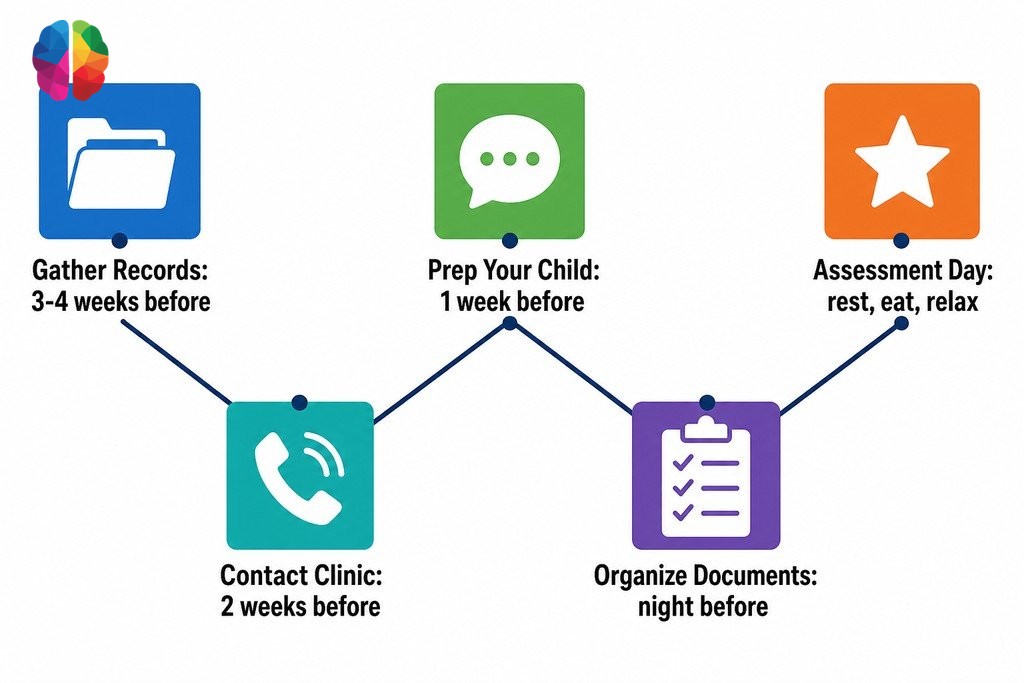
Assessment Preparation Timeline for Vancouver Families
Families working against school placement or accommodation deadlines benefit from treating preparation as a multi-week process rather than a last-minute sprint.
Three to four weeks before: Gather school records, request teacher observations, and locate any prior assessments or medical reports.
Two weeks before: Contact the clinic with questions about report format, timelines, and session structure. Confirm what documents to bring.
One week before: Talk to your child about what to expect. Begin noting specific concerns you want the psychologist to be aware of during the intake conversation.
The night before: Organize documents in a folder, confirm the appointment time and location, and ensure an early, calm bedtime.
The morning of: Serve a normal breakfast, avoid rushing, offer light reassurance, and keep the conversation positive and simple.
Families in Vancouver pursuing private assessments often face tighter timelines than those waiting for school-board referrals. Being organized from the start protects your ability to meet those deadlines without added stress.
Understanding the Results and What Comes Next
Once the report is ready, knowing how to read it is the next challenge. Psychoeducational reports typically include background history and intake observations, results across each assessed domain, diagnostic conclusions where applicable, and specific recommendations for accommodations or interventions.
Schools most commonly reference the sections covering cognitive profile, academic achievement, and the formal recommendations. When sharing the report with a school, flag the recommendation section specifically and ask the receiving staff member how they typically action those recommendations in practice.
Suzanne Pellarin, a Psycho-Educational Consultant with the London Catholic District School Board, offers a useful reminder: "We want the information in our reports to be helpful throughout their school careers and we encourage parents, teachers and high school students to ask for a review of the assessment report and an update of recommendations at any time." The report is not a one-time document. It is a resource you can return to and build on as your child grows and their needs evolve.
At All Brains Clinic, every assessment is followed by a complimentary post-assessment support session. This session gives families space to review findings together, ask questions about what specific results mean, and begin building a plan that aligns with their child's learning profile. A multidisciplinary team of psychologists, psychiatrists, speech-language pathologists, and other specialists contributes to each case, which means the recommendations you receive reflect a comprehensive, collaborative picture rather than a single professional's view.
If you are ready to take the next step for your child, we welcome you to reach out to All Brains Clinic in Vancouver. Our team is here to support your family through every stage of this process, with the care and clarity you deserve.
Frequently Asked Questions About Psychoeducational Assessment in Vancouver
How long does a psychoeducational assessment take in Vancouver?
Most psychoeducational assessments in Vancouver span two to four sessions, each lasting one to three hours depending on the child's age and the scope of testing. The full process from initial sessions to written report delivery typically takes several weeks. Private clinics may offer faster turnaround than school-board referral pathways.
Who can conduct a psychoeducational assessment in British Columbia?
In British Columbia, psychoeducational assessments must be conducted by a registered psychologist or registered psychological associate. These professionals are regulated by the College of Psychologists of British Columbia, which sets standardized qualifications and ethical practice requirements across the province.
Will a private psychoeducational assessment be accepted by Vancouver school boards?
In most cases, yes. Vancouver-area school boards generally accept private psychoeducational reports when they meet the required format and are completed by a registered psychologist. It is advisable to confirm format requirements with the specific school or district before the assessment begins, particularly if accommodation deadlines are involved.
At what age can a child have a psychoeducational assessment?
Children can be assessed as young as four to five years old, though the scope of testing is adapted to developmental stage. Assessments for school-age children typically begin in the early primary years. There is no upper age limit; teens and young adults are also commonly assessed, particularly when pursuing post-secondary accommodations.
What should I do if my child is anxious about the assessment?
Keep your explanation simple and reassuring. Let your child know there are no right or wrong answers, nothing to study for, and no grades involved. Avoid framing it as a medical appointment if that causes worry. For older children, a straightforward explanation of why the family is pursuing the assessment tends to reduce rather than increase anxiety.
How is a psychoeducational assessment different from a school-based assessment?
A private psychoeducational assessment is typically more comprehensive than a school-based one and is completed on a timeline the family can control. School-based assessments are often limited in scope and subject to waiting lists. Private assessments include a detailed written report and, at clinics like All Brains, a post-assessment session to review findings with the family.

Dr. Ali Eslami, Chief Editor
Dr. Ali Eslami is a child psychiatrist at BC Children’s Hospital and All Brains Clinic with a PhD from Brown University. With expertise in neurodevelopmental disorders, autism assessment, and AI research in mental health, he ensures every article meets the highest standards. His sharp editorial eye guarantees clarity, accuracy, and credibility in all our content.


