
.svg)
.png)


.png)


.svg)


.svg)
For many families in British Columbia, the question of which assessment to pursue first arrives alongside a school deadline, a teacher's concern, or a child who is clearly struggling but not fitting any single category. Understanding the difference between an autism assessment vs psychoeducational assessment is not simply a matter of knowing two definitions. It is about finding the right lens for your child's specific situation so that every professional involved, from the school's resource team to the psychologist writing the report, is working from accurate, complete information.
Children do not always present with a single, straightforward profile. A child might show reading difficulties, attention challenges, and social differences all at once, and the root of each struggle may only become clear once the right evaluation is underway. This article walks through what each assessment type covers, how they differ, and when having both becomes not just useful but necessary for your child's educational future.
What Is the Difference Between an Autism Assessment and a Psychoeducational Assessment?
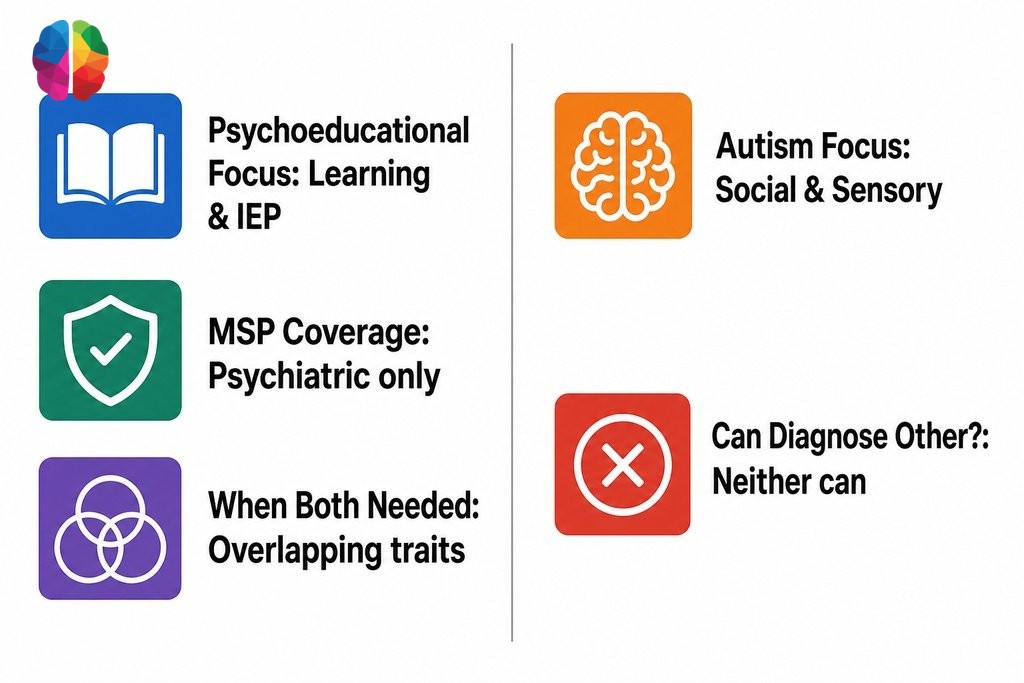
A psychoeducational assessment measures how a child learns, covering cognitive ability, academic skills, memory, and attention, and produces the standardized report schools need to set up accommodations or an Individual Education Plan (IEP). An autism assessment is a separate evaluation that examines social communication, sensory responses, and developmental history to determine whether a child meets criteria for an autism diagnosis. One cannot substitute for the other, and some children need both.

Why BC Families Face This Decision Before School Placement
School admission and accommodation timelines in British Columbia create real urgency. Families who need an IEP, modified instruction, or formal accommodations in place by September often find themselves booking assessments months in advance, sometimes without a clear sense of which type the school actually requires. A delayed or mismatched assessment can mean another school year without the right support.
What makes this harder is that the signs families notice at home often point in multiple directions at once. A child who avoids reading, struggles to follow classroom routines, has difficulty making friends, and becomes overwhelmed in noisy environments could be showing signs of a learning disability, autism, ADHD, or a combination of all three. When learning concerns and autism traits appear together, choosing the wrong starting point can mean going through the entire process twice. Taking time early to understand what each evaluation covers can save significant time, cost, and frustration.
What a Psychoeducational Assessment Covers
A psychoeducational assessment examines how a child learns across four core areas: cognitive ability (reasoning and problem-solving), academic achievement in reading, writing, and mathematics, processing speed and working memory, and executive function and attention. The result is a detailed learning profile that identifies strengths, weaknesses, and patterns that help explain why a child may be struggling in school. Standardized tools compare the child's performance against same-age peers and grade-level expectations, giving schools a clear basis for planning support.
Psychoeducational results can identify learning disabilities such as dyslexia, highlight attention or processing difficulties, and recommend instructional accommodations. What they cannot do is determine whether your child has autism. As one clinic publication states directly: "A psychoeducational assessment is not an autism assessment. Autism assessments are an entirely different kind of assessment and must be completed by somebody approved for that type of service provision in the province of British Columbia." Families sometimes assume a comprehensive psychoeducational report will answer all their questions about both learning and development, but this boundary matters from the outset.
What BC Schools Expect From Assessment Reports
Schools and admissions teams in British Columbia have specific expectations for the reports they use to plan accommodations. A psychoeducational report typically includes standardized test scores, cognitive and academic profiles, a summary of functional implications, and clear classroom recommendations. Schools rely on these reports to determine eligibility for support services, develop IEP goals, and justify accommodation requests for standardized testing, including provincial exams where applicable. The report format, the tools used, and the assessing psychologist's qualifications all factor into whether a school will accept the results. Confirm with your child's school or the relevant educational authority which assessment type and report format is required before you book.

What an Autism Assessment Examines
An autism evaluation is built around a different set of questions. Rather than measuring academic skill levels, it examines social communication patterns, sensory processing responses, behavioural patterns across different environments, and developmental history from early infancy onward. The goal is to understand how the child experiences and navigates the world, not simply how they perform on academic tasks. This means gathering information from multiple sources, including caregivers, teachers, and direct clinical observation, across multiple developmental domains.
The distinction between school testing and autism testing is not about which evaluation is more thorough; both can be highly rigorous. The difference is in what each one is designed to answer. Psychoeducational results and autism evaluation findings complement one another because they address different questions entirely. Treating them as competing options often leads families to pursue one when their child genuinely needed both from the start.
How All Brains Clinic Approaches Autism Evaluations
At All Brains Clinic, every autism case is reviewed through two independent assessments to minimize the risk of bias influencing the outcome. This gives families confidence that findings reflect the child's genuine profile rather than the perspective of a single evaluator. For children under six, the clinic uses a five-domain evaluation covering emotional, social, cognitive, language, and motor development, recognizing that younger children's presentations require a broader developmental frame to interpret accurately. This level of clinical care matters especially when a family is navigating both academic testing and developmental concerns, because it reduces the chance that one area of difficulty overshadows another.
When Does a Child Need Both Assessments?
The most common scenario that brings families to a clinic like All Brains is not a child with one clearly defined difficulty. It is a child showing academic challenges alongside social or developmental differences, where neither concern fully explains the other.
When a child struggles to read and finds unstructured social time consistently overwhelming, a learning assessment alone may identify the reading difficulty and recommend interventions, while leaving the social and sensory dimensions entirely unaddressed. Conversely, an autism evaluation that identifies social communication differences will not produce the standardized academic profile a school's resource team needs to build a support plan.
This is precisely where the framing of autism assessment vs other child assessments becomes most useful for families. Understanding that different assessments answer different questions reframes the decision from an either-or choice into a sequencing and coordination question. The topic of when learning problems suggest autism assessment is one families frequently raise in consultation, and the answer depends heavily on the specific signs a child is showing and the urgency of the school's accommodation timeline. The question of how autism assessment reports support school planning is closely connected but distinct, covering how diagnostic findings translate into actionable educational recommendations once results are in hand.
How a Multidisciplinary Team Changes the Assessment Picture
When a child's presentation spans learning, social, language, and developmental domains, a single-discipline assessment captures only part of the picture. A multidisciplinary team allows each specialist to contribute domain expertise to a shared understanding of the child. Research published in the Journal of Autism and Developmental Disorders found that school psychologists using both formal and informal assessment data were able to agree with autism expert panels on appropriate educational placements and IEP goals for students with high-functioning autism, suggesting that combining data sources tends to support more informed planning decisions.
All Brains Clinic brings together psychiatrists, psychologists, and speech-language pathologists on the same case, so the resulting profile reflects multiple clinical perspectives. The clinic also includes a full psychiatric evaluation as part of the assessment process, covered under BC's Medical Services Plan (MSP). For British Columbia families already managing the cost of private assessments, having the psychiatric component covered through MSP is a meaningful reduction in out-of-pocket expenses. This coordination also improves the quality of the final report, because schools and referring physicians receive a coherent, integrated document rather than separate reports that may not connect with one another.

Practical Steps Before Booking an Assessment in British Columbia
Gathering the right materials before your appointment makes the process more efficient and ensures the evaluator has the full picture from the first session. A well-prepared family typically brings school observation notes or written concerns from the classroom teacher, previous academic testing or report cards showing patterns over time, a developmental history summary including milestones and health records, and documentation of specific concerns raised by teachers, physicians, or other professionals.
Before booking, confirm with your child's school which assessment type their accommodation process requires, as requirements can vary between districts across BC. Consult your family physician or a registered psychologist to clarify whether your child's presentation calls for a learning assessment, an autism evaluation, or both. Ask the clinic directly what their report format includes and whether it aligns with what the school's resource team will accept. That one conversation can prevent the cost and delay of repeating the process later.
What Happens After You Receive the Results?
Receiving a completed assessment report is not the end of the process. For many families, the most important conversation happens in the debrief session that follows, when a clinician explains what the findings mean in practical terms and outlines next steps specific to the child's profile. The National Institutes of Health review of autism assessment highlights that comprehensive psychological evaluation of ASD requires multi-domain data that goes beyond academic or cognitive testing, underscoring why translating findings into a usable plan benefits from expert interpretation rather than independent reading of the report alone.
All Brains Clinic includes complimentary post-assessment support sessions after each evaluation, so families leave with a concrete, personalized plan rather than simply a document to pass along to the school. This might mean guidance on requesting specific accommodations, referrals to other specialists, or recommendations for therapeutic supports that align with the assessment findings. The goal is for every family to feel genuinely prepared to advocate for their child, whether they are walking into a school meeting, following up with their family physician, or beginning a new support programme.
If you are navigating overlapping concerns and trying to find the right path forward for your child in British Columbia, All Brains Clinic is here to help you make sense of the options. Reach out to the clinic to discuss your child's specific situation and find out which assessment pathway fits your family's needs and your school's timeline.
Frequently Asked Questions About Autism Assessment vs Psychoeducational Assessment
Can a psychoeducational assessment diagnose autism?
No. A psychoeducational assessment measures how a child learns, covering cognitive ability, academic skills, and attention, but it is not designed to evaluate social communication or developmental history. A separate autism assessment, completed by a qualified provider in British Columbia, is required for an autism diagnosis.
Which assessment should my child have first?
The right starting point depends on your child's most pressing concerns and your school's timeline. If academic accommodations or an IEP are urgently needed, a psychoeducational assessment is typically the priority. If developmental or social differences are the primary concern, an autism evaluation may come first. Consulting a psychologist or family physician before booking either can help clarify the right sequence.
Will BC schools accept a private psychoeducational assessment report?
Most BC schools will accept a private psychoeducational assessment completed by a registered psychologist using recognized standardized tools. Requirements can vary between districts, so confirm the expected report format and credential requirements directly with your child's school before booking.
Is an autism assessment covered by MSP in British Columbia?
The psychiatric evaluation component of an autism assessment at clinics like All Brains is covered under BC's Medical Services Plan (MSP). The broader assessment, including psychologist and speech-language pathologist involvement, typically involves private fees. Ask any clinic directly about which components are MSP-covered before proceeding.
How long does each assessment take?
Assessment length varies by clinic and by the child's profile. Psychoeducational assessments generally involve several hours of testing across one or more appointments, followed by report preparation and a debrief. Autism evaluations are similarly multi-session, particularly when a multidisciplinary team is involved. In most cases, expect several weeks from the first appointment to the final report.
What if my child needs both assessments — do they have to be done at the same clinic?
No, but coordinating both through one provider can improve the coherence of the final documentation. If separate clinics are involved, ensure each provider knows about the other assessment so that both reports can be interpreted together by the school's resource team.


