
.svg)
.png)


.png)


.svg)


.svg)
When your child is struggling at school and you are trying to figure out the right next step, the number of assessment options can feel genuinely overwhelming. Psychoeducational evaluations, speech assessments, occupational therapy reports, autism evaluations — each sounds important, and none of the names make it obvious which one your child actually needs. Knowing the difference between these evaluations is one of the most practical things you can do before booking an appointment.
For families in British Columbia, the stakes are real. The right evaluation leads to the right report, which leads to the right school supports. Choosing the wrong starting point can mean delays in accessing an IEP or the learning accommodations your child is entitled to under BC's school system. This guide will help you understand what each type of evaluation actually covers so you can feel confident about the path forward.
Why the Type of Assessment Matters for School Support in BC
Not all child assessments produce the same kind of report, and schools treat those reports differently. A psychoeducational assessment might confirm a specific learning disability and recommend classroom modifications, but it will not result in an autism diagnosis. An autism evaluation examines a distinct set of behaviours and developmental patterns that other evaluations are simply not designed to capture.
If your child's school is asking for documentation to support an IEP application, the type of assessment you choose determines what documentation you can actually provide. According to PMC via the National Institutes of Health, the median age of autism diagnosis in the US is approximately 4.5 years old, despite screening tools aimed at identifying autism before 24 months. A similar pattern plays out in Canada, where waitlists and uncertainty about which assessment to pursue first can contribute to delays. Starting with the right assessment from the beginning can help shorten that timeline and support your child in accessing BC Ministry of Education supports sooner.
The Main Types of Child Assessments and What Each One Covers
Several types of developmental evaluations are available for children in British Columbia. While they can overlap in useful ways, each is built around a different set of questions.
Psychoeducational Assessments
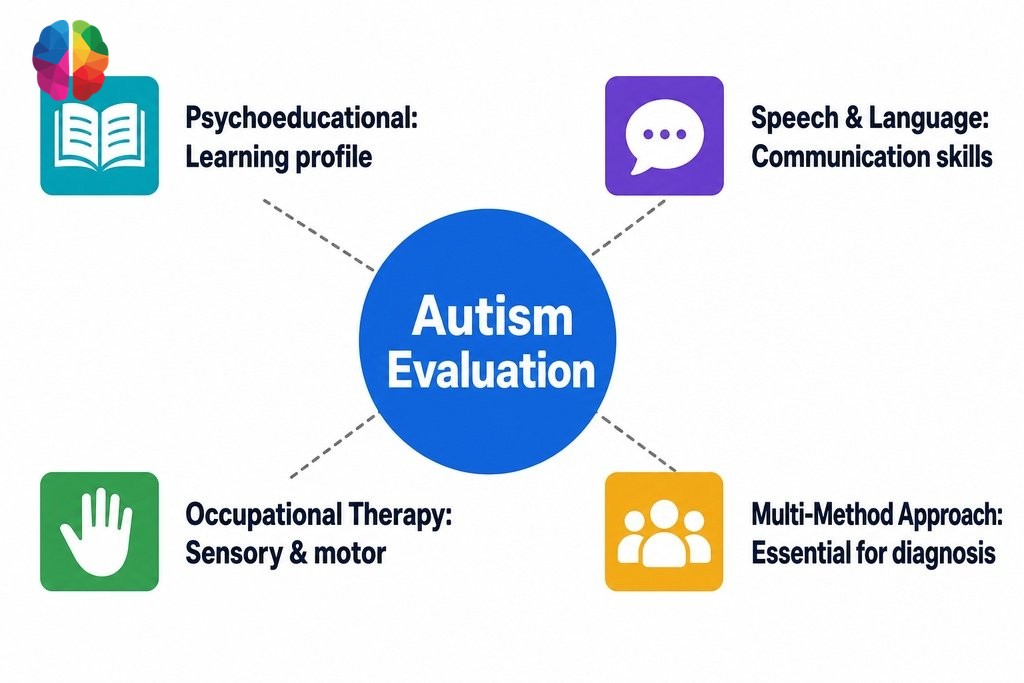
These evaluations cover cognitive ability, academic achievement, and learning profile. They are typically requested when a child is underperforming academically, showing signs of a learning disability, or struggling with attention and processing in the classroom. Results inform recommendations around classroom accommodations, reading support, and academic planning. The comparison outlined in autism assessment vs psychoeducational assessment goes deeper into the distinctions that matter most for school-age children.
Speech and Language Assessments
These evaluations cover receptive language (understanding what is said), expressive language (communicating thoughts), and broader communication development. They are often the first step when a child has delayed speech, unclear articulation, or difficulty following instructions. Results connect directly to support from a speech-language pathologist and can inform classroom strategies. When both communication and social interaction are concerns, the distinctions covered in autism assessment vs speech assessment can help you decide whether a standalone speech evaluation is enough or whether a broader autism evaluation is more appropriate.
Occupational Therapy and Motor Assessments
These evaluations cover sensory processing, fine motor skills, and daily functioning, including handwriting, self-care routines, and how a child responds to sensory input at school. They are recommended when a child seems unusually sensitive to noise, touch, or movement, or when physical coordination is affecting participation in school activities. Occupational therapy evaluations are sometimes completed alongside an autism evaluation, because sensory processing differences are common among autistic children. They can also be conducted independently when the primary concerns are motor or sensory rather than social or communicative.
What Sets Autism Assessments Apart
The key difference is what the evaluation is specifically designed to examine. Autism assessments identify patterns in social communication, repetitive or restricted behaviours, and developmental history across multiple settings and over time. They are not simply a longer version of a speech or cognitive test; they follow a different framework entirely, grounded in the DSM-5 diagnostic criteria used across Canada and most other English-speaking countries.
Because no single tool is sufficient for an autism diagnosis, these evaluations rely on a combination of structured observation, standardised diagnostic instruments, and in-depth caregiver interviews. A systematic review published on PubMed found that across 32 studies, standardised autism diagnostic tools showed variable sensitivity and specificity, and results frequently diverged from clinical judgment, confirming that a multi-method approach is not optional but essential. This level of methodological rigour is not required for a speech or occupational therapy evaluation, which is one reason autism assessments tend to take longer and involve more professionals.
Why Autism Assessments Cover Multiple Developmental Domains
A thorough autism evaluation, particularly for children under six, does not focus on one area in isolation. At All Brains Clinic, paediatric assessments cover five developmental domains together: emotional, social, cognitive, language, and motor development. This integrated approach reflects what research consistently shows: autism-specific tools assess behaviours across sensory, motor, social, and communicative domains simultaneously, in a way that no single-domain assessment can replicate. For young children, this breadth produces a much richer picture of how a child is developing and where support will have the greatest impact.
Why Two Independent Reviewers Matter
One feature that distinguishes a rigorous autism evaluation from many other child assessments is the use of multiple assessors. All Brains Clinic uses two independent reviewers for every autism case, a practice designed to reduce the influence of individual bias on the diagnostic conclusion. This matters especially when results will be used to access formal school supports in BC, because the report needs to hold up to scrutiny from school teams, specialists, and in some cases insurance or funding bodies. When a diagnosis is reached independently by two qualified clinicians, families and educators can have greater confidence in both the findings and the recommendations that follow.

When One Assessment Is Not Enough
Autism frequently co-occurs with other conditions, including ADHD, language delays, anxiety, and learning differences. In these situations, a single evaluation may not produce a complete enough picture to guide teachers and school teams effectively. A child who receives an autism diagnosis but also has a significant language delay may need speech assessment findings included in their school report to access the full range of supports available through BC's education system.
Questions about whether a child's attention difficulties are related to autism or better explained by ADHD require careful evaluation of both, which is exactly what autism vs adhd assessment for children addresses in its own dedicated discussion. A multidisciplinary approach is considered best practice in autism diagnostic assessment, with guidelines recommending structured evaluations across neurodevelopmental, physical, and mental health conditions, as documented in research published in BMJ Paediatrics Open. For parents in British Columbia, a thorough initial evaluation by a team of professionals is often more efficient than completing multiple separate single-domain assessments over months or years.
How to Choose the Right Assessment for Your Child in British Columbia
The most useful starting point is usually the clearest question you want answered. If you are concerned your child may be autistic, begin with a comprehensive autism evaluation. If the school has flagged academic underperformance without social or behavioural concerns, a psychoeducational assessment may be the better first step. If speech and communication are the central issues, a speech and language assessment provides the most targeted information.
In many cases, an initial consultation with a multidisciplinary clinic can help you map out the most efficient path forward. One question BC parents frequently ask is whether a formal diagnosis is required before an IEP can be created. In British Columbia, a diagnosis is not always a strict prerequisite for some classroom accommodations, but a formal written report from a qualified assessor is typically required to access more structured supports. Understanding whether you are seeking a private autism assessment vs public autism assessment is also relevant here, since timelines, reporting formats, and the depth of post-assessment support can vary considerably between the two routes.

What to Expect From a Comprehensive Autism Evaluation
A well-structured autism evaluation should feel like a guided process, not a series of disconnected appointments. At All Brains Clinic, the process begins with a full psychiatric evaluation covered by MSP, British Columbia's provincial health plan, making it accessible to families regardless of their financial situation. From there, the assessment moves through structured observation, standardised diagnostic tools, developmental history interviews, and input from parents and caregivers whose observations carry real clinical weight.
Research published in the MDPI Children journal validated parent-completed assessments across a sample of 9,573 children, confirming that structured parent-report instruments are a distinct and necessary component of a thorough autism evaluation, not a formality. Once the evaluation is complete, families receive a full written report with specific, plain-language recommendations that teachers and school teams can act on directly. All Brains Clinic also provides complimentary post-assessment support sessions, so the results meeting is not the end of the conversation. Families leave with a clear understanding of the findings, a plan for next steps, and ongoing access to the team.
Questions to Ask Before Booking a Child Assessment
Before committing to any clinic or provider, the answers to a few key questions will tell you a great deal about whether the evaluation will produce the kind of report your child's school will actually use.
For families in British Columbia, an autism assessment Vancouver families can trust should offer transparent timelines, a bilingual-friendly approach where needed, and a clear path from assessment to school support. BC's Lower Mainland and surrounding communities are home to many multilingual families, and a clinic that can accommodate different language needs and cultural contexts is a genuine asset.
At All Brains Clinic, we understand that booking an assessment for your child is a big step, and we want the process to feel as clear and supported as possible. If you are ready to move forward, or simply want to talk through which evaluation makes sense for your child, please reach out to our team. We are here to help you find the right path forward, together.
Frequently Asked Questions About Autism Assessments
What is the difference between an autism assessment and a psychoeducational assessment?
An autism assessment evaluates social communication patterns, repetitive behaviours, and developmental history using DSM-5 diagnostic criteria. A psychoeducational assessment focuses on cognitive ability and academic achievement. The two evaluations answer different questions, and only an autism assessment can result in an autism diagnosis. Depending on your child's needs, both may eventually be relevant.
Can a speech and language assessment identify autism?
No. A speech and language assessment evaluates communication skills such as expressive and receptive language, but does not assess the broader social and behavioural patterns required for an autism diagnosis. If communication concerns are accompanied by social difficulties, a comprehensive autism evaluation is worth discussing with a qualified clinician.
Does my child need an autism diagnosis to get an IEP in British Columbia?
A formal autism diagnosis is not always required for basic classroom accommodations in BC, but a written report from a qualified assessor is typically needed to access more structured IEP supports. The depth of support available can depend significantly on the documentation provided, so choosing the right assessment from the outset matters.
Why does an autism assessment involve more than one professional?
No single tool is sufficient for an autism diagnosis, so a multi-method approach is essential. Using multiple professionals, including independent reviewers, reduces individual bias and strengthens the reliability of the findings. This is especially important when the report will be used to access formal school supports or funding in BC.
How long does a comprehensive autism evaluation typically take in BC?
Timelines vary by clinic and by the complexity of a child's presentation. A thorough evaluation generally spans multiple appointments covering observation, diagnostic tools, and caregiver interviews, followed by report preparation. At All Brains Clinic, the process begins with an MSP-covered psychiatric evaluation, helping families get started without financial barriers.
Is occupational therapy assessment part of an autism evaluation?
Not automatically. OT assessment is sometimes completed alongside an autism evaluation because sensory processing differences are common among autistic children, but it is not included in every autism assessment. It can also be conducted independently when motor or sensory concerns are the primary issue. A multidisciplinary clinic can advise on the combination that best fits your child's situation.


