
.svg)
.png)


.png)


.svg)


.svg)

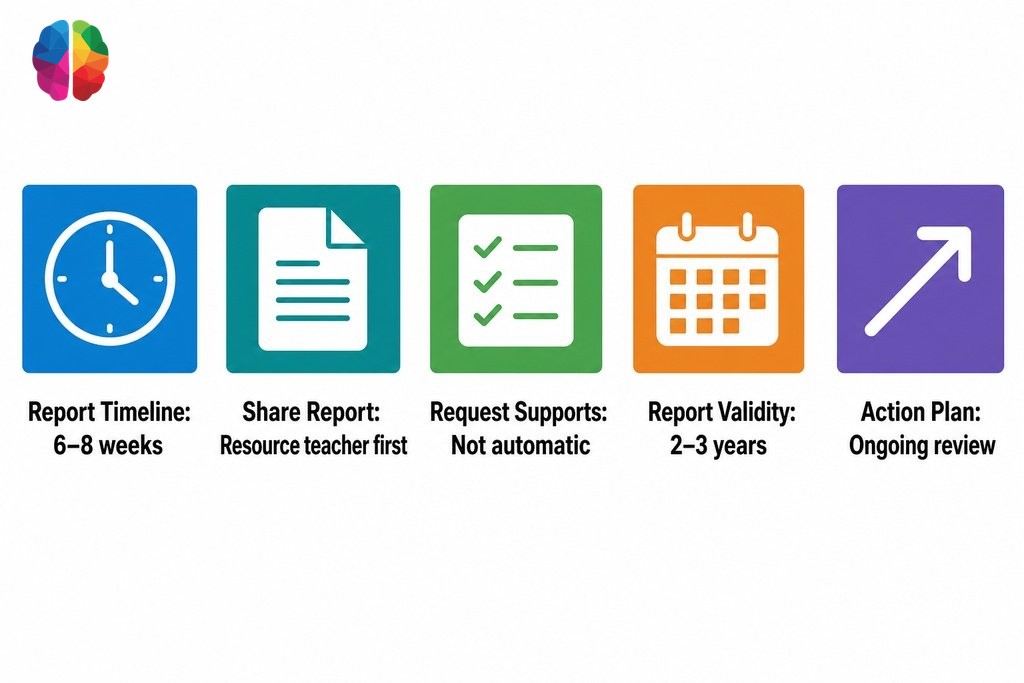
Receiving the results of a psychoeducational assessment is a meaningful moment for any family. After weeks of waiting, which according to Bluebird Psychology typically spans six to eight weeks from intake to feedback meeting, you finally have a detailed picture of how your child learns, processes information, and engages with academic demands. Yet the moment the report arrives, a different kind of uncertainty often begins. What happens after a psychoeducational assessment is complete is where many families feel least prepared, and where the distance between having information and acting on it can feel the widest.
This article guides British Columbia families through that transition: from understanding your report to working with schools, coordinating outside supports, and building a clear path forward. Developing a learning support plan after assessment or exploring therapy and coaching after assessment each deserve their own focused attention and are covered separately. Here, the goal is a grounded, practical framework for next steps, one that keeps school placement timelines and admissions deadlines front of mind.
Why the Period After Testing Feels Uncertain
The weeks following a psychoeducational evaluation carry an emotional weight that is easy to underestimate. Parents often spend considerable energy preparing for the assessment itself, only to find that receiving the report opens a new set of questions. A diagnosis or detailed learning profile can be validating and disorienting at the same time, and the pressure of school deadlines can make it hard to sit with that information before acting on it.
Part of what makes this stage difficult is the gap between the clinical language of the report and the practical decisions it is meant to inform. A psychoeducational report covers cognitive abilities, academic achievement, executive functioning, attention, behaviour, and social-emotional functioning, all within a single integrated document. Understanding what that document means for your child's day-to-day school experience requires translation, and not every family receives that translation in a way that feels complete. Acknowledging this gap is the first step toward closing it.
What Your Assessment Report Actually Includes
A psychoeducational assessment report is not simply a collection of test scores. It presents a full learning profile, including standardized scores across cognitive and academic domains, observations about how your child performed under testing conditions, and a set of post-assessment recommendations tailored to their specific strengths and needs. According to PsychDB, identifying the gap between academic achievement and cognitive potential is precisely what gives the assessment its practical value, as it provides a structured basis for narrowing that gap and improving how your child functions academically.
The distinction that matters most for families is between raw findings and actionable guidance. Scores and diagnostic conclusions tell you what was found; post-assessment recommendations tell you what to do about it. A well-written report will include specific suggestions for school-based supports, environmental adjustments, and, where relevant, referrals for further evaluation or therapy. Because psychoeducational reports are intended to remain useful throughout a student's entire school career, treat the guidance they contain as a long-term resource rather than a one-time document.
What Makes a Report Useful for BC Schools
School teams and admissions coordinators in British Columbia look for specific elements when reviewing a psychoeducational report: that standardized, recognized assessment tools were used; that any diagnosis is clearly stated with supporting evidence; and that recommendations are written in language that maps directly onto school-based supports. A report heavy on clinical terminology without educational translation can create delays, because learning support teachers need to understand not just what was found but what the school is being asked to do in response. Before submitting, confirm that your report meets the format, recency, and credentialing requirements of your specific school district or admissions office, as expectations can vary between BC public schools and independent schools.
What Happens After a Psychoeducational Assessment at School in British Columbia
Once your family has a report in hand, share it with the appropriate people at your child's school as soon as possible. In most British Columbia schools, this means connecting with a resource teacher or learning support coordinator, who will review the findings and determine whether an accommodation letter, modified programme, or Individual Education Plan (IEP) is warranted.
Timing matters considerably here. School placement decisions and accommodation plans in BC often operate on fixed annual cycles, and missing a submission window can mean waiting an entire term or longer for formal supports to be put in place. Families pursuing independent or private school admissions in the Lower Mainland, Vancouver Island, or elsewhere in the province face similar constraints, as many admissions offices require documentation well before placement decisions are finalised. Treat the post-assessment period with the same urgency you applied to booking the assessment itself.
School Supports Families Can Request After Testing
The recommendations in your report will vary depending on your child's learning profile, but certain categories of school support appear frequently. Common accommodations your school team may consider include extended time on tests and assignments, preferential seating or reduced-distraction environments, access to assistive technology such as text-to-speech tools, modified assignment formats or alternative ways to demonstrate knowledge, and regular check-ins with a resource teacher or school counsellor. These supports are not automatic. They must be formally requested and documented, usually through an accommodation plan or IEP meeting where the school team, parents, and sometimes the student all participate.

Building a Family Action Plan After the Evaluation
Once you have shared the report with the school, take a broader view of what the findings mean for your family as a whole. A clear action plan starts with identifying which recommendations are time-sensitive and which can be addressed more gradually. Bring a copy of the report to every school meeting, prepare questions about any recommendation you do not fully understand, and avoid signing an accommodation plan until you are clear on what it involves. Revisit the report at key transition points, such as moving from elementary to secondary school, as your child's needs will shift across grades and environments.
Beyond the school context, treat the report as a living document. LD@School, an Ontario Ministry of Education-affiliated resource, notes that assessment information should remain useful throughout a student's school career, and that parents, teachers, and students are encouraged to request reviews and updates as needs evolve. Keeping supports aligned with current needs is an ongoing process, not a one-time task.
When to Seek Additional Support After Assessment
A psychoeducational report sometimes identifies needs that fall outside what a school can address on its own. Speech and language difficulties, motor development concerns, or mental health findings may point toward supports that require a separate referral to a qualified specialist. Research published by the National Library of Medicine found that students who received structured psychoeducation-informed support showed lower levels of academic distress and more positive perceptions of mental health services, reinforcing the value of following through on assessment findings rather than leaving them unaddressed.
This is also where a post-assessment support session can make a real difference. Sitting with the clinician who conducted the evaluation gives families the opportunity to ask questions, understand how different recommendations connect, and decide which next steps to prioritise. For families weighing whether to pursue therapy and coaching after assessment or a learning support plan after assessment, these sessions help ensure those decisions are made with full understanding rather than guesswork.

How All Brains Clinic Supports Vancouver Families Beyond the Report
At All Brains Clinic in Vancouver, the assessment process does not end when the report is delivered. Every psychoeducational assessment includes complimentary post-assessment support sessions where families receive a guided walkthrough of the findings, a clear explanation of any diagnosis or learning profile, and a personalised plan for moving forward. This reflects the clinic's core belief that science and empathy work together, and that families deserve not just answers, but the support to act on them meaningfully.
The multidisciplinary team includes psychiatrists, psychologists, speech-language pathologists, kinesiologists, and other specialists who collaborate across each case. If your child's results point toward speech-language therapy or occupational therapy, those services connect directly with the assessment outcomes, without requiring your family to start the intake process from scratch. That continuity between assessment and follow-on care can be especially valuable for families across BC who are navigating complex or overlapping diagnoses.
What to Verify Before Acting on Your Results
Before finalising any school submission or signing an accommodation plan, confirm a few practical details. Check whether your report meets the format, recency, and credentialing requirements of your school district or admissions office, since these can vary across BC and may differ between public and independent schools. If the report was completed more than a couple of years ago, ask whether an update is needed before it will be accepted. If any diagnosis is unclear, a suggested support does not seem to match your child, or a referral conflicts with advice you have received elsewhere, raise those questions directly with the assessing clinician.
Families who feel genuinely informed about their child's learning profile are far better positioned to advocate effectively at school meetings and to make confident decisions about next steps. If you are ready to move from assessment to action with clarity and confidence, All Brains Clinic is here to walk alongside your family every step of the way.
Frequently Asked Questions
How long does it take to receive a psychoeducational assessment report in BC?
Most families receive their report within six to eight weeks of the initial intake appointment, covering testing sessions, scoring, interpretation, and preparation of the written report before the feedback meeting takes place.
Who receives a copy of the psychoeducational assessment report?
The report is provided to the family, who then decides who else receives a copy. In BC, families typically share it with their child's school resource teacher or learning support coordinator, and may also provide it to outside specialists or admissions offices.
Does a psychoeducational report automatically trigger school supports in BC?
No. Supports such as accommodations or an IEP must be formally requested after the report is submitted. The school team reviews the findings and works with the family to determine which supports are appropriate and how they will be documented.
How recent does a psychoeducational report need to be for BC schools to accept it?
Requirements vary by school district and institution. Many BC schools and independent school admissions offices prefer reports completed within the past two to three years. If your report is older, check directly with the school or district before submitting.
What should I do if I do not understand part of my child's assessment report?
Contact the clinician who conducted the assessment. They can clarify clinical terminology, explain how a finding relates to your child's school experience, and confirm whether a particular recommendation still applies given your child's current circumstances.
Can a psychoeducational assessment report be used for private school admissions in BC?
Yes, many independent and private schools in BC accept psychoeducational reports as part of the admissions process. Contact the admissions office directly to confirm their specific requirements regarding format, recency, and the credentials of the assessing clinician.

Dr. Ali Eslami, Chief Editor
Dr. Ali Eslami is a child psychiatrist at BC Children’s Hospital and All Brains Clinic with a PhD from Brown University. With expertise in neurodevelopmental disorders, autism assessment, and AI research in mental health, he ensures every article meets the highest standards. His sharp editorial eye guarantees clarity, accuracy, and credibility in all our content.


