
.svg)
.png)


.png)


.svg)


.svg)

Receiving the results of a psychoeducational assessment can feel like reaching the top of one mountain only to discover another range stretching ahead. Families often arrive at this moment hoping for clarity, and while the report does bring answers, it also introduces decisions that can feel equally daunting. Understanding what happens after a psychoeducational assessment means recognizing that the report itself is a beginning, not an end. At All Brains Clinic, we believe every family deserves more than a document; they deserve a clear and supported path forward.
Whether your child's assessment has identified a learning difference, ADHD, autism, or a combination of challenges, the question of what to do next is entirely valid. The weeks following a formal evaluation often involve decisions about therapy and coaching after assessment, school accommodation requests, and sometimes difficult emotional processing. This article walks through those decisions in practical terms, helping families across British Columbia move forward with confidence.
Why Families Feel Uncertain After Receiving Results
Even when results confirm what a family suspected, receiving a formal report can feel overwhelming. Psychoeducational reports are detailed and technical, and translating findings into real-world decisions requires guidance that many families don't automatically have access to. There is also an emotional side to this moment worth acknowledging. Parents may feel relief, grief, confusion, or all three at once, and that range of responses is completely normal.
The path forward depends on more than a diagnosis alone. A child's age, the school's intake timeline, the family's existing resources, and the specific nature of identified needs all shape which supports make the most sense and in what order. Feeling unsure during this period isn't a sign of failure; it reflects how genuinely individual each child's situation is. Structured support helps translate assessment findings into action.
Therapy and Coaching After Assessment in British Columbia: What Is the Difference?
Two of the most commonly recommended supports following a psychoeducational evaluation are therapy and coaching. These terms are often used interchangeably, but they describe quite different things.
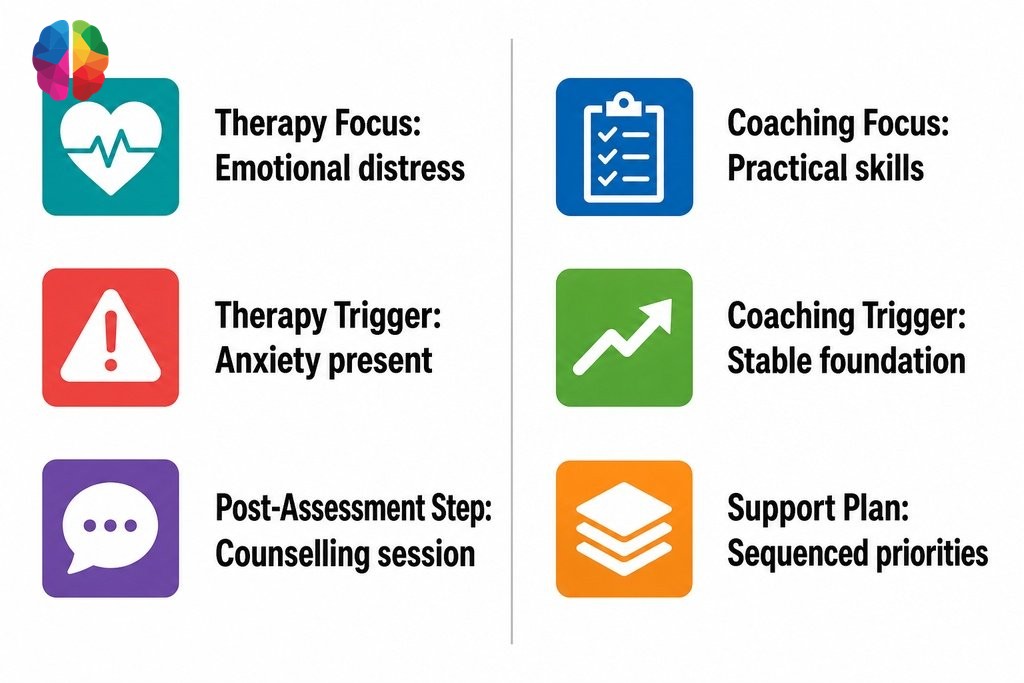
Therapy is delivered by a regulated mental health professional, such as a registered psychologist or registered clinical counsellor (RCC). It addresses emotional, psychological, or behavioural concerns within a clinical framework. Coaching is a structured, goal-oriented relationship focused on building practical skills and habits, such as organization, time management, and task initiation.
Understanding this distinction helps families choose the right professional for the right purpose. A well-designed support plan often includes both at different points in time.
Research increasingly supports coaching as a meaningful pathway in its own right. According to the Administration and Policy in Mental Health and Mental Health Services Research (Springer), a real-world study of a blended care platform found that ICF-certified coaching within a stepped-care model was associated with significant improvements in mental health outcomes over three months. For many post-assessment situations, coaching is a distinct and potentially effective approach rather than simply a lesser alternative to therapy.
When Is Therapy the Right Starting Point?
Some children arrive at the post-assessment stage carrying emotional weight that extends well beyond academic difficulty. When a child's learning struggles have left marks on their emotional wellbeing, mental health support for learning struggles is foundational, not supplementary. Trauma responses connected to years of unidentified learning differences are more common than many families expect. Signs that therapy should come first include significant school anxiety, a history of feeling different from peers, responses that look like defiance but may stem from genuine distress, or visible impact on self-worth and emotional regulation. Families who recognize these signs should connect with a regulated mental health professional first, then layer in coaching and academic supports as the child stabilizes.
When Does Coaching Fit Better?
For children whose emotional foundation is relatively stable, executive function coaching after evaluation offers a more immediate and practical route to progress. Coaching tends to be the right fit when the assessment has identified challenges with organization, time management, task initiation, or working memory, and when no significant anxiety or mood concerns are present. It is also well suited when a school placement change is imminent and the child needs new strategies quickly.
The evidence base for coaching in these contexts continues to grow. According to the Journal of Technology in Behavioral Science, research on a digital coaching platform found that a majority of participants who started care with symptoms of depression experienced clinical recovery after at least one session with a certified coach, and participants reported notable increases in overall well-being. For families weighing their options after an assessment, coaching represents a clinically studied pathway worth considering alongside therapy.
How Therapy and Coaching Align with BC School Placement Timelines
For families pursuing assessments with school placement or accommodation needs in mind, the timing of post-assessment decisions is both practical and strategic. Schools in British Columbia typically require a formal psychoeducational report to initiate accommodation planning, and many independent or specialized schools in the province expect this documentation as part of their admissions process. Acting promptly after results are received can make a meaningful difference to whether a child is placed with the right supports in place for September.
When families engage with therapy and coaching after assessment early, they also strengthen their file. Schools want to see that a family is actively working with the report's recommendations. Connecting with a coach, therapist, or specialist promptly demonstrates engagement and helps families speak confidently during admissions meetings. Post-assessment counselling support plays a direct role here, helping families understand the report's recommendations well enough to advocate effectively during placement conversations.

What Post-Assessment Counselling Support Includes
Post-assessment counselling support is structured guidance from someone who understands the report and can translate it into a realistic action plan. It is not therapy in the clinical sense; it is a focused, practical conversation about what the findings mean and which steps are most important to take first.
At All Brains Clinic, every assessment is followed by complimentary post-assessment support sessions as part of our comprehensive care continuum. These sessions are designed so that families leave with a clear, personalized plan and ongoing guidance, not just a report and no context. Our multidisciplinary team, which includes psychiatrists, psychologists, and speech-language pathologists, collaborates throughout this process to ensure the support plan reflects the full picture of each child's strengths and needs.
Mental Health Support for Learning Struggles
Learning differences rarely stay contained within the classroom. Children who have struggled with reading, attention, or processing for months or years often carry those experiences into how they see themselves, how they relate to family members, and how they approach new challenges. Providing mental health support for learning struggles means addressing both the practical and the emotional dimensions of a child's experience, and recognizing that these two things are deeply connected.
Families should also consider the difference between short-term coping support and longer-term intervention. A child who is anxious about a new school year may benefit from a focused, time-limited therapeutic approach that builds coping skills before September. A child dealing with deeper self-esteem concerns or family stress related to years of undiagnosed challenges may need more sustained support. Understanding this distinction helps families avoid either under-investing or over-committing to a particular level of care before they have a clearer sense of how their child responds.

How to Build a Practical Support Plan After Assessment
A strong support plan is not a list of everything a child might possibly benefit from; it is a thoughtful sequence of priorities that respects the child's capacity, the family's bandwidth, and the school's timeline. The phrase learning support plan after assessment refers to something specific: a document that bridges what the assessment found with what the school and family will actually do, and it is distinct from the assessment report itself.
A realistic plan sequences supports by urgency and impact, sets reasonable expectations about timelines, and builds in a review point later in the school year to assess what is working. Families in British Columbia should also be aware that certain school accommodations may require formal requests made before the school year begins, so early action matters. Family support after diagnosis is most effective when it is coordinated rather than reactive. Because each case at All Brains Clinic is reviewed by a collaborative team rather than a single assessor, the resulting guidance reflects a fuller picture of the child's needs, including areas that single-specialty reports sometimes miss.
When to Return to Your Assessment Team
An assessment is a starting point, not a final answer. Families should feel empowered to return to their assessing clinician when a child is not responding to recommended supports after a reasonable period of consistent effort, when a school placement decision does not go as planned, when new concerns emerge as the child transitions into a different environment, or when a co-occurring condition may not have been fully captured the first time.
The relationship with a qualified assessment team does not have to end when the report is delivered. At All Brains Clinic, our commitment to family support after diagnosis extends beyond the initial evaluation, and we encourage families across the Lower Mainland and broader BC to stay in contact as their child's needs evolve. Change is possible at every stage of this journey, and the right team will continue to walk alongside you as that change unfolds.
If you are navigating next steps after a psychoeducational assessment and would like support from a team that understands both the clinical and the human side of this process, we welcome you to reach out to All Brains Clinic. Our team in Vancouver is here to help you move from results to real, meaningful action for your child.
Frequently Asked Questions
What should families do immediately after receiving a psychoeducational assessment report?
Schedule a post-assessment counselling session to review the findings and build a prioritized action plan. Acting promptly is especially important in BC, where school accommodation requests and independent school admissions often have deadlines tied to the start of the academic year.
How is therapy different from coaching after a psychoeducational assessment?
Therapy is delivered by a regulated mental health professional and addresses emotional or psychological concerns. Coaching is goal-oriented and focuses on practical skills such as organization and time management. A well-designed support plan often includes both, introduced at different stages based on the child's needs.
When is mental health therapy the right first step after an assessment?
Therapy is the right starting point when a child shows significant anxiety, low self-worth, or emotional distress connected to their learning struggles. Mental health support should be established before adding coaching or academic skill-building, as emotional stability is the foundation everything else rests on.
How does a learning support plan differ from the psychoeducational report itself?
The psychoeducational report documents assessment findings and diagnoses. A learning support plan translates those findings into specific actions for the school and family, with sequenced priorities, realistic timelines, and a built-in review point to track what is working.
Can families return to All Brains Clinic after the initial assessment is complete?
Yes. Families are encouraged to stay in contact as their child's needs evolve. Common reasons to return include a child not responding to recommended supports, unexpected school placement outcomes, or new concerns arising during a transition to a different environment.
Does All Brains Clinic provide support after the assessment report is delivered?
Yes. All Brains Clinic includes complimentary post-assessment support sessions as part of its care continuum. These sessions help families understand the report's recommendations and leave with a clear, personalized plan rather than a document with no context or next steps.


