
.svg)
.png)


.png)


.svg)


.svg)

Receiving your child's psychoeducational report is a significant moment, but for many families in British Columbia it marks the beginning of a new kind of uncertainty. The document is detailed, the terminology is clinical, and the pressure to act quickly — particularly when school placement timelines are approaching — can feel immense. Understanding what happens after a psychoeducational assessment is not just about reading a report; it is about knowing what to do with it, who to involve, and how to turn clinical findings into real, meaningful change for your child. A well-built learning support plan after assessment bridges what the evaluation found and what your child actually experiences in the classroom and at home.
This article walks you through that process: from interpreting your child's report in plain language, to building a coordinated home and school support plan, to knowing when to return to your clinical team for additional guidance.
Why the Gap Between Assessment and Action Feels So Overwhelming
Psychoeducational reports are written primarily for clinicians and school professionals. When a family receives a document dense with percentile scores, confidence intervals, and diagnostic terminology, it is entirely understandable to feel lost rather than informed. The gap between what the report says and what a parent is expected to do next is rarely explained. You may know your child needs support without knowing whether to call the school first, seek a specialist, or wait for someone to contact you.
There is also an emotional dimension that is easy to overlook. Parents often process a range of feelings when they receive their child's results: relief at finally having answers, worry about the future, and uncertainty about whether the school system will actually respond. As the Learning Policy Institute notes, current assessment systems often fall short of giving families and educators the practical, ongoing information they need to support learning. That shortfall is real, and it means families sometimes have to advocate more actively than expected — something many BC parents find themselves doing as they navigate the school district process. The good news is that the report itself contains a roadmap, and learning to read it is the first step toward using it effectively.
Understanding What Your Child's Report Is Really Telling You
A psychoeducational report typically contains background history, behavioural observations, standardized test scores, a learning profile summary, and clinical recommendations. Scores are often presented as standard scores or percentiles, which can look alarming without context. A score at the 25th percentile does not mean your child is failing; it means they performed at that level relative to peers of the same age. What matters more than any single number is the pattern across scores and how those patterns show up in everyday learning.
Two terms that often cause confusion are worth clarifying. Processing speed describes how quickly your child can complete routine cognitive tasks, which affects how long it takes to copy from the board or finish a timed test. Working memory refers to the ability to hold and use information in the short term, playing a direct role in following multi-step instructions or solving math problems mentally. These are not permanent limitations; they are characteristics of how your child's brain currently works, and they point directly toward the kinds of supports that will help most.
Research from the Education Resources Information Center suggests that sharing performance results with students alongside strategies to close the gap between current and desired performance can have a positive impact on achievement, particularly when feedback is timely and constructive. This is exactly the purpose a good report serves when it is interpreted well.
Reading Recommendations as a Roadmap, Not a Diagnosis
The recommendations section of a psychoeducational report is often the most practically useful part, yet it is also the most frequently misread. Families sometimes treat recommendations as a fixed label, reading them as a declaration of what their child cannot do rather than as informed starting points. A recommendation for explicit phonics instruction, for example, is not a statement that your child will always struggle to read; it is guidance toward the most effective teaching approach for how their brain learns best right now. These recommendations are starting points for planning, not endpoints for expectation.
How to Build a Learning Support Plan After Assessment
Translating a report into an actionable learning support plan requires collaboration. No single person, whether a clinician, a teacher, or a parent, can build an effective plan alone. The process works best when it follows a structured cycle: assess your child's current profile using the report findings, plan specific and measurable goals with clear ownership, implement strategies consistently across home and school, and review progress regularly to adjust as needed.
According to Panorama Education, student support plans are most effective when they connect data to targeted interventions across academic, behavioural, and life skills areas. In practical terms, your child's plan should address the whole child across all the settings where they spend their time, not just reading or just attention.
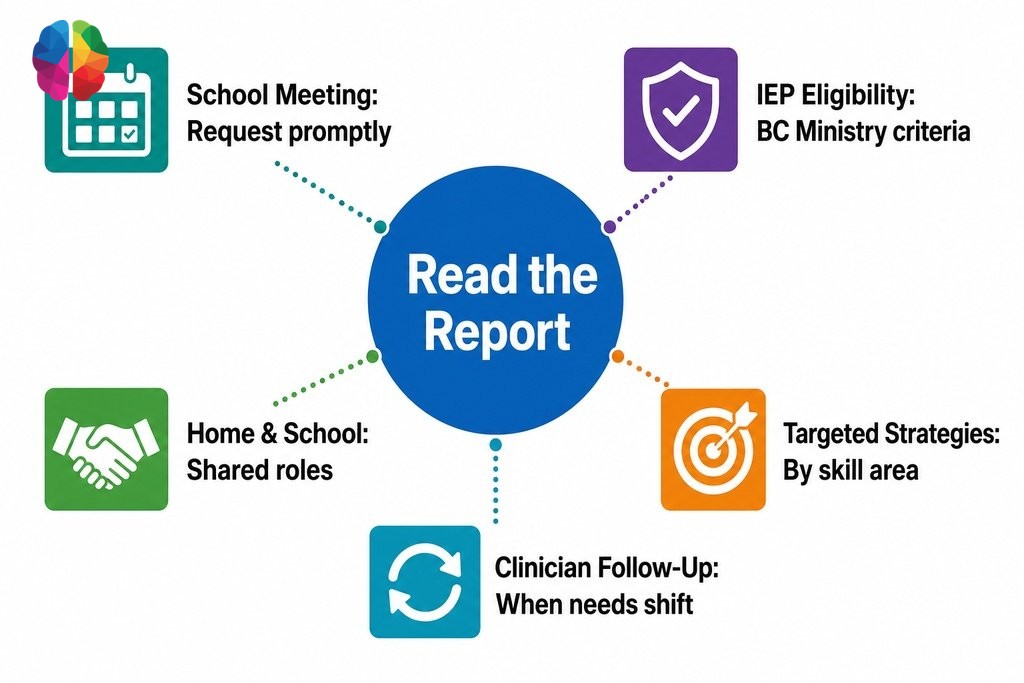
To get started, request a meeting with the school's learning support teacher or resource room coordinator as soon as the assessment report is available. Bring a copy of the full report, including the recommendations section, and ask directly how the school plans to incorporate the findings. Come with questions prepared and ask for timelines in writing.

Home and School Support Plan in British Columbia: Who Does What
One of the most common sources of confusion after an assessment is responsibility. Families often assume schools will take full ownership of implementation, while school teams sometimes assume families will arrange additional services privately. An effective home and school support plan requires both sides to understand their distinct roles.
Schools in British Columbia are responsible for reviewing the assessment report, determining eligibility for formal accommodations, and initiating an Individual Education Plan (IEP) where appropriate. Parents play a complementary role by reinforcing strategies at home, communicating observations back to the school team, and ensuring their child understands their own learning goals. As Panorama Education notes, students who do not understand or engage with their goals rarely make consistent progress, while families kept in the dark cannot reinforce interventions at home. Keeping everyone informed and aligned is not administrative overhead; it is a core condition for the plan to work.
Academic Intervention Planning Inside the BC School System
In British Columbia, once a school receives a psychoeducational report, the learning support team reviews it to determine what accommodations or designations the student may be eligible for under the BC Ministry of Education and Child Care framework. For students with identified learning differences, an IEP is typically developed to outline specific goals, adaptations, and the personnel responsible for each.
The timeline varies by district and school, but families should generally allow several weeks from the point of submission to when formal accommodations are in place. Schools typically require the full psychoeducational report, including test scores and the clinician's recommendations, before putting any formal plan in motion. Submitting documentation promptly and following up with the school's learning support coordinator helps prevent delays, particularly when placement or programme decisions are tied to specific enrolment windows. This is a consideration that comes up regularly for families in districts across Metro Vancouver, the Fraser Valley, and other parts of BC.
Targeted Learning Strategies for Reading, Writing, and Math
A well-constructed support plan does not rely on generalised remediation. Evidence-based interventions are specific to the skill area and matched to what the assessment identified. Children with decoding difficulties typically benefit from structured literacy approaches grounded in systematic phonics instruction. For written expression, strategies often include graphic organizers, sentence starters, and explicit instruction in planning and editing. Numeracy interventions may focus on concrete representations of abstract concepts, repeated low-stakes practice, and explicit instruction in problem-solving steps.
Cornell University's Center for Teaching Innovation notes that formative assessments can be used to measure student learning on an ongoing basis, revealing how and what students are learning and informing next steps. This principle applies directly at home as well: brief, regular check-ins about schoolwork are more useful than waiting for the next report card to see whether strategies are working.

Questions to Ask Before Accepting Any Support Plan
Before treating a support plan as final, families should confirm a few key points. Has the school's learning support team read the full assessment report, not just the summary page? Will an IEP be initiated, and if not, what is the school's rationale? Are the recommended strategies evidence-based, or are they general classroom accommodations that were already in place? Who is the designated point of contact, and how often will they communicate progress to the family? Does the timeline for implementing accommodations align with any upcoming placement or admissions decisions?
If your child is being considered for a specialised programme or a different school setting, documentation of a formal support plan may be required before that process moves forward. Asking these questions clearly and early helps prevent gaps that can quietly derail even the best-intended plans.
When to Return to a Clinician for Follow-Up Guidance
A psychoeducational report captures a moment in time, reflecting your child's profile on the day of assessment within the context of their current age and circumstances. When recommendations feel unclear, when the school team has not responded substantively, or when your child's needs appear to be shifting, returning to the clinician who conducted the assessment is a reasonable and often valuable step. Written reports have limits; a conversation allows for nuance, clarification, and updated guidance that a static document cannot provide.
At All Brains Clinic, families do not receive a report and then navigate alone. Each assessment includes complimentary post-assessment support sessions, giving families the opportunity to sit with the clinical team, review findings in plain language, ask questions about specific recommendations, and work together toward a realistic and personalised plan. This is especially valuable when the school process stalls or when a family is weighing options across different educational settings in British Columbia.
It is also worth knowing that therapy and coaching after assessment is a related but distinct topic, one that addresses the ongoing therapeutic and skill-building support some children benefit from beyond what a school plan alone can provide. If your child's needs extend into social-emotional development, executive function coaching, or speech and language therapy, that is a conversation worth having with your clinical team separately.
If you have recently received your child's assessment results and are not sure where to begin, All Brains Clinic's team is here to help you make sense of what comes next. Reach out to start a conversation with a clinician who already knows your child's profile and is invested in helping your family move forward with clarity and confidence.
Frequently Asked Questions
What is a learning support plan after a psychoeducational assessment?
A learning support plan translates a psychoeducational report's findings into specific strategies, goals, and accommodations for your child. It is built collaboratively by parents, school staff, and, where applicable, the assessing clinician, and covers both classroom and home support.
How long does it take for a BC school to put a support plan in place after receiving a report?
Timelines vary by district, but families should generally allow several weeks from submission to when formal accommodations are in place. Submitting the full report promptly and following up with the school's learning support coordinator helps avoid unnecessary delays, particularly if placement decisions have deadlines attached.
Does every child who receives a psychoeducational assessment in BC get an IEP?
Not automatically. An IEP is initiated when a student meets the eligibility criteria under the BC Ministry of Education and Child Care framework. If you are unsure whether your child qualifies, ask the school's learning support team directly after submitting the report.
What role do parents play in a home and school support plan?
Parents reinforce strategies at home, share observations with the school team, and help their child understand and engage with their learning goals. Children tend to make more consistent progress when the same strategies are applied across both home and school settings.
When should a family return to their clinician after receiving the assessment report?
Consider returning if recommendations feel unclear, the school has not responded meaningfully, or your child's needs appear to be changing. A follow-up conversation can provide nuance and updated guidance that a written report alone cannot offer.
Can a psychoeducational report be used for more than school accommodations?
Yes. A report can inform decisions about private tutoring, therapy, coaching, and programme placement. It may also be required if your child is applying to a specialised educational setting that needs formal documentation of learning needs before admissions can proceed.


