
.svg)
.png)
.svg)
If your child has been referred for testing and you are now on a school psychoeducational assessment waitlist, you are not alone. Across Vancouver and the broader Lower Mainland, families are waiting far longer than expected for publicly funded evaluations, and the uncertainty can feel just as difficult as the learning challenges that prompted the referral. Understanding why delays happen, what your child needs during the wait, and when a private assessment makes practical sense can help you move forward with confidence.
This guide covers what the waiting period means for your child, what meaningful support looks like before the formal evaluation, and how to make sure placement deadlines and accommodation windows are not missed.
Why Is the School Psychoeducational Assessment Waitlist So Long?
The gap between referral and assessment reflects a structural shortage of registered psychologists in publicly funded school and clinical systems, not a judgment about the urgency of your child's needs. Referral volumes consistently outpace available appointments.
According to the Ontario Human Rights Commission's Right to Read Inquiry Report, Ontario school boards face long wait times and, in some cases, apply unsupported criteria that delay referrals further, including the mistaken belief that children must reach Grade 3 before being assessed for a reading disability. While this report focuses on Ontario, the same pressures are felt by families in Vancouver and across British Columbia, where community-based and publicly funded psychology services face comparable demand.
The problem extends well beyond school board offices. The University of Waterloo's Centre for Mental Health Research and Treatment has closed its referral intake for children's psychoeducational assessments, with its waitlist projected to reopen in May 2027 for assessments in 2028 or later. For Vancouver families relying on publicly funded services through Vancouver School Board or neighbouring districts, timelines can be similarly extended.
What Assessment Delays Actually Mean for Your Child
A long waitlist does not mean your child stops developing or that gaps become permanent. Children continue to grow, respond to teaching, and build skills throughout the wait. What changes is how intentionally you use that time.
The Right to Read Inquiry put it directly: "Schools should not wait for the results of a psychoeducational assessment before providing more intensive intervention." A referral in progress is already an acknowledgment of need, and that acknowledgment carries real weight in conversations with teachers, principals, and support staff. The waiting period is an opportunity to observe, document, and advocate, all of which will make the formal assessment more useful when it arrives.
Support You Can Start Before the School Evaluation
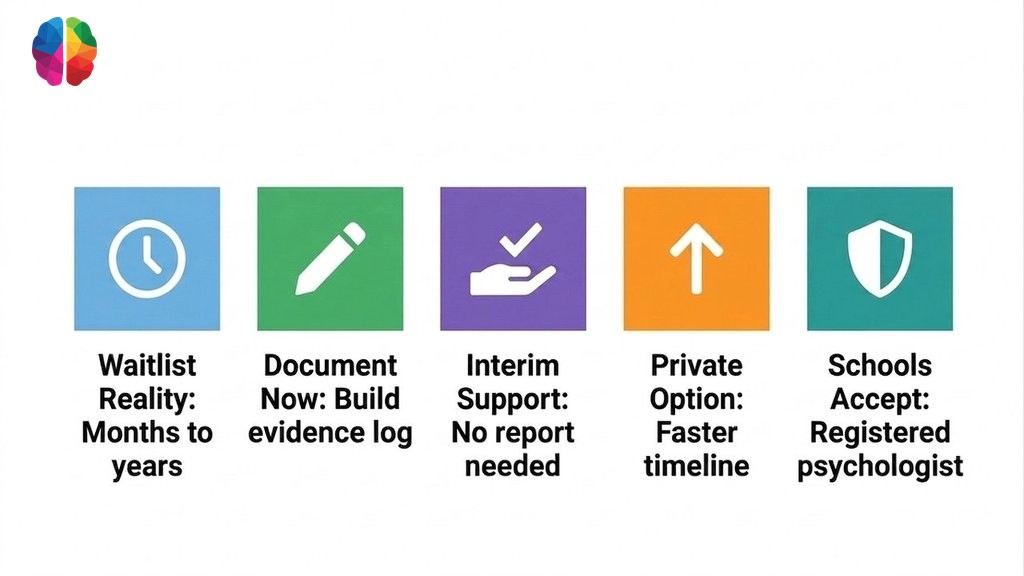
You do not need a completed report or formal diagnosis to begin supporting your child. The most practical step during this window is building a documentation habit. Keep a simple log noting what your child finds difficult and in which contexts, what strategies or adjustments seem to help, how long they can sustain focus on different types of tasks, and how they respond emotionally to schoolwork and academic pressure.
This kind of structured observation gives the eventual assessor richer context and helps teachers recognise patterns they might otherwise attribute to behaviour or motivation. It also strengthens your position when requesting interim accommodations, because you are arriving with evidence rather than impressions.
Working With Your Child's Teacher During the Wait
Start by asking what the teacher is already noticing, which strategies have helped even slightly, and whether any informal classroom adjustments can be made while the assessment is in progress. Many teachers are willing to offer preferential seating, extended time, or simplified instructions, particularly once a family has already initiated the referral process.
Ask specifically about the school's learning support teacher or resource room support. In Vancouver and across British Columbia, these professionals can provide in-class support, develop an informal learning plan, and document observations that feed directly into the assessment. Keep a written record of all conversations, including dates and what was agreed upon. This record becomes part of the profile that supports your child going forward.
Everyday Learning Support at Home
Structure and predictability are among the most powerful tools available to you at home. Children waiting for an assessment often carry anxiety about school that compounds the underlying difficulty. A calm, consistent routine around homework, reading, and winding down reduces cognitive load and creates space for learning without added pressure.
Low-pressure activities such as puzzles, storytelling games, drawing sequences of events, and reading aloud together provide genuine developmental value without feeling like remediation. The goal is not to fix what has not yet been formally identified. It is to keep your child engaged, supported, and confident while the formal process moves forward.

Options for Vancouver Families Facing a Long Waitlist
Families who cannot wait indefinitely have a real alternative: a private psychoeducational assessment completed by a registered psychologist outside the school system. Understanding the differences between private vs school psychoeducational assessment options is essential before making this decision.
A school board assessment is publicly funded and conducted by a board-employed psychologist, but families have limited control over timing and scope. A private assessment is arranged independently, typically with partial coverage through extended health benefits, giving families more direct input into the timeline and process.
Vancouver-area schools generally accept private assessment reports for Individual Education Plans and accommodation decisions, provided the report is completed by a registered psychologist using standardised, recognised tools. Before committing to any private provider, confirm their reports meet the format your child's school or prospective programme expects.
When a Private Assessment Makes Practical Sense
The decision to pursue private testing usually comes down to timing. If your child is approaching a school placement deadline, transitioning to secondary school, or being considered for specialised programming, a publicly funded slot may simply not arrive in time.
Weighing the private learning assessment pros and cons honestly matters here. The cost is real and not insignificant, but so is the cost of missing a critical placement window or watching a child struggle without formal recognition of their needs.
A comprehensive private assessment typically covers cognitive processing and academic achievement, attention and executive function, social-emotional factors, clear diagnostic impressions where applicable, and specific classroom accommodation recommendations schools can act on directly.
At All Brains Clinic, assessments are designed to produce exactly this kind of actionable picture, with a multidisciplinary team contributing perspectives that a single evaluator working alone cannot replicate.
What to Verify Before Booking a Private Assessment in BC
Before confirming any appointment, verify the following directly with the provider:
- The assessor holds registration with the College of Psychologists of British Columbia.
- The assessment uses standardised, normed tools currently recognised in clinical practice and accepted by BC schools.
- The final report format meets the requirements of your child's school board or programme for accommodation and placement decisions.
- Post-assessment support, including a results consultation and written recommendations summary, is included and not treated as an add-on.

How a Multidisciplinary Assessment Differs From a Standard One
A single-clinician evaluation captures what one professional can observe and measure. A multidisciplinary assessment draws on psychologists, speech-language pathologists, occupational therapists, and other specialists working as a coordinated team.
For children whose learning challenges overlap with language development, motor coordination, sensory processing, or attention regulation, this broader view is not a luxury. It is what separates a report that confirms a concern from one that actually explains it. When a report reflects input from multiple qualified perspectives, the recommendations are more specific, more credible to educators, and more useful for families in Vancouver navigating placement decisions or requesting formal accommodations.
All Brains Clinic brings this team-based approach to every assessment, ensuring your child's learning profile is understood across the developmental domains that matter most for school success.
Signs You Should Seek Professional Guidance Sooner
Some children move through the waiting period without significant distress. Others show signs that suggest support is needed now rather than after the assessment is complete. Seek professional guidance sooner if your child is experiencing significant emotional withdrawal or increased anxiety about school, regression in skills they had already mastered, persistent school refusal, or communication changes that go beyond what academic difficulty alone would explain.
If you feel your child's needs span more than one developmental area, or the wait is no longer manageable given what you are observing, consulting a qualified professional now is the right move. At All Brains Clinic, our Vancouver-based team is here to listen, help you understand what your child may need, and guide you toward the right next step, whether that is a full psychoeducational assessment, a speech and language evaluation, or a broader multidisciplinary review. Reach out to us to begin that conversation.
Frequently Asked Questions
How long is the typical wait for a school psychoeducational assessment in Vancouver?
Wait times vary by district and referral volume, but families in Vancouver and the broader Lower Mainland often wait many months to over a year for a publicly funded school assessment. Demand consistently exceeds the number of available registered psychologists in school board systems, making timelines difficult to predict when a child is first referred.
Can my child receive classroom support before the assessment is completed?
Yes. Schools in British Columbia are expected to provide appropriate support based on observed need, not only after a formal assessment. Once a referral is in progress, families can request informal accommodations such as preferential seating, extended time, or learning support teacher involvement without waiting for a completed report.
Will a private psychoeducational assessment be accepted by my child's Vancouver school?
Vancouver-area schools generally accept private assessment reports for Individual Education Plan and accommodation purposes, provided the assessment was completed by a registered psychologist using standardised tools. Confirm directly with your school board that the report format meets their specific requirements before booking.
At what age can a child be referred for a psychoeducational assessment?
Children can be referred at any age when a learning concern is identified. There is no requirement to wait until a specific grade. The misconception that children must reach Grade 3 before being assessed, noted in the Ontario Human Rights Commission's Right to Read Inquiry, is not supported by evidence and delays access to necessary support.
What does a psychoeducational assessment actually evaluate?
A comprehensive psychoeducational assessment typically evaluates cognitive processing, academic achievement, attention, executive function, and social-emotional development. Depending on the child's profile, it may also include input from speech-language pathology or occupational therapy. The report provides diagnostic impressions and specific recommendations for classroom accommodations and learning support.
Is a private psychoeducational assessment covered by insurance in BC?
Many extended health benefit plans in BC provide partial coverage for psychological assessments completed by a registered psychologist. Coverage amounts vary significantly between plans. Review your policy details or contact your benefits provider directly to confirm what is reimbursable before booking a private assessment.


.png)


