
.svg)
.png)


.png)


.svg)


.svg)

Receiving a psychoeducational assessment report for your child is a significant moment. The document holds real answers about how your child learns, thinks, and processes the world around them. Yet for most families, the first read-through feels more confusing than clarifying. Pages of numbers, percentiles, confidence intervals, and clinical terminology rarely come with a plain-language guide. If you are working through understanding psychoeducational assessment reports and wondering where to begin, you are not alone. The core concepts are far more approachable than they first appear.
This guide is written for families in British Columbia who are interpreting assessment results and making informed decisions about school placement, accommodations, or next steps. Whether your child was recently assessed or you are revisiting an older report ahead of an annual review, this is a helpful place to start.
Why Assessment Reports Can Feel Overwhelming at First
Psychoeducational reports are written primarily for psychologists, educators, and school teams. They follow a professional format designed to be precise and defensible, which makes them dense with standardised language by design. A typical report may include cognitive composite scores, index breakdowns, academic achievement scores, processing speed comparisons, and confidence intervals across multiple subtests.
Once you understand a handful of core concepts, the structure becomes much easier to navigate. Most reports follow a consistent pattern, and the same types of scores appear across different assessments and testing tools. Building familiarity with standard scores, percentile ranks, and confidence intervals gives you a reliable framework for reading any report your child receives, now or in the future.
The Core Numbers Explained
Psychoeducational assessments typically evaluate cognitive abilities such as reasoning, memory, and processing speed, alongside academic achievement in reading, writing, and mathematics. As PsychDB notes, these assessments help identify the gap between a child's cognitive ability and their academic achievement, which is central to determining whether a learning difference may be present. Scores generally fall into three main categories: composite scores, which summarise broad areas of functioning; index scores, which capture specific cognitive domains; and subtest scores, which reflect performance on individual tasks. Each level offers a different lens on your child's learning profile, and they are meant to be read together rather than in isolation.
What Are Standard Scores?
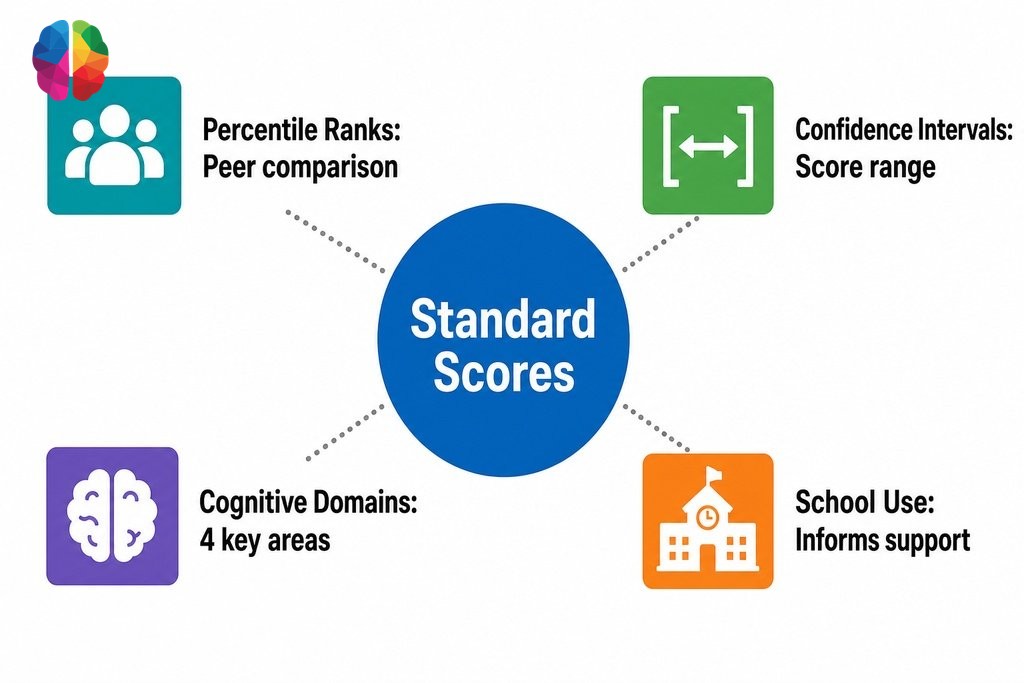
Standard scores are the most commonly used score type in psychoeducational reports. They are calculated so that the population average is 100, with a standard deviation of 15. Scores between 85 and 115 fall within the average range, covering roughly the middle two-thirds of children assessed. Scores between 116 and 130 are above average, while scores between 70 and 84 are below average. These benchmarks apply consistently across most major cognitive and academic measures, making standard scores a useful common reference when comparing results across different areas of the report.
A single number, however, never tells the whole story. As the Pathfinders for Autism editorial team notes, "No single test can be used to diagnose. No single score can stand alone to indicate a specific strength or weakness." Meaningful conclusions come from the pattern of scores across the full report.
What Are Percentile Ranks?
Percentile ranks show where your child stands relative to peers their age. A percentile rank of 75 means your child scored higher than 75 per cent of children in the same age group in the test's normative sample. It does not mean your child answered 75 per cent of questions correctly. According to Disability Rights California, test norms allow psychologists and educators to obtain an age- or grade-referenced percentile rank, for example in reading achievement, which is what makes these scores meaningful as a comparison tool. The 50th percentile is squarely average; a score at the 30th percentile falls within the low-average range and may not indicate a significant concern on its own. Percentile ranks are most useful when read alongside standard scores rather than interpreted in isolation.
What Are Confidence Intervals?
Most reports present scores as a range rather than a single fixed number, for example 92 to 104. This range is called a confidence interval, and it reflects the natural variability in any standardised test. A child might perform slightly differently depending on how well they slept, how comfortable they felt with the examiner, or whether they were coming down with a cold. As noted by SUNY Lumen Learning's educational psychology resources, understanding how variability affects score interpretation is essential for reading any standardised result accurately. Seeing a range is not a sign that the assessment is imprecise. It is a sign that the report is being transparent about the limits of measurement, which is exactly what good professional practice looks like.
Reading Your Child's Learning Profile, Not Just the Totals
Composite scores give a useful summary, but the most meaningful information in a report often lies in the variation across individual scores. A child who scores in the average range overall may have significant differences between their verbal reasoning abilities and their processing speed, for instance. That uneven profile can reveal a great deal about how a child experiences learning, what tasks feel effortless versus effortful, and where targeted support would make the most difference.
What Cognitive Scores Reveal
Cognitive scores typically cover four key domains. Verbal comprehension reflects how well a child understands and uses language-based concepts, which is foundational to most classroom learning. Fluid reasoning captures the ability to think logically and solve novel problems. Working memory measures how much information a child can hold in mind and manipulate at once, directly affecting multi-step instructions, mental arithmetic, and reading comprehension. Processing speed shows how quickly a child completes simple cognitive tasks accurately, which affects note-taking and timed tests. Seeing these areas broken out allows families and schools to understand not just whether a child is struggling, but why.
What Academic Achievement Scores Reveal
Academic achievement scores measure how a child is performing in foundational school subjects relative to age-based expectations. Reading scores may cover decoding, fluency, and comprehension separately. Writing scores typically address spelling, sentence construction, and written expression. Math scores often include both calculation skills and applied problem-solving.
These scores are most informative when reviewed alongside cognitive scores, because the relationship between a child's cognitive ability and their academic output is central to identifying whether additional support is warranted. It is also worth noting that restandardised tests account for generational gains in performance, meaning a child could score differently on a newer version of the same test than on an older one. This is one reason the edition and standardisation date of a test matters when interpreting results.

How Scores Connect to School Placement and Accommodations in British Columbia
Understanding what test scores mean is only part of the picture. The other part is knowing how schools use those scores to make decisions. In British Columbia, psychoeducational assessment results inform eligibility for resource support, adapted programming, individualised education planning, and in some cases, gifted placement. BC school districts review score patterns across cognitive and academic domains to give the assessing psychologist the evidence needed to recommend specific accommodations, teaching strategies, or referrals.
Families pursuing placement or accommodation decisions in BC often have real concerns about timing. Assessment reports requested ahead of school admissions or annual review cycles need to be completed with enough lead time for the school team to review and act on them. Confirm early in the process what the receiving school or district requires in terms of format, recency of assessment, and the specific areas the report must address. Knowing how to use an assessment report at school starts with ensuring the report was written in a way the school can act on directly.
What to Check Before Acting on Assessment Results
Before making any significant placement or accommodation decision based on a report, confirm that the assessments used are current editions, appropriate for your child's age, and accepted by the receiving school or district. Consider whether the norm group is sufficiently representative, since a larger, more representative normative sample means the performance range is more reliably defined. Also check that the recommendations are specific and actionable, as a school team needs clear, implementable guidance to translate results into daily classroom support. If recommendations are vague or incomplete, a follow-up conversation with the assessing psychologist to clarify or supplement the report is entirely reasonable.

When to Seek Additional Guidance After Receiving Results
A written report is a starting point, not the final word on your child's needs. For many families in BC, a follow-up conversation with the assessing psychologist is the most valuable step after receiving results. This is the opportunity to ask questions about score patterns that seem contradictory, understand what specific recommendations mean in practice, and clarify how findings should be communicated to the school team.
Suzanne Pellarin, Psycho-Educational Consultant with the London Catholic District School Board, captures this well: "We want the information in our reports to be helpful throughout their school careers and we encourage parents, teachers and high school students to ask for a review of the assessment report and an update of recommendations at any time."
For children with more complex profiles, particularly those where language development, motor skills, or social communication are also areas of concern, additional specialist input can meaningfully change the support plan. A speech-language pathologist, occupational therapist, or other specialist may identify needs that a psychoeducational assessment alone was not designed to capture. Families in BC navigating complex needs benefit from understanding that additional assessments may be relevant to their child's full support picture.
How All Brains Clinic Supports Vancouver Families Through the Assessment Process
At All Brains Clinic in Vancouver, the assessment process is built around the understanding that no single score and no single specialist can capture the full picture of a child's learning and development. The clinic's multidisciplinary team brings together psychologists, speech-language pathologists, and other specialists who collaborate on each case. This team-based approach helps reduce the risk that an important need is missed or that a child's strengths are overshadowed by a single area of difficulty.
After every assessment, All Brains Clinic provides complimentary post-assessment support sessions where clinicians walk families through their child's results in plain language, answer questions, and help translate findings into practical next steps for school. Families leave those conversations with a clear understanding of what the scores mean, how the recommendations connect to their child's daily experience, and what to bring to their school team. If your family is ready to take the next step toward understanding your child's learning profile, the team at All Brains Clinic is here to guide you through every part of the process, from the first appointment to the final conversation with your child's school.
Frequently Asked Questions About Psychoeducational Test Scores
What is a standard score in a psychoeducational assessment?
A standard score shows how your child performed compared to other children the same age, with 100 as the population average and a standard deviation of 15. Scores between 85 and 115 fall within the average range. Standard scores make it easier to compare results across different areas of the same report.
What does a percentile rank mean on an assessment report?
A percentile rank shows the percentage of same-age peers your child outperformed on a given measure. A score at the 60th percentile means your child performed higher than 60 per cent of children in the normative sample. It does not reflect the percentage of questions answered correctly.
Why are scores shown as a range rather than a single number?
That range is a confidence interval, reflecting natural variability in any standardised test. Factors such as sleep, comfort with the examiner, or minor illness can slightly affect results on the day. The interval shows the range within which your child's true ability most likely falls, and it signals honest, transparent measurement.
How are psychoeducational assessment results used by BC schools?
In British Columbia, assessment results inform eligibility for resource support, adapted programming, and individualised education planning. Schools review score patterns across cognitive and academic domains to determine appropriate accommodations or referrals. Reports should be current and formatted to meet the receiving school or district's specific requirements.
When should a family consider additional assessments beyond a psychoeducational report?
Additional assessments are worth considering when a child has concerns in areas such as language development, motor skills, or social communication that a psychoeducational assessment is not designed to fully evaluate. Specialists such as speech-language pathologists or occupational therapists can identify needs that inform a more complete support plan.
How soon after receiving a report should families follow up with the assessing psychologist?
A follow-up conversation is most useful once the family has had time to read the report and form questions. Meeting promptly allows families to clarify confusing score patterns, understand recommendations, and prepare to communicate findings to the school team before placement or planning decisions are made.

Dr. Ali Eslami, Chief Editor
Dr. Ali Eslami is a child psychiatrist at BC Children’s Hospital and All Brains Clinic with a PhD from Brown University. With expertise in neurodevelopmental disorders, autism assessment, and AI research in mental health, he ensures every article meets the highest standards. His sharp editorial eye guarantees clarity, accuracy, and credibility in all our content.


