
.svg)
.png)


.png)


.svg)


.svg)
Receiving a psychoeducational assessment report for your child is a significant moment. After weeks of appointments, testing sessions, and waiting, you finally have a detailed document that explains how your child learns, where they struggle, and what support they need. But for many families in British Columbia, that moment is quickly followed by a quieter question: now what? Knowing how to use an assessment report at school is the part that rarely comes with instructions, and yet it is where the real difference gets made.
This guide walks through the practical steps of turning a clinical report into genuine classroom support. Whether your child was assessed for learning differences, ADHD, or autism, the path from report to real-world help involves understanding what the document contains, sharing it with the right people at school, and following up in ways that keep recommendations from getting lost.
Why the Report Is Just the Beginning
A psychoeducational assessment report is a milestone, not a finish line. It documents your child's learning profile with a level of detail that classroom observations simply cannot capture on their own. As research from the U.S. Department of Education notes, no single assessment can tell educators everything they need to know about a student; multiple sources of valid and reliable information are required to make meaningful instructional changes. The report is one powerful piece of that picture, and it becomes most useful when it is actively shared, discussed, and connected to what teachers already know about your child.
Families sometimes assume that submitting a report to the school is enough and that accommodations will follow naturally. In practice, schools need guidance on how to interpret findings and translate them into specific supports. The report opens a door, and your role as a parent or guardian is to walk through it alongside the school team. Understanding psychoeducational assessment reports well enough to advocate for your child does not require a clinical background. It requires knowing which sections matter most and how to communicate them clearly.
Understanding What Is Actually in the Report
Most psychoeducational assessment reports follow a consistent structure. The background history section provides your child's developmental and academic context. Test results cover findings across cognition, memory, language, and academic achievement. The learning profile outlines your child's relative strengths and areas of difficulty. Finally, the clinical recommendations section is the most actionable part for school purposes. Lead with this section when bringing the report to teachers or a learning support team.
Renaissance Learning has noted that more than 70% of students can miss specific assessment questions even when a class average looks strong, which is a useful reminder that group-level classroom observations rarely reveal the individual patterns a detailed report uncovers. It helps to distinguish between diagnostic findings and school-specific recommendations before you bring the report forward: diagnostic language explains what was found and why, while recommendation language tells schools what to do about it.
Decoding Clinical Language Before Sharing the Report
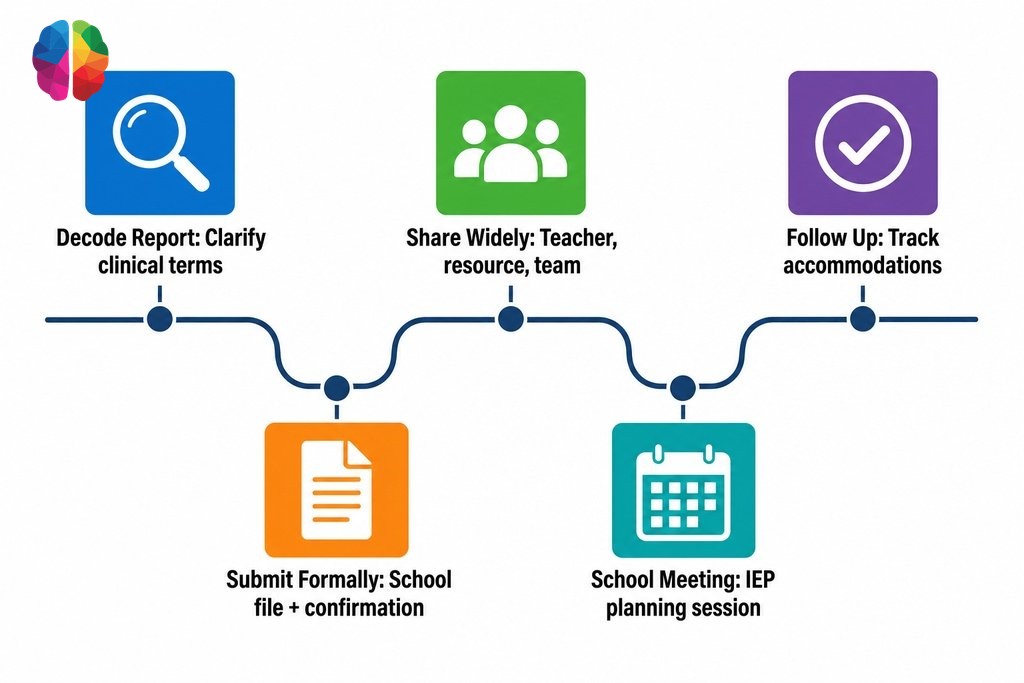
Psychoeducational reports are written for clinicians, and the language can feel dense or technical. Before sharing the report with the school, read it carefully and note any terms you do not fully understand. Your assessing clinician can clarify these points, and reaching out before the school meeting means you can speak confidently about your child's results when it matters most.
Ask specifically what any diagnosis or score means in everyday classroom terms, and which recommendations are the highest priority for an immediate school response. Preparing a short plain-language summary at this stage — half a page covering your child's main strengths, main challenges, and the top two or three recommendations — can be enormously helpful when sitting down with a teacher or resource staff member who has not read the full document. This is especially useful when the report is supporting a placement decision or accommodation request with a tight timeline.
How to Use an Assessment Report at School in BC: Step by Step
Once you feel confident in what the report says, the next step is formally submitting it to the school.
Step 1: Submit the Report to the School Office
In British Columbia, this typically means providing a copy to the school principal or vice-principal and requesting that it be added to your child's school file. Ask for written confirmation that the report has been received and that a follow-up meeting will be scheduled. Keeping a record of this exchange protects both you and your child if questions arise later about whether the school was made aware of the results.
Step 2: Act Before Deadlines
Timing matters, particularly if the report is connected to placement decisions or accommodation approvals for the upcoming school year. Schools in BC often finalise Individual Education Plans and learning support allocations within specific windows, so submitting a report close to the end of the school year may push planning into the fall. If you are working against an admissions or placement deadline, say so explicitly when you contact the school office. Many independent schools in BC also have their own timelines for reviewing assessment documentation, so confirming those windows early can prevent a report from arriving too late to influence the decision.
Step 3: Make Sure the Right People See It
The report should not stop at the front office. In most BC schools, the key people involved in your child's support are the classroom teacher, who implements day-to-day accommodations; the resource teacher or learning support teacher, who coordinates formal planning documents; the school-based team, which makes decisions about additional support services; and the school psychologist, where available, who may review external assessment findings. Making sure the right people have access to the report, and know they have permission to read it, is a step families sometimes overlook.

Sharing Your Assessment Report With Teachers in BC
Sharing an assessment report with teachers works best when it is framed as a collaborative conversation rather than a clinical handoff. Teachers know your child in a way that a one-time assessment cannot fully capture, and they are far more likely to engage meaningfully with report findings when they feel like a partner in the process rather than a recipient of instructions.
The James Madison University Centre for Assessment and Research Studies notes that assessment results have the best chance of being acted upon when they tell a meaningful story, are clear and concise, and adequately address reasonable questions. That principle applies directly to how you present your child's report. When meeting with the teacher, lead with the learning profile and top recommendations, connect those recommendations to specific classroom situations your child encounters, and invite the teacher's own observations as part of the discussion. Framing the conversation this way turns the report into a shared tool rather than an external document.
Navigating the School Meeting After an Evaluation
The school meeting after an evaluation is where recommendations move from paper to planning. Depending on your child's needs and the school's process, this may be an IEP meeting, a school-based team meeting, or an informal planning conversation. In BC, parents and guardians are full participants in IEP planning and have every right to ask that specific recommendations from the report be discussed and recorded in your child's plan.
Go into the meeting prepared with a copy of the report and your plain-language summary, along with a short list of questions: Which recommendations will be included in the IEP? How will those accommodations be implemented? When will the plan be reviewed? As Glenn Milewski, Chief Program Officer at ERB, has written, "If you are going to invest the time and money to conduct an assessment and require your students to put forth their best effort, you owe it to the entire school community to debrief on the results." That spirit of follow-through applies to families as much as it does to schools.
What to Do If the School Is Slow to Act
Some families find that schools are slow to schedule meetings or cautious about committing to specific accommodations after an assessment is submitted. The most effective approach is usually to follow up in writing, restate what you are requesting, and give a reasonable timeline for a response. Keeping communication respectful and solution-focused tends to produce better outcomes than escalating quickly. If significant delays continue, BC's Ministry of Education and Child Care guidelines and your school district's special education coordinator are useful resources for understanding your child's rights and the school's obligations under provincial policy.

Turning Recommendations Into Real Classroom Supports
There is a meaningful difference between having recommendations written in a report and having those recommendations appear as specific, agreed-upon accommodations in a formal learning plan. Common accommodations that emerge from psychoeducational assessments include extended time on tests and assignments, preferential seating, access to assistive technology, reduced written output requirements, and modified assignment formats. Each of these needs to be named explicitly in the IEP or learning plan so that all teachers who work with your child are aware of them.
Once accommodations are in place, tracking whether they are actually being implemented is part of your ongoing role. Check in with your child regularly about whether they are receiving the supports listed in the plan, and keep communication open with the classroom teacher throughout the year. Research from the National Center for the Improvement of Educational Assessment found that detailed item-level descriptions in score reports can help staff develop more targeted goals for students with diverse learning needs, which underscores the value of pointing teachers toward specific sections of the report when setting up supports.
Using Reports for Learning Plans Over Time
A psychoeducational report is not a one-time document. As your child grows, transitions between grades, or moves to a new school anywhere in BC, the report continues to serve as a foundation for using reports for learning plans at every stage. Most reports are considered current for approximately three years before a reassessment may be recommended, though the recommendations within them can guide planning throughout that period. When your child moves to a new school or a new grade brings significantly heavier academic demands, bringing the report back into the conversation ensures that new teachers and support staff have the same informed starting point.
When to Return to Your Assessment Clinic for Guidance
Navigating the school system after an assessment is a process, and families are not expected to do it entirely on their own. Returning to your assessment clinic with questions is a legitimate and valuable step, particularly before an important school meeting or when you are unsure how to respond to a school's interpretation of the report.
At All Brains Clinic, post-assessment support is built into the process from the beginning. Complimentary post-assessment sessions give families a dedicated space to revisit the report, ask questions about what the findings mean in practical terms, and prepare for school meetings with professional guidance behind them. Whether your child was assessed for autism, ADHD, or learning differences, that ongoing connection with the clinic means you are never left to interpret clinical findings alone or advocate without support.
If you are ready to take the next step for your child, reach out to All Brains Clinic to learn how our team can help you move from assessment to action with confidence.
Frequently Asked Questions About Using an Assessment Report at School in BC
What should I do first after receiving my child's psychoeducational assessment report?
Read the report carefully before submitting it to the school and note any clinical terms you do not fully understand. Contact your assessing clinician to clarify those points, then prepare a short plain-language summary covering your child's main strengths, challenges, and the top two or three recommendations. This preparation makes your first school conversation far more productive.
Who at the school should receive a copy of the assessment report?
The report should reach the classroom teacher, the resource or learning support teacher, and the school-based team, not just the front office. In BC, the school psychologist, where one is available, may also review external assessment findings. Confirm that each person has received the report and has permission to read it, as this follow-up step is one families often need to initiate themselves.
Do I need to share the full report with the school, or just a summary?
Share the full report so specialists have access to all test data. A plain-language summary is a helpful addition for teachers who need a quick overview, but it should complement the full document rather than replace it. Ask which staff will need access and confirm the report has been formally added to your child's file.
How long is a psychoeducational assessment report considered current in BC?
Most psychoeducational reports are considered current for approximately three years, after which a reassessment may be recommended. Recommendations within the report can continue to guide learning plans throughout that period. Check with your school district or assessment clinic if you are unsure whether an older report still meets the school's requirements.
What can I do if the school does not act on the report's recommendations?
Follow up in writing, clearly stating which recommendations you are requesting and giving the school a reasonable timeline to respond. If delays continue, your school district's special education coordinator and BC's Ministry of Education and Child Care guidelines are helpful resources for understanding your child's rights and the school's obligations. Staying respectful and solution-focused tends to produce better outcomes.
Can I request that specific recommendations be added to my child's IEP?
Yes. In BC, parents and guardians are full participants in IEP planning and have the right to ask that specific recommendations from the assessment report be discussed and formally recorded. Bringing a copy of the report and a prepared list of questions to the meeting helps ensure key accommodations are not overlooked.

Dr. Ali Eslami, Chief Editor
Dr. Ali Eslami is a child psychiatrist at BC Children’s Hospital and All Brains Clinic with a PhD from Brown University. With expertise in neurodevelopmental disorders, autism assessment, and AI research in mental health, he ensures every article meets the highest standards. His sharp editorial eye guarantees clarity, accuracy, and credibility in all our content.


