
.svg)
.png)


.png)


.svg)


.svg)
If your family is preparing for a psychoeducational assessment in British Columbia, one of the most practical things you can do ahead of time is gather the right paperwork. Having the key documents ready helps the process move forward smoothly and reduces the risk of delays that could affect school placement timelines or accommodation decisions. For families working against admissions deadlines, whether for independent schools in the Lower Mainland, post-secondary programmes on Vancouver Island, or district school placements in the Interior, that kind of preparation can make a real difference.
Understanding how to prepare for a psychoeducational assessment starts well before the first appointment. The records you bring give the assessing psychologist a developmental and educational foundation to work from, so that standardised test results can be interpreted accurately within the full context of your child's history. This guide walks you through the key documents, why each one matters, and what to do if some records are missing or incomplete.
Core Documents Required for Psychoeducational Testing in BC
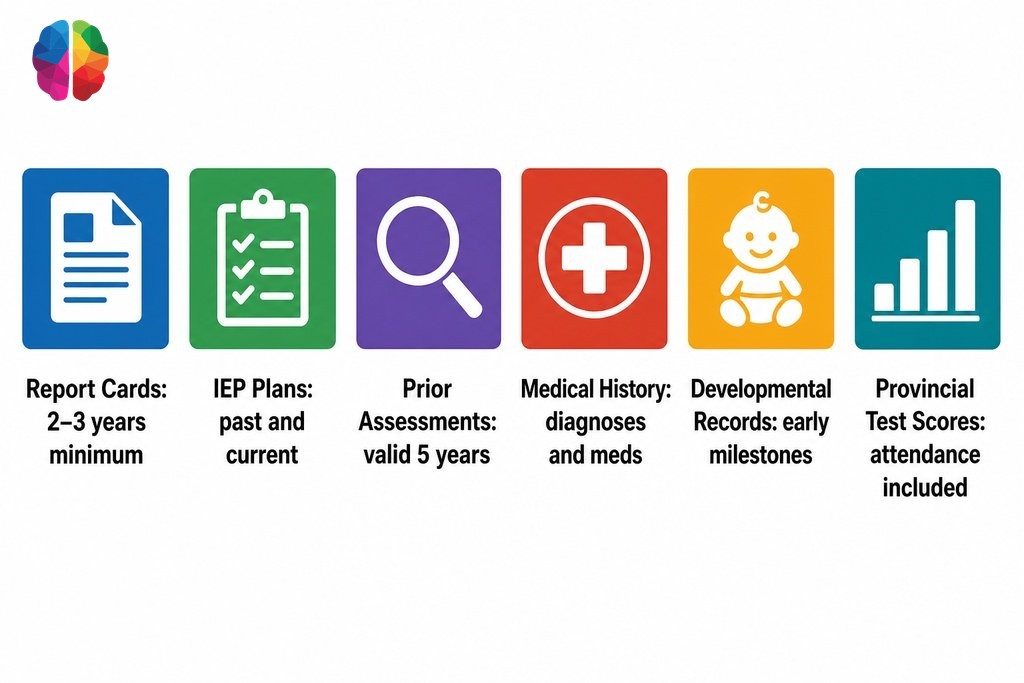
The documents most commonly requested for a psychoeducational assessment include report cards and teacher comments from at least two to three years, Individual Education Plans or school support plans, previous psychological or therapy assessments, medical history and current or past medications, early developmental records, and standardised provincial test scores and attendance records.
Not every family will have all of these on hand, and that is completely normal. Bring what you have, and communicate openly with your assessor about any gaps.
Why Document Preparation Matters Before an Assessment
Background information gathered before the assessment, including developmental history, school records, and prior diagnoses, is essential to interpreting test results accurately. According to the Ontario Psychological Association, a comprehensive psychoeducational assessment should evaluate cognitive abilities, assess academic achievement using standardised tools, and identify evidence-based supports. All of these require strong documentation from multiple sources. No single document tells the whole story, but together they allow the assessment team to build a reliable picture of how your child learns.
Arriving well-prepared also protects your investment of time and money. In BC, psychoeducational assessments are not covered under the Medical Services Plan for the psychoeducational component, and private assessments tend to be quite costly. When assessors have thorough records from the start, fewer follow-up sessions are typically needed, and the resulting report is more likely to meet the documentation standards required by BC schools and post-secondary institutions such as UBC, SFU, and BCIT.
Report Cards and Teacher Comments
Report cards offer a longitudinal view of your child's academic progress that standardised tests alone cannot replicate. Assessors look for patterns across grades, not just current performance. Subject-specific struggles that appear consistently over multiple school years carry more diagnostic weight than a single difficult semester.
Teacher comments are especially valuable because they capture observations about focus, effort, organisation, social engagement, and classroom behaviour. These are details that never appear in numerical scores. Gathering report cards from at least the past two to three years gives the psychologist enough breadth to identify meaningful trends. If your child has recently changed schools, for example moving between districts in the Fraser Valley or transitioning from a public school to an independent school in Metro Vancouver, collect records from both institutions.
IEP Documents and Previous School Support Plans
If your child has an Individual Education Plan or has previously received school-based support, bring those documents to the assessment. In BC, IEPs are developed collaboratively by school teams and are a key part of how the school system identifies and supports students with diverse learning needs. These documents reveal what accommodations and learning goals have already been identified, which interventions were tried, and how your child responded.
This context shapes the recommendations from a new assessment. An assessor who knows what has already been attempted can suggest next steps rather than repeating ground already covered. If the IEP is current, it also signals which school-identified concerns are still active.

Previous Assessment Records and Outside Evaluations
If your child has ever received a speech-language, psychological, or occupational therapy evaluation, those reports are among the most valuable documents you can bring. They help assessors track how your child's profile has changed over time, prevent unnecessary duplication of testing, and offer professional observations that go beyond what parents or teachers may have noted.
Many institutions require psychoeducational reports to be no more than five years old to remain valid for accommodation purposes, a threshold common at BC post-secondary institutions as well. If an earlier report exists but is approaching that limit, a new assessment can build on it rather than starting from scratch, potentially reducing the overall scope of testing required.
Medical History and Developmental Background
A child's learning profile does not exist in isolation from their health history. Bringing a summary of your child's medical background, including birth history, hearing or vision screening results, known diagnoses, and current or past medications, allows the psychologist to consider whether physical or neurological factors may be influencing academic performance. Hearing and vision concerns in particular are routinely checked because they can mimic or contribute to learning difficulties if left unaddressed.
Early developmental milestones are equally relevant. When your child first walked, spoke their first words, or reached social and motor milestones can point to patterns that explain current challenges or strengths. If you have a baby book, early health records from your family doctor or BC paediatrician, or notes from your child's first years of school or daycare, those are worth including. A brief written summary you prepare yourself can also give the assessor useful context.

School Records That Support Placement and Accommodation Decisions
When an assessment is being pursued specifically for school placement or accommodations, certain additional records become especially relevant. Standardised provincial test scores, attendance records, and classroom observation notes from resource teachers or learning support staff all speak the language that admissions coordinators and resource teachers look for when reviewing an assessment report.
According to best-practice guidelines from the American Psychological Association, selection of appropriate assessment measures and thorough documentation of background history are foundational components of any ethical and competent psychological evaluation. When your child's school records reflect a consistent history of challenge in specific areas, the resulting recommendations tend to carry more credibility with district student services teams, independent school admissions offices, and post-secondary accessibility centres in BC.
What Happens to Your Documents During the Assessment
Once you submit your records, they become part of a structured intake and review process. At All Brains Clinic, a multidisciplinary team that includes psychologists and other specialists reviews submitted records as part of a comprehensive evaluation, rather than relying on any single source. Your documents provide the historical context that allows standardised test results to be interpreted meaningfully.
After the assessment is complete, All Brains Clinic's post-assessment support sessions give families a dedicated opportunity to review findings with the clinical team, ask questions about how specific records informed the results, and understand what the recommendations mean in practical terms for school placement or accommodations. This step is included as part of the clinic's commitment to comprehensive care, so no family leaves uncertain about what the report says or what to do next.
What to Do If Some Documents Are Missing
Many families arrive without a complete record set, and this is more common than you might expect. School files can be lost during transitions, early IEPs are not always retained, and older assessments may have been conducted through providers who are no longer reachable. None of these gaps make an assessment impossible. Assessors are trained to work with partial information and to note where records are unavailable, rather than treating their absence as a barrier to a valid evaluation.
If you realise a document is missing before your appointment, here are some practical starting points:
Even if you can only gather a portion of what is listed here, communicate openly with your assessor about what is and is not available. The clinical team at All Brains Clinic approaches every family's situation with flexibility and understanding, recognising that every journey is unique. If you have questions to ask before a learning assessment, or want guidance on how to prepare for a psychoeducational assessment specific to your child's needs in BC, reaching out directly to the clinic before your appointment is always encouraged.
Frequently Asked Questions About Psychoeducational Testing in BC
What is the most important document to bring to a psychoeducational assessment in BC?
Report cards from the past two to three years are among the most valuable documents because they show patterns in academic performance over time. Combined with teacher comments and any existing IEPs, they give the assessing psychologist the historical context needed to interpret standardised test results accurately.
Can a psychoeducational assessment proceed if I don't have all the documents?
Yes. Assessors are trained to work with incomplete records and will note gaps in their report rather than refusing to proceed. Bring whatever you have and inform your assessor about what is missing. The evaluation can still yield valid and useful results.
How far back should school records go for a psychoeducational assessment?
At minimum, two to three years of report cards and teacher comments are recommended. If earlier IEPs or school support plans exist, include those as well. A longer record history helps identify persistent patterns rather than isolated difficulties, which strengthens the diagnostic picture.
Are psychoeducational assessments covered by BC's Medical Services Plan?
The psychoeducational component of an assessment is not covered under BC's Medical Services Plan, so most private assessments involve an out-of-pocket cost. Some families may have partial coverage through extended health benefits. It is worth checking your plan before booking.
How long does a psychoeducational report remain valid for accommodations in BC?
Most BC post-secondary institutions and many school programmes require assessments to be no more than five years old. If an existing report is approaching that threshold, a new assessment can build on the earlier findings, potentially reducing the scope and time required.
Who can I contact to retrieve missing school records in BC?
Contact your child's current or former school first. If the school cannot locate the records, reach out to the BC school district's student services or special education department. For medical history, your family doctor or paediatrician can usually provide a summary letter covering diagnoses, medications, and developmental notes.

Dr. Ali Eslami, Chief Editor
Dr. Ali Eslami is a child psychiatrist at BC Children’s Hospital and All Brains Clinic with a PhD from Brown University. With expertise in neurodevelopmental disorders, autism assessment, and AI research in mental health, he ensures every article meets the highest standards. His sharp editorial eye guarantees clarity, accuracy, and credibility in all our content.


