
.svg)
.png)


.png)


.svg)


.svg)

Choosing the right moment to pursue a psychoeducational assessment is one of the most consequential decisions a family can make when a child is struggling at school or facing a major educational transition. Age matters — but it is only one piece of the picture. The child's developmental stage, the specific concerns driving the referral, upcoming school deadlines, and the type of recommendations the family needs all shape whether a given assessment will produce results that are accurate, actionable, and accepted by schools.
Understanding how to choose a psychoeducational assessment that fits your child's current stage — and your family's actual timeline — begins with understanding why timing affects what results can tell you in the first place.
Why Timing Affects What Assessment Results Can Tell You
Standardized psychoeducational tools measure a child's abilities relative to age-matched peers. When a child is very young, cognitive and language skills are still developing rapidly, so scores captured at one point can shift considerably within a year or two. A profile that looks one way at age five may look quite different at age seven, once formal literacy instruction has begun and academic demands have increased.
Earlier is not always better. Testing before skills have had a chance to emerge through formal schooling can produce results that are inconclusive or difficult for schools to act upon. Equally, waiting too long means a child spends years without the support they need. The goal is to find the window where the concerns are clear enough to measure, the tools are reliable enough to produce a valid profile, and the results are timely enough to drive real change in the child's educational plan.
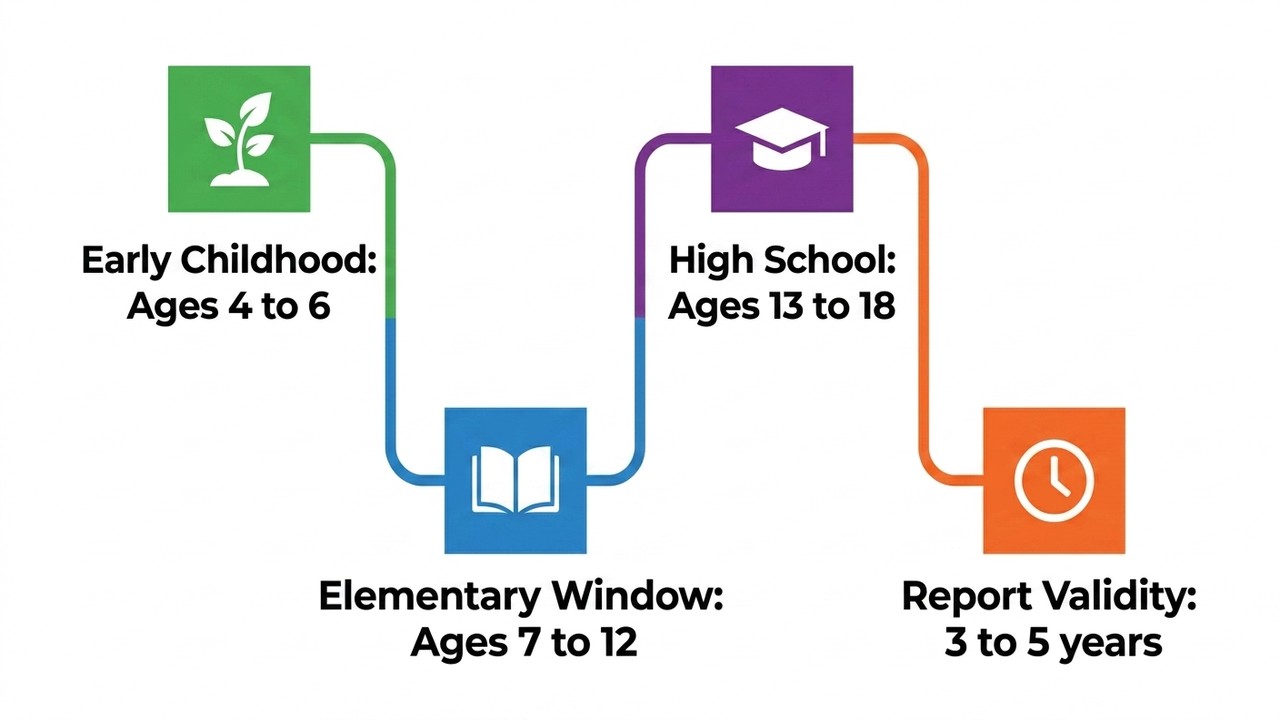
Early Childhood (Ages 4 to 6): Is It Too Early?
Families who notice significant developmental differences in preschool-aged children often wonder whether formal evaluation is worthwhile at this stage. In most cases, a full psychoeducational assessment at this age will not produce a definitive learning profile the way later testing can. However, early evaluation still serves an important purpose: it identifies areas that warrant closer attention, early support, or monitoring before a child enters formal schooling.
What Early Evaluations Typically Cover
For children under age six, a developmentally appropriate evaluation covers five core domains rather than relying on academic skill measures alone: emotional development, social development, cognitive development, language development, and motor development. Assessing across all five areas gives clinicians a holistic picture of how a young child is progressing relative to developmental norms.
When Early Results Are Reliable Enough to Act On
Certain concerns justify pursuing evaluation before school entry, regardless of age. Significant speech and language delays, early differences in social communication, or notable gaps in motor readiness can all lead to recommendations that genuinely improve a child's trajectory — such as early intervention services, speech-language therapy, or occupational therapy support.
Results from this window are best understood as a starting point rather than a conclusion. Acting early, when there are clear signs of difficulty, is generally better than waiting.

Elementary School (Ages 7 to 12): The Most Reliable Testing Window
For most children, the middle elementary years represent the most diagnostically productive window for a learning assessment for elementary students. Between ages seven and ten, children are expected to read fluently, write in paragraphs, and follow increasingly complex instructions. These academic demands create conditions where learning differences — in reading, processing speed, working memory, or written expression — become observable, measurable, and distinct enough for standardized tools to capture reliably.
This age range also aligns well with school placement decisions, IEP eligibility reviews, and formal accommodation requests. According to the University of Waterloo's Centre for Mental Health Research and Treatment, comprehensive psychoeducational assessments are designed for children and adolescents aged 6 to 16 — reflecting the evidence-informed age boundaries used in academic clinical settings across Canada.
Aligning Assessment Timing With Vancouver School Deadlines
Families in Vancouver pursuing assessment to support school applications or programme transitions need to be strategic about timing. Most private and independent school admissions cycles in British Columbia run from fall through early spring. As a general guide:
- Begin the assessment process three to six months before any application deadline.
- Aim to have a completed report before a school transition, not after.
- For elementary-to-secondary transitions, earlier is almost always better.
Having a report in hand before the transition gives schools the information they need to plan appropriate support from day one. This applies whether your child is moving from a neighbourhood elementary school into a Vancouver secondary programme, applying to an independent school, or transitioning into a gifted or specialist programme within the Vancouver School Board.
High School (Ages 13 to 18): What Changes in Adolescence
Adolescence brings its own distinct considerations for a learning assessment for high school students. By the secondary school years, self-report measures become more valid and informative, diagnostic clarity around ADHD and processing difficulties tends to increase, and students can participate meaningfully in the assessment process. A teenager's full learning history and compensatory strategies can also be analyzed together, producing a richer and more actionable profile.
The Post-Secondary Shelf-Life Problem
There is an important practical consideration at this stage. Post-secondary institutions across Canada — including universities and colleges in British Columbia — typically require psychoeducational assessment results to have been completed within three to five years when students apply for academic accommodations. This means an assessment completed in Grade 10 or 11 may not remain eligible for accommodation applications by second or third year of university. Families and students should factor this window into their planning rather than treating an adolescent assessment as a permanent document.
When Is a Child Ready for Learning Disability Testing?
The Ontario Human Rights Commission's Right to Read Inquiry Report addresses this directly:
"It is not necessary or appropriate to wait until Grade 3 to refer them for psychoeducational assessment, although this is a common belief and practice. The student's lack of response to an intervention, not their age, maturity or developmental level, is the information that should trigger decision-making around assessment." — Ontario Human Rights Commission, Right to Read Inquiry Report
A child's unmet needs matter more than any single age threshold. Signs that assessment may be needed now — regardless of age — include persistent reading difficulties that have not responded to school support, unexplained gaps between apparent ability and academic output, teacher referrals or formal concerns, significant anxiety around schoolwork, and an upcoming programme change that requires formal documentation of learning needs.
These patterns are not a diagnostic checklist, and no set of observable signs replaces a professional evaluation. But when they persist over time despite reasonable support, consulting a qualified professional sooner rather than later is generally in the child's best interest.
What Makes an Assessment Report Accepted by Schools
Not all assessment reports carry equal weight in school settings. For a report to be accepted and acted upon, it generally needs to have been completed recently, use standardized and recognized assessment tools, be authored by a registered psychologist with appropriate credentials, and clearly document the instruments used, scores obtained, and specific recommendations.
The Ontario Human Rights Commission notes that psychoeducational referrals in publicly funded school systems are generally made for students in Grade 3 and older, with many boards requiring Grade 4 before assessing — citing developmental variability as a confounding factor in younger children. For Vancouver families pursuing a private assessment to meet school deadlines, this context explains why proactive action through a qualified clinic is often the most reliable path.
What to Confirm Before Booking a Psychoeducational Assessment in Vancouver
Once your family has decided the timing is right, choosing the right provider comes down to a few key questions: Is the assessment conducted by a registered psychologist? Will the report format meet the specific requirements of the school or programme you are applying to? Are the tools standardized, current, and widely recognized? Does the assessment include a psychiatric evaluation to capture the full picture?
At All Brains Clinic, each psychoeducational assessment includes a full psychiatric evaluation — covered by MSP, British Columbia's public health plan — and is followed by complimentary post-assessment support sessions. These sessions give families the opportunity to review results in detail, ask questions, and leave with a clear plan rather than a report they must interpret on their own.
The clinic's multidisciplinary team of psychologists, psychiatrists, speech-language pathologists, and other specialists collaborates on each case, producing a report that reflects a comprehensive perspective rather than a single clinician's view. When school placement decisions or accommodation applications are on the line — whether for a Vancouver public school, an independent school on the North Shore, or a post-secondary institution in BC — that depth of process makes a meaningful difference.
If you are weighing the right time to pursue an assessment for your child, the team at All Brains Clinic is here to help you think it through. Reach out to start the conversation — every journey is unique, and we are ready to support yours.
Frequently Asked Questions About Psychoeducational Assessment in Vancouver
What is the earliest age a child can receive a psychoeducational assessment?
Children as young as four can receive a developmentally appropriate evaluation, though it will focus on developmental domains rather than academic skills. A full psychoeducational assessment is generally more reliable and actionable once a child is in Grade 1 or 2, when formal learning demands have begun and measurable patterns can emerge.
How long does a psychoeducational assessment take in Vancouver?
Most assessments involve multiple sessions spread over several days or weeks. The full process — including testing, report writing, and a feedback session — typically takes several weeks from intake to final report. Timelines vary by clinic and the complexity of the child's profile.
Does a psychoeducational assessment expire?
Reports do not expire for all purposes, but post-secondary institutions in BC typically require results completed within three to five years for academic accommodation applications. For school-based supports, relevance depends on how much a child has changed since testing and whether the school requests an updated evaluation.
Can a psychoeducational assessment diagnose ADHD or dyslexia?
A psychoeducational assessment can identify patterns consistent with ADHD, dyslexia, or other learning differences and provide a formal diagnosis when conducted by a registered psychologist. At All Brains Clinic, the process also includes a psychiatric evaluation, supporting a more complete and clinically grounded diagnostic picture.
Is a psychoeducational assessment covered by insurance or MSP in BC?
The psychiatric evaluation component at All Brains Clinic is covered by MSP. The broader psychoeducational testing is not typically covered by MSP but may be partially covered by extended health benefits, depending on the plan. Families should confirm coverage details with their provider before booking.
How do I know if my child needs a psychoeducational assessment rather than tutoring?
Tutoring addresses skill gaps; a psychoeducational assessment identifies why those gaps exist. If a child has received consistent academic support but continues to struggle, or if there are unexplained differences between apparent ability and school performance, an assessment can provide answers that tutoring alone cannot.

Dr. Ali Eslami, Chief Editor
Dr. Ali Eslami is a child psychiatrist at BC Children’s Hospital and All Brains Clinic with a PhD from Brown University. With expertise in neurodevelopmental disorders, autism assessment, and AI research in mental health, he ensures every article meets the highest standards. His sharp editorial eye guarantees clarity, accuracy, and credibility in all our content.


