
.svg)
.png)


.png)


.svg)


.svg)
Deciding to seek a psychoeducational assessment for your child is a significant step, one that often comes after weeks or months of weighing your own observations against what teachers are noticing. Finding the right clinic in Vancouver, understanding what the evaluation involves, and making sure the report will open the right doors at school can feel overwhelming without a clear framework.
Asking the right questions before booking is not a sign of distrust toward a provider. It is one of the most important forms of advocacy you can offer your child.
As part of the broader conversation around how to choose a psychoeducational assessment, this article focuses specifically on what families should ask and confirm before committing to a booking, so you can walk into that first conversation with confidence and the right information.
Why Preparation Matters More Than Most Vancouver Families Realize
By the time most families contact a clinic, the emotional weight of the journey is already significant. That investment can sometimes cause parents to move too quickly, accepting a provider before confirming whether the assessment will meet their school or district's specific standards.
Wait times for publicly funded psychoeducational assessments through BC school boards can stretch considerably, which creates real pressure to act fast when a private clinic spot opens up. That urgency is understandable, but it is precisely when preparation matters most. Asking questions before booking is the responsible foundation of a decision that could shape your child's educational experience for years to come.

Key Questions to Ask Before Booking a Psychoeducational Assessment
The questions below cover process, credentials, timelines, and fit. These are the four areas that most directly affect whether an assessment delivers what your child and school actually need.
What Does the Assessment Include?
A psychoeducational assessment evaluates cognitive, academic, and behavioural functioning to identify learning disabilities, ADHD, giftedness, and other exceptionalities. It typically includes standardized tests, clinical observations, interviews, and questionnaires completed by parents and teachers. Understanding this scope helps you ask more targeted questions and signals to the provider that you are an engaged advocate for your child.
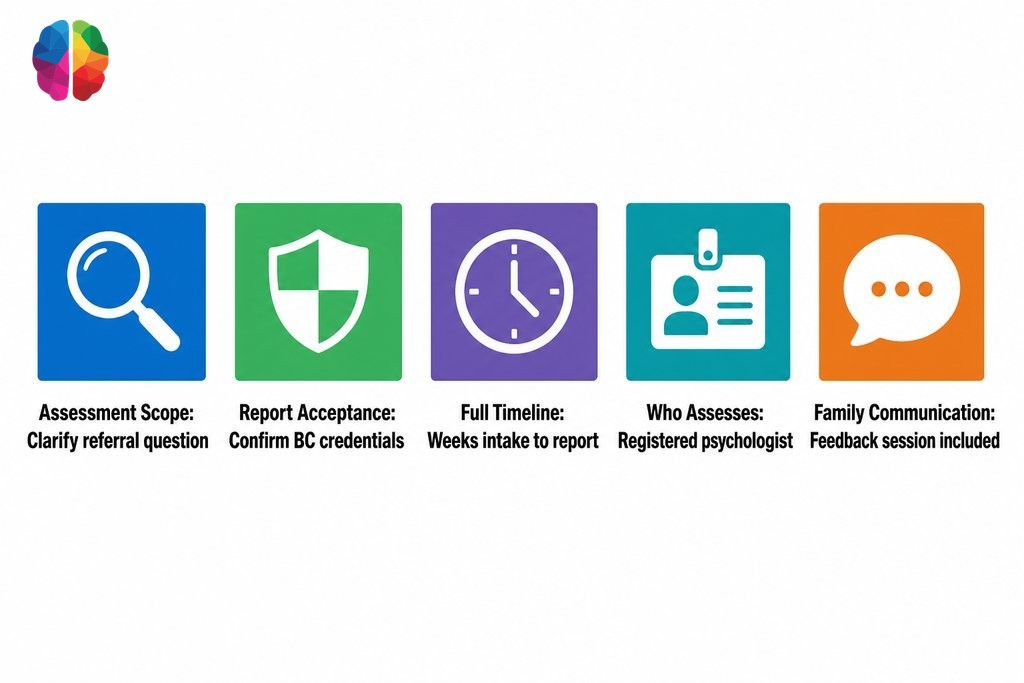
One of the most important things to clarify upfront is the referral question: the specific reason you are seeking the assessment. Whether you are concerned about reading difficulties, attention challenges, or eligibility for accommodations, that question shapes the entire scope of testing. If you are coming through a doctor referral for psychoeducational assessment, your referring clinician may have already framed this, but it is worth confirming that the assessing psychologist agrees before the process begins.
Will the Report Be Accepted by My Child's BC School?
This is one of the most practical questions a family can raise, and one of the most commonly overlooked. A report that does not meet the format or credentialing standards expected by your school district or admissions office will not achieve its purpose, regardless of the quality of the evaluation itself.
Ask the clinic directly whether their reports are accepted by the school or institution you are targeting, and verify the credentials of the psychologist who will be signing the report. In British Columbia, reports submitted for school accommodations must be prepared by a registered psychologist or psychological associate registered with the College of Psychologists of British Columbia. Confirming this at the outset protects your child's timeline and ensures the report meets the standards expected by Vancouver-area schools and the Vancouver School Board.
It is also worth asking whether the clinic uses standardized, professionally validated testing tools. The quality of the examiner's interpretation, and their ability to translate findings into actionable guidance, determines the real-world usefulness of the report. A report built on recognized instruments, interpreted by a qualified professional, and formatted to meet institutional expectations is a document your child will benefit from throughout their school career.
How Long Will the Full Process Take?
Timelines are critical, particularly for families working against school placement or accommodation review deadlines. Ask the clinic how long the full process takes from intake to report delivery, and be specific about any deadlines you are working with. Key questions to raise include:
- How many sessions are required, and how far apart are they typically scheduled?
- What is the current wait time from booking to the first appointment?
- How long after testing is completed will the written report be ready?
- Can the clinic accommodate a firm deadline if you have one?
If you have a specific admissions or accommodation deadline, for example ahead of a new school year or a Ministry of Education designation review, say so clearly before booking. A transparent clinic will tell you honestly whether they can meet it.
Who Will Conduct and Sign Off on the Assessment?
Who conducts the assessment matters enormously. Ask specifically about the qualifications of the person working directly with your child, and who will be interpreting the results and authoring the report. In some settings, supervised trainees administer portions of testing, with a senior psychologist reviewing the data afterward. Understanding this structure helps you gauge the level of clinical oversight your child's evaluation will receive.
There is also a meaningful difference between an assessment conducted by a single clinician and one that draws on a multidisciplinary team. When psychologists, speech-language pathologists, and other specialists contribute to a child's profile, the resulting picture is more complete, particularly when a child's presentation is complex or when multiple areas of functioning need to be examined together. Ask whether the clinic's model supports cross-disciplinary collaboration, and how those contributions are reflected in the final report.
How Will the Clinic Communicate With Our Family?
An assessment is not just a test. It is a relationship between a clinic and a family. Before booking, ask how the clinic communicates with parents throughout the process:
- Will there be a feedback session after the report is complete?
- Who will explain the findings, and in what format?
- Can you ask follow-up questions after you have had time to read the report?
As Suzanne Pellarin, M.A., Psycho-Educational Consultant at the London Catholic District School Board, has noted: "We want the information in our reports to be helpful throughout their school careers and we encourage parents, teachers and high school students to ask for a review of the assessment report and an update of recommendations at any time." A clinic that treats the report as a living document rather than a finished product is one that genuinely invests in your child's long-term outcome.

What to Prepare Before Your First Appointment
Preparation should start before you even book. Gathering the right materials in advance helps the assessing psychologist understand your child's history and tailor the evaluation accordingly. Consider pulling together:
- Recent school reports and progress notes
- Previous assessment records, if any exist
- Teacher observations or written concerns
- Relevant medical documentation
It is equally important to prepare your child emotionally. Research from the Learning Disabilities Association of PEI confirms that children who understand the purpose and format of psychoeducational testing, and who are reassured that it is not a test they can pass or fail, are better prepared and more likely to engage productively. Framing the assessment as a way of understanding how your child learns best, rather than a measure of their intelligence or capability, sets a tone that benefits both your child and the accuracy of the results.
When to Pause Before Booking
Not every moment is the right moment, and a trustworthy clinic will acknowledge this openly. If your child is currently experiencing significant stress, a recent trauma, or a major life transition, the timing of the assessment may affect the reliability of the results. A short deferral, or a preliminary consultation with a psychologist, may serve your child better than proceeding immediately.
Similarly, if you have not yet received feedback from a teacher, or have not yet explored whether a doctor referral is appropriate, those steps may sharpen the referral question and make the evaluation more targeted.
Watching for red flags when choosing an assessment provider is also part of this stage. A clinic that discourages your questions, cannot explain its process clearly, or is vague about its team's credentials deserves careful scrutiny. The right provider will not only welcome your questions; they will use them as an opportunity to demonstrate transparency and professional rigour.

How to Know You Have Found the Right Vancouver Clinic
When you have found a clinic genuinely suited to your family's needs, several things will stand out:
- The team is transparent about who conducts the assessment, what tools are used, and how the report is formatted.
- They can confirm their documentation meets the requirements of your target school or institution, including Vancouver-area independent schools and public school districts.
- Timelines are discussed openly and realistic expectations are set from the start.
- The clinic treats the post-assessment period as an active part of their commitment to your child, not simply a conclusion to the process.
Questions before booking should feel welcomed, not deflected. A clinic whose process is clearly explained, whose team is collaborative, and whose support extends beyond report delivery reflects genuine investment in each child's journey.
At All Brains Clinic in Vancouver, our multidisciplinary team brings together psychologists, speech-language pathologists, psychiatrists, and other specialists to ensure every assessment produces a complete, actionable profile. Families across Vancouver, including those in areas such as the West Side, East Vancouver, North Shore, and the Tri-Cities, come to us for assessments that meet BC school standards and support lasting outcomes. If you are ready to take the next step, or simply want to ask your questions before deciding, we invite you to reach out and start the conversation with us.
Frequently Asked Questions About Psychoeducational Assessment in Vancouver
What is the difference between a psychoeducational assessment and a psychological assessment?
A psychoeducational assessment focuses on learning, academic achievement, and cognitive functioning to support educational planning. A psychological assessment is broader and may address emotional, behavioural, or mental health concerns beyond the school context. For children with learning or attention difficulties in BC schools, a psychoeducational assessment is typically the relevant evaluation.
How long does a psychoeducational assessment take in Vancouver?
The full process from intake to final report typically spans several weeks. Testing usually involves two to four sessions of two to three hours each, spread across multiple appointments. Report writing and the feedback session add additional time. Families with firm school deadlines should communicate those clearly when first contacting a clinic.
Does my child need a doctor's referral to access a private psychoeducational assessment in Vancouver?
A doctor's referral is not required to access a private psychoeducational assessment in Vancouver. However, a referral from your family physician or pediatrician can help frame the referral question and may be relevant if your child is also being assessed for conditions such as ADHD. Some clinics welcome referrals from teachers or school counsellors as well.
Who is qualified to conduct a psychoeducational assessment in British Columbia?
In BC, assessments accepted by schools must be conducted and signed off by a registered psychologist or psychological associate registered with the College of Psychologists of British Columbia. Always confirm the credentials of the clinician who will author and sign the final report before booking.
Will a private psychoeducational assessment report be accepted by Vancouver public schools?
Generally yes, provided the report is completed by a registered psychologist or psychological associate in BC and meets the documentation standards of the relevant school board. Confirm this directly with the clinic before booking, as format and credentialing requirements can vary by district or institution.
At what age can a child receive a psychoeducational assessment?
Assessments can be conducted with children as young as four or five, though the tools used vary by age. Many families seek assessments during the early elementary years when learning differences first become apparent. There is no upper age limit; adolescents and young adults can also benefit, particularly when pursuing post-secondary accommodations.

Dr. Ali Eslami, Chief Editor
Dr. Ali Eslami is a child psychiatrist at BC Children’s Hospital and All Brains Clinic with a PhD from Brown University. With expertise in neurodevelopmental disorders, autism assessment, and AI research in mental health, he ensures every article meets the highest standards. His sharp editorial eye guarantees clarity, accuracy, and credibility in all our content.


