
.svg)
.png)


.png)


.svg)


.svg)
Choosing between a private and school-based psychoeducational assessment is one of the most consequential decisions a family can make when a child is struggling in school. The path you take shapes how quickly your child receives support, how much information you get, and which doors that information can open. Whether you are exploring options for the first time or weighing a recommendation from your child's teacher, this choice deserves careful thought.
For families in Vancouver and across British Columbia, this decision often arrives at a stressful moment: a child falling behind, an upcoming school transition, or a growing sense that something more is going on beneath the surface. This guide walks you through both pathways honestly, whether you are in Vancouver's west side, the North Shore, Burnaby, or a more rural part of the province, so you can move forward with clarity and confidence.
What Is the Difference Between a Private and School-Based Psychoeducational Assessment?
The core difference comes down to who conducts the assessment, what it covers, how long it takes, and what you can do with the results. School-based assessments are free, conducted by a school psychologist, and focused on determining eligibility for in-school supports. They do not produce a clinical diagnosis. Private assessments are conducted by a registered psychologist outside the school system. They are broader in scope, faster to access, can produce DSM-5 diagnoses, and results remain confidential unless you choose to share them.
Both pathways have real advantages and real limitations. What matters most is matching the right option to your child's specific needs, your timeline, and your family's circumstances.
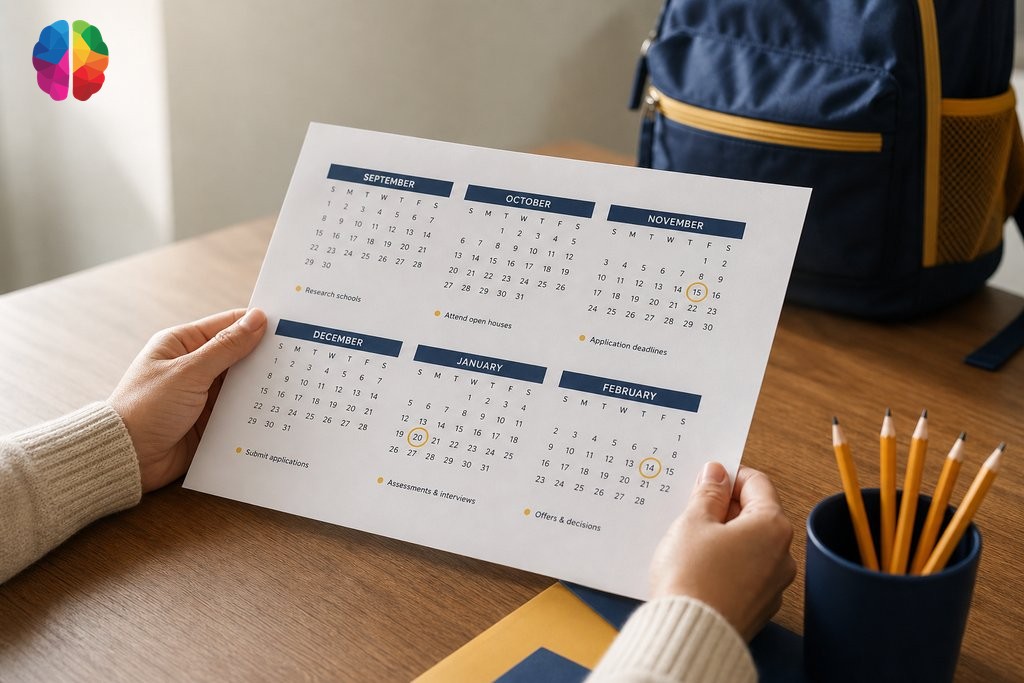
How School-Based Psychoeducational Assessments Work in BC
A school-based psychoeducational assessment is initiated through the public school system and conducted by a school psychologist employed by the school district. In British Columbia, parents can request this assessment without waiting for a teacher referral, though referrals from school staff are a common starting point. Once a referral is in place, a school team reviews whether the student meets criteria, typically requiring documented evidence of academic difficulties affecting classroom functioning.
The process is free, which makes it an important option for families without access to private funding. However, wait times are a significant challenge across BC school districts. Families in many districts, including the Vancouver School District and surrounding areas, regularly face lengthy delays. In some cases, the wait extends to 18 months.
What a School Assessment Covers
School-based assessments typically evaluate cognitive abilities, academic achievement in reading, writing, and math, and in some cases processing speed and working memory. Results are used to determine eligibility for special education services and classroom accommodations. However, a school psychologist cannot provide a formal clinical diagnosis such as ADHD or a learning disability under DSM-5. If a diagnosis is needed for external services, insurance, or medical referrals, a school report alone will not be sufficient.
Who Controls the Results
Results from a school-based assessment become part of your child's official education record within the BC school system. School staff involved in your child's education can access the information, and it is retained within the school district's records. Parents receive a copy and should be offered a meeting to review findings, but the data is not fully under parental control in the way a private report is.
What a Private Psychoeducational Assessment Offers
Private assessments are conducted by registered psychologists in clinical or multidisciplinary settings. The scope is broader and can be tailored to the specific questions your family needs answered.
As Dr. Ellen Braaten, Associate Professor of Psychology at Harvard Medical School and Executive Director of the Learning and Emotional Assessment Program at Massachusetts General Hospital, explains: "A psychoeducational battery commonly includes an IQ test, academic achievement testing, and sometimes subject-specific tests that look at reading, writing, or math. With this kind of battery, I might use these tests to answer the question of does a child have a learning disability, or slow processing speed, or trouble with working memory."
In a private setting, this battery can also extend to assess for ADHD, social-emotional functioning, language development, and other areas, all within a single coordinated evaluation.
Key Advantages of Private Testing
Private assessments offer four meaningful benefits over the school-based pathway. They can yield DSM-5 diagnoses, which school evaluations cannot provide. Results are shared only with your consent, giving you full control over who receives the information. Access timelines are typically 2 to 6 weeks, compared to waits of up to 18 months in some public systems. Multiple areas of concern can also be assessed together, rather than through separate evaluations spread across months or years.
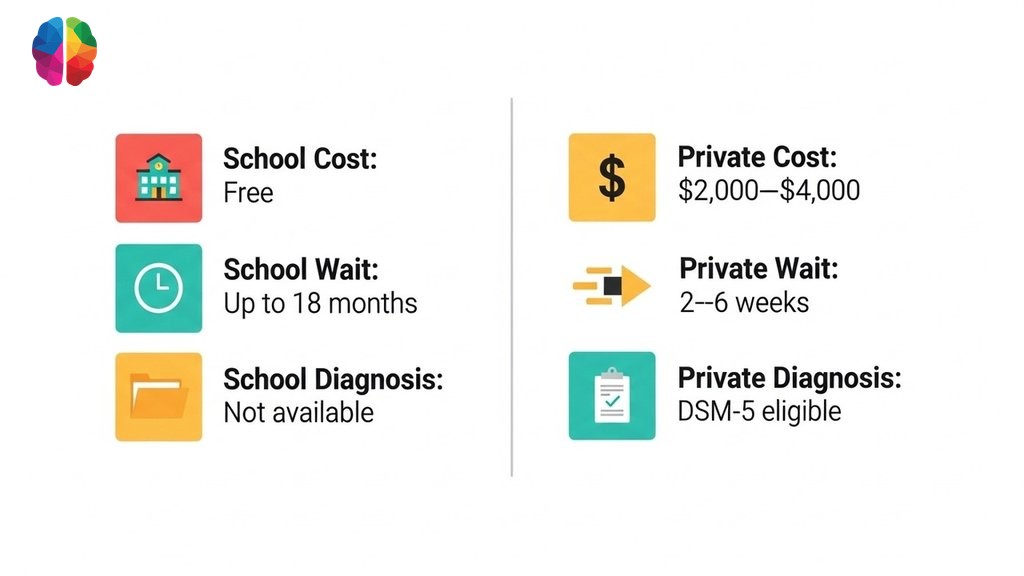
Comparing Wait Times: BC Public vs Private Pathways
Timing is one of the most practical differences between the two pathways. For families with placement or admissions deadlines, it is often the deciding factor. Public school-based assessments in BC can involve wait times of up to 18 months in some districts. For a child approaching middle school, applying for a gifted programme, or needing documentation before the next school year begins, that wait may not be viable.
Private assessment wait times are typically 2 to 6 weeks. Costs generally range from $2,000 to $4,000, depending on the clinic and location. Some extended health benefit plans in BC may offset a portion of those costs, and university-based psychology training programmes sometimes offer lower-cost alternatives.
You can also explore the full advantages and limitations of private testing to help weigh this decision alongside the current school psychoeducational assessment waitlist situation in your area.
Will a Private Assessment Be Accepted by Vancouver Schools?
Many schools and admissions teams in Vancouver and across BC accept private psychoeducational assessment reports, particularly when conducted by a registered psychologist using recognized standardized tools. However, some school districts require their own psychologists to review private reports before implementing recommended accommodations. This means that even with a strong private report, there may be an additional internal process before your child receives school-based support.
To minimize complications, any private assessment should use standardized instruments recognized within BC school systems, clearly link findings to practical and school-relevant recommendations, and be formatted in a way that aligns with how BC schools document and plan supports, rather than being written primarily for clinical or medical audiences.
Questions to Ask Before Choosing a Provider in BC
Before committing to a private assessment provider, it is worth confirming the following:
- Is the assessor a registered psychologist with experience in pediatric psychoeducational evaluation?
- Which standardized tools are used, and are they recognized within BC school systems?
- What is the expected turnaround time from first appointment to receiving the written report?
- Is post-assessment support included, such as a review meeting to discuss findings and recommendations?
- Does the clinic have experience preparing reports used for school placement or accommodation requests in BC?

When a Multidisciplinary Assessment Makes Sense
Some children present with concerns that span more than one area of development. A child struggling with reading may also show signs of attention difficulties, language processing challenges, or social communication differences. When multiple concerns exist, a single-discipline evaluation may answer one question while leaving others unresolved, sending families back into the system for additional assessments over months or years.
A team-based approach, where psychologists, speech-language pathologists, and other relevant specialists evaluate the child together within a coordinated process, produces a more complete picture in far less time.
This is the model at All Brains Clinic in Vancouver, where specialists across psychology, speech-language pathology, and related disciplines collaborate on each assessment. Rather than managing multiple separate appointments with providers who may never communicate with one another, families in Vancouver and the broader Lower Mainland receive a unified evaluation that addresses the full range of their child's needs. Each assessment also includes a full psychiatric evaluation covered by BC's Medical Services Plan, along with complimentary post-assessment support sessions, so families understand the results, receive a personalised plan, and have clear guidance for next steps.
Learn more about how to choose a psychoeducational assessment that fits your child's needs.
Choosing the Right Pathway for Your Child
Choosing between school-based and private assessment depends on four key factors: whether your child is approaching a placement deadline or school transition; whether your child has multiple overlapping needs that a single evaluation should address; whether you need a formal clinical diagnosis for external services or medical purposes; and whether your family can access private funding, extended health coverage, or subsidised options available in BC.
If your child is far from an academic transition and the concern is relatively contained, the school pathway may be appropriate, provided the wait time does not cause significant harm in the meantime. If your child is approaching a placement deadline, presents with multiple overlapping concerns, or needs a formal clinical diagnosis, a private assessment is likely the more responsive option.
Whatever path you choose, treat the results as a starting point, not a final label. A psychoeducational report describes your child's profile at a particular moment and provides a roadmap for support. The findings should be reviewed with qualified professionals who can help you understand what they mean in practical terms and how to act on them effectively.
At All Brains Clinic in Vancouver, that guidance is built into the process. If you are ready to explore your options or simply want to ask a few questions before deciding, our team is here to help.
Frequently Asked Questions About Psychoeducational Assessment
Can a school-based psychoeducational assessment diagnose ADHD or a learning disability?
No. School psychologists in BC cannot provide formal clinical diagnoses under DSM-5. A school assessment determines eligibility for in-school supports and accommodations, but it does not constitute a medical or psychological diagnosis. If a diagnosis is required for external services, medication referrals, or insurance purposes, a private assessment by a registered psychologist is necessary.
How long does a private psychoeducational assessment take in Vancouver?
Most private assessments in Vancouver have intake timelines of 2 to 6 weeks from initial contact to the first appointment. The full process, including testing sessions, scoring, report writing, and a feedback meeting, typically takes several weeks in total. This is considerably faster than public school waitlists, which can extend to 18 months in some BC districts.
How much does a private psychoeducational assessment cost in BC?
Private psychoeducational assessments in BC typically cost between $2,000 and $4,000, depending on the clinic, scope of evaluation, and location. Some extended health benefit plans offer partial reimbursement for psychological services. University-based psychology training clinics may offer reduced-cost alternatives, though wait times can vary.
Will a private assessment report be accepted by my child's school in Vancouver?
Many Vancouver and BC schools accept private psychoeducational reports, particularly those produced by registered psychologists using standardized tools. Some districts require an internal review before implementing accommodations. To improve acceptance, ensure the report includes school-relevant recommendations formatted in a way BC educators can apply directly to classroom planning.
At what age should a child have a psychoeducational assessment?
Assessments can be conducted from early childhood onward, though they are most commonly sought during the school years when learning difficulties become more apparent. There is no single right age. The appropriate time depends on the child's concerns and circumstances. Earlier assessment generally allows for earlier support, which can meaningfully reduce the impact of unaddressed learning differences.
What is the difference between a psychoeducational assessment and a psychological assessment?
A psychoeducational assessment focuses on learning-related abilities, including cognitive functioning, academic achievement, processing skills, and how these affect school performance. A psychological assessment is broader and may include social-emotional functioning, mental health, personality, or diagnostic evaluation for conditions beyond learning. In practice, private assessments often combine both elements within a single evaluation.
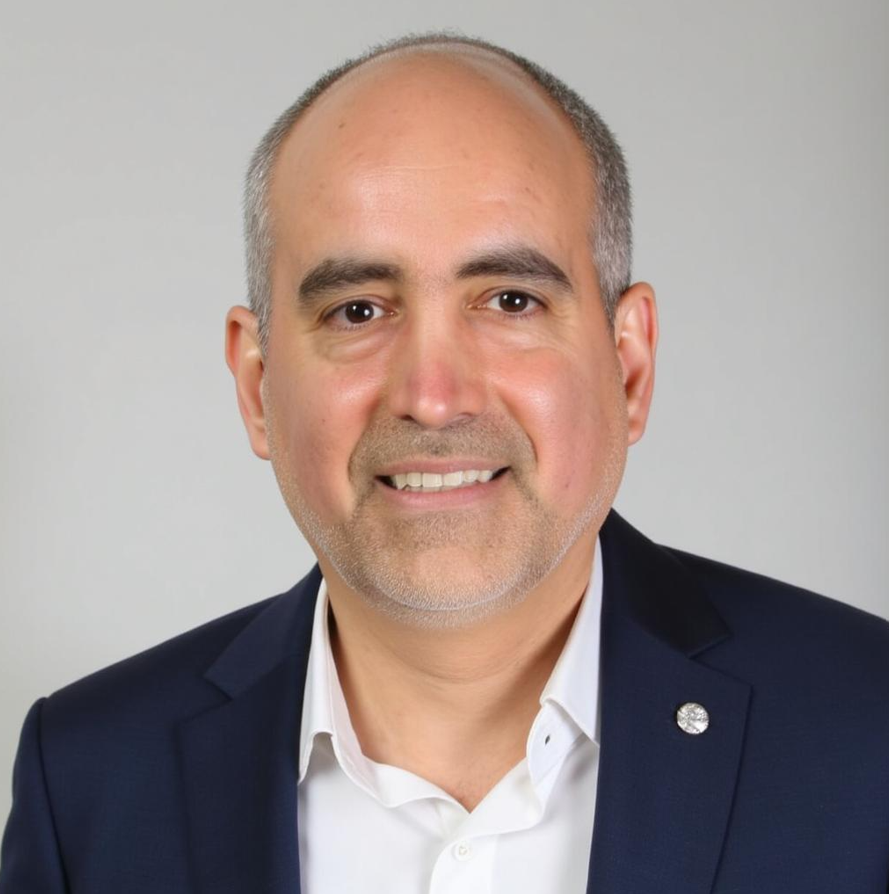
Dr. Ali Eslami, Chief Editor
Dr. Ali Eslami is a child psychiatrist at BC Children’s Hospital and All Brains Clinic with a PhD from Brown University. With expertise in neurodevelopmental disorders, autism assessment, and AI research in mental health, he ensures every article meets the highest standards. His sharp editorial eye guarantees clarity, accuracy, and credibility in all our content.


