
.svg)
.png)


.png)


.svg)


.svg)
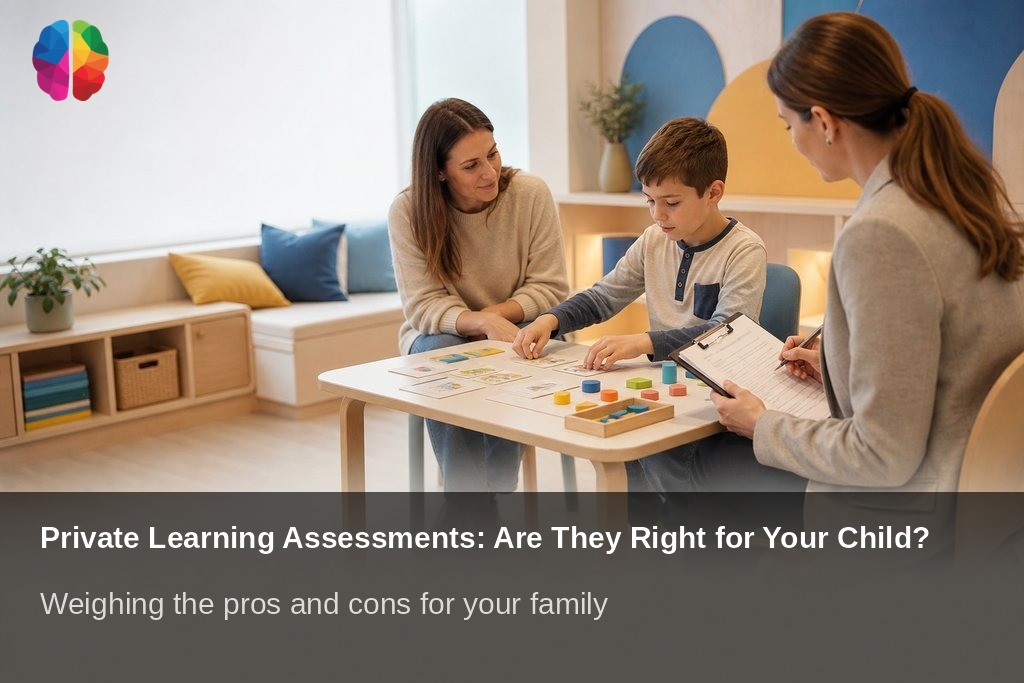
When a child is struggling in school, showing signs of a learning difference, or approaching a key transition, families often face an urgent question: wait for a school-based evaluation, or pursue a private learning assessment? Understanding the real pros and cons of private learning assessments is essential before committing to either path. The right answer depends on your child's specific situation, your timeline, and what you need the results to accomplish.
This guide helps families across Vancouver and the broader Metro Vancouver region think through that decision clearly, with realistic expectations on both sides. Whether you are planning for school admissions, seeking accommodations, or building a fuller picture of your child's learning profile, the information here will help you move forward with confidence.
What Is a Private Learning Assessment?
A private learning assessment, often called a psychoeducational assessment, typically includes standardized cognitive and academic testing, clinical interviews with the child and caregivers, behavioral rating scales, and a comprehensive written report. The process is designed to show how a child thinks, learns, processes information, and performs across academic areas.
Depending on the provider and the child's needs, the assessment may also include speech and language evaluation, social-emotional screening, or motor development observation.
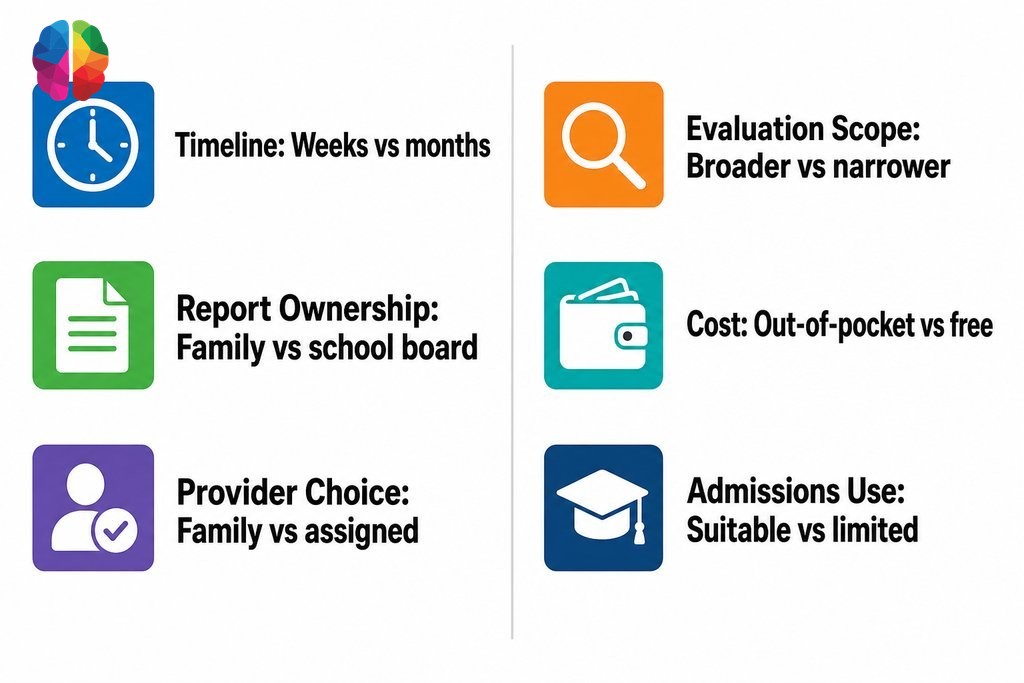
The key difference between a private psychoeducational assessment and a school-based screening is depth and independence. School assessments are generally narrower in scope, designed to determine eligibility for specific services rather than to explore a child's full learning profile. A private evaluation is conducted by registered psychologists or a multidisciplinary team, and the resulting report belongs to the family, not the school board. That distinction matters significantly when families are navigating school placement or requesting accommodations across multiple institutions.
Advantages of Private Learning Assessments
Faster Timelines
One of the most important advantages of a private assessment is timeline control. Families can often schedule evaluations within weeks rather than waiting months through the public system. This matters most when a child needs supports in place quickly mid-year, or when a family is working toward an admissions deadline at a Vancouver independent or private school.
More Comprehensive Learning Profiles
Because private assessments are not limited by school board eligibility criteria, assessors can explore a wider range of cognitive, developmental, and emotional factors. This is especially valuable for children whose challenges are subtle or who have needs across more than one area. Children with dyslexia, ADHD, dysgraphia, or dyscalculia often benefit from assessments that identify specific processing differences that standard school-administered testing may miss.
Family Ownership of the Report
The assessment report belongs to the family. It can be shared with independent schools, therapists, or other providers and used across multiple settings without going through a school board's internal process first.
Choice of Provider
Families can select a provider whose approach fits their child's specific needs. School referral pathways rarely offer this flexibility.
Admissions-Ready Documentation
Private schools, independent programs, and specialized educational settings across Vancouver and the Lower Mainland commonly require standardized assessment results as part of their intake process. Admissions deadlines rarely align with public system waitlists. A private assessment allows families to obtain results, review findings, and submit documentation on a schedule that fits their child's admissions cycle rather than a school board's administrative queue.
Limitations of Private Learning Assessments
Cost
The financial cost of a private psychoeducational assessment is a genuine barrier for many families. Fees in Vancouver and across British Columbia vary considerably depending on the provider, the scope of the evaluation, and whether a psychiatric component is included. Understanding what is and is not covered before committing is essential.
Uneven Report Quality
Not all private assessment reports are equal. A well-constructed report uses recognized standardized tools, documents methodology clearly, and includes actionable recommendations tied to specific educational needs. Reports that lack these elements may not be accepted or acted upon by a BC school board.
No Guarantee of School Action
A private assessment report does not automatically result in a school placement decision or guaranteed accommodation. Schools review reports through their own processes, and families may still need to advocate for the recommendations to be implemented.
A Snapshot, Not a Final Answer
A single assessment captures one moment in a child's development. It should always be paired with thoughtful follow-up and ongoing observation rather than treated as a definitive statement about a child's potential or long-term trajectory.

Public vs. Private Testing in Vancouver: How to Decide
Choosing between public and private testing depends on several variables: your child's age and current level of urgency, whether a diagnosis already exists, what you hope to learn from the process, what the results need to accomplish, and how long you have already been waiting through the school system.
If accessing school board services is the primary goal and the timeline is not pressing, a Vancouver School Board or Surrey School District referral may be a reasonable starting point. However, if your child is approaching a critical transition, has complex or overlapping needs, or if your family has already been waiting on the school psychoeducational assessment waitlist without resolution, a private assessment is often the more practical and effective path.
It is also worth acknowledging the equity dimension honestly. Access to private assessments is shaped by financial resources, and Vancouver families should explore provincial funding programmes, extended health benefits, and subsidised clinic rates before assuming private assessment is out of reach.
Questions to Ask Before Choosing a Private Assessment Provider
To protect the value of your investment and ensure the report will be accepted by your child's school, ask these questions during any initial consultation:
- What are the assessor's credentials and registration with a provincial regulatory body?
- Which standardized tools are used, and are they current and normed for your child's age group?
- Is a psychiatric evaluation included, and is any portion covered by MSP or extended benefits?
- What does post-assessment support look like, and how are findings communicated to the family?
- Does the clinic have experience producing reports accepted by BC school boards?

Costs and Coverage for BC Families
Families in Vancouver and across British Columbia face a specific set of considerations. Provincial funding for private assessments exists in some circumstances, particularly for children with an autism spectrum disorder diagnosis, though eligibility varies. MSP does not typically cover psychoeducational testing itself, but it may cover a psychiatric component if one is included. Confirming this with your provider before starting can meaningfully reduce out-of-pocket costs.
It is also important to confirm that a private clinic's methodology and reporting standards meet the expectations of BC school boards and independent schools. A high-quality assessment report should use tools recognised by Canadian educational institutions, document the assessor's methodology transparently, and provide recommendations that school teams can realistically implement.
Why a Multidisciplinary Assessment Produces Better Results
One of the most meaningful differences between assessment providers is whether the evaluation draws on a single discipline or a coordinated team. A multidisciplinary assessment, involving psychologists, speech-language pathologists, and where relevant, occupational therapists or psychiatric clinicians, produces a more integrated and accurate picture of a child's strengths and challenges. When professionals with different training observe and interpret the same child's performance, the conclusions tend to be more nuanced and more useful for building a strong educational plan.
At All Brains Clinic, this integrated approach is central to every assessment. The clinic's team of psychiatrists, psychologists, speech-language pathologists, kinesiologists, and other specialists collaborate on each case. Every assessment includes a full psychiatric evaluation, a portion of which is covered by MSP, and is followed by complimentary post-assessment support sessions to help families understand the results and translate them into a practical plan.
For Vancouver families in neighbourhoods such as Kitsilano, East Vancouver, North Vancouver, and Burnaby who are weighing whether a private assessment is the right step, that combination of clinical depth and ongoing support goes well beyond a single report. If you are ready to take the next step, reaching out to All Brains Clinic to discuss your child's needs is a strong place to begin.
Frequently Asked Questions About Private Learning Assessments
How long does a private learning assessment take?
Most private psychoeducational assessments involve two to four testing sessions spread over several weeks, followed by report preparation and a feedback meeting. From first appointment to receiving the written report, the process typically takes four to eight weeks, depending on the provider's availability and the complexity of the child's needs.
Will a private assessment report be accepted by BC public schools?
BC public schools review private assessment reports, but acceptance is not automatic. Reports are more likely to be acted upon when they use recognized standardized tools, are written by a registered psychologist, and include specific, implementable recommendations. Choosing a clinic with experience in BC educational contexts improves the likelihood of acceptance.
Is a private psychoeducational assessment covered by insurance or MSP in British Columbia?
MSP does not typically cover psychoeducational testing, but it may cover a psychiatric evaluation if one is included. Some extended health benefit plans offer partial reimbursement for psychological services. Confirm coverage details with your insurer and ask the clinic which components may qualify before starting.
At what age should a child have a learning assessment?
Assessments can be conducted from early childhood onward, though most standardized tools are designed for children aged five and up. Earlier assessment is appropriate when developmental concerns are present. For school-age children, assessments are most useful when consistent academic difficulty is present, when a diagnosis is being explored, or ahead of a school transition.
What is the difference between a school-based assessment and a private psychoeducational assessment?
School-based assessments are typically narrower in scope, focused on determining eligibility for specific school services. Private psychoeducational assessments offer a broader evaluation of cognitive, academic, and emotional functioning. The private report belongs to the family and can be used across multiple settings, whereas school assessments are managed within the school board's own system.
Can a private assessment help with university or exam accommodations?
Yes. A private psychoeducational assessment is commonly used to support accommodation requests at the post-secondary level. Many universities and standardized testing bodies require a recent report from a registered psychologist to approve accommodations such as extended time or alternative testing formats. Requirements vary by institution, so confirm specifics directly with each one.
Dr. Ali Eslami, Chief Editor
Dr. Ali Eslami is a child psychiatrist at BC Children’s Hospital and All Brains Clinic with a PhD from Brown University. With expertise in neurodevelopmental disorders, autism assessment, and AI research in mental health, he ensures every article meets the highest standards. His sharp editorial eye guarantees clarity, accuracy, and credibility in all our content.


