
.svg)
.png)


.png)


.svg)


.svg)

Booking a psychoeducational assessment is a significant step for any family. Understanding your insurance coverage before you commit can save you from financial surprises and unnecessary delays. Many parents in Vancouver and across British Columbia assume their extended health plan will cover most of the cost, only to discover mid-claim that reimbursement is partial, conditional, or requires documentation they never collected. Getting clear answers upfront protects your family's timeline and your budget, especially when school placement or accommodation decisions depend on receiving a completed report by a specific date.
This guide walks you through the right questions to ask, what to expect from your plan, and how to prepare your documentation so your insurance claim moves as smoothly as possible alongside the assessment itself.
Does Insurance Cover Psychoeducational Assessments in BC?
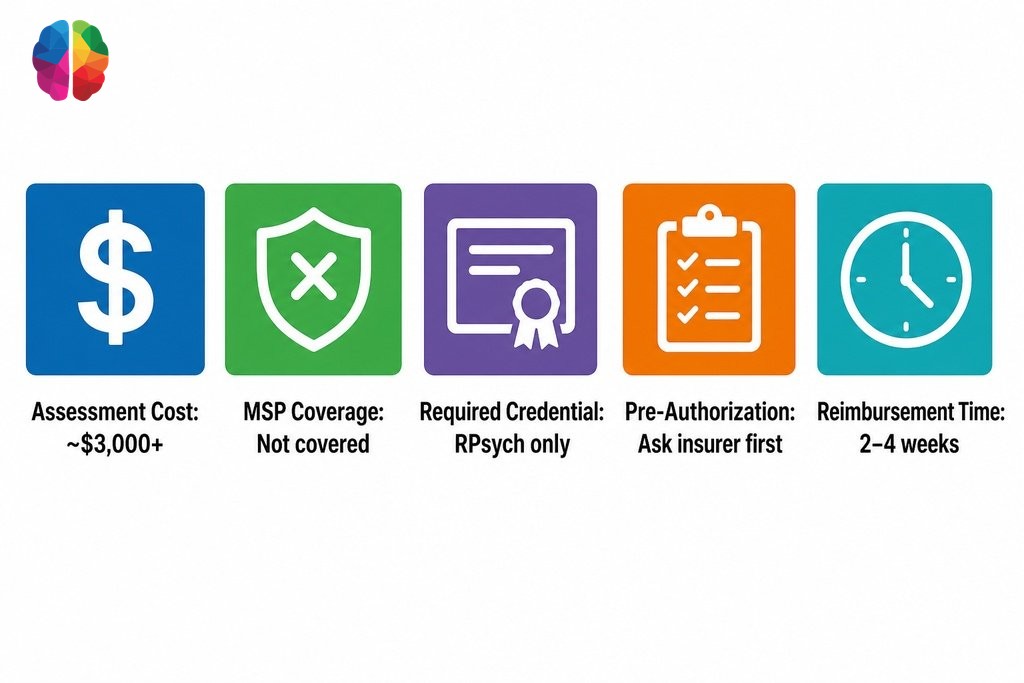
Yes, but not through provincial health insurance. In British Columbia, assessments are not covered by MSP (Medical Services Plan) the way physician visits are. Coverage instead falls under extended health benefits, either through an employer-sponsored group plan or a private plan purchased individually.
The challenge is that extended health benefits vary considerably between providers. Plans that look similar on paper can carry very different rules about what qualifies, who can perform the assessment, and how much gets reimbursed. As noted by Start My Wellness, there is no uniform standard for psychological testing coverage across Canadian insurers. Knowing your actual entitlements requires reading your plan documents carefully and confirming the details directly with your insurer.

Why Insurance Questions Matter Before You Book
Private psychoeducational assessments typically cost around $3,000, according to Special Needs Consultant, with some assessments reaching $3,400 or more. In Metro Vancouver, costs follow a comparable range, making this one of the larger out-of-pocket health expenses a family can face outside a hospital setting. Even partial reimbursement is financially meaningful, which is why asking the right questions before you book is worth the effort.
For families navigating school admissions or accommodation requests, the stakes are even higher. Public school waitlists for assessments through Vancouver School Board or neighbouring districts can stretch from one to three years, according to Special Needs Consultant, which is why many Vancouver families pursue private assessments rather than waiting. If a reimbursement issue surfaces after the assessment is complete, it can delay financial recovery at precisely the moment families are also managing school deadlines. Sorting out coverage questions early means you can focus on your child's needs, not paperwork complications.
Understanding Extended Health Benefits for Psychology Testing
What "Psychology Coverage" Actually Covers
One of the most common misunderstandings families encounter is assuming that psychology coverage automatically includes formal psychoeducational assessments. Many plans use language that covers sessions with a registered psychologist, but are written with therapy or counselling in mind, not multi-session diagnostic testing.
Even when listed under the same benefit, assessments and therapy visits are often treated differently. A plan that covers 80 per cent of psychology fees to a $1,500 annual maximum may still pay out meaningfully if the assessment is structured and billed correctly, but it will not cover the full cost. Before you book, confirm whether your plan's psychology coverage extends to learning evaluations and assessment-type services specifically, rather than just therapeutic sessions.
How Plan Type Affects Your Reimbursement
Group benefits through an employer, individual plans, and family plans each carry their own eligibility rules and annual maximums. Some employer-sponsored group plans offer stronger psychology benefits than individually purchased plans, while others are more restrictive about provider credentials.
Knowing your plan type before you call your insurer matters because some plans allow assessment costs to be legitimately split across two family members' individual psychology benefits, or billed across two calendar years to maximize total reimbursement. These options are only available if you understand how your plan is structured.

Questions to Ask Your Insurance Provider Before Testing
Going into a call unprepared can mean getting incomplete answers that leave you with false confidence. The goal is not just to confirm whether you have psychology coverage. It is to understand exactly how your plan applies to a formal psychoeducational assessment. Before you call, have these questions ready:
- Does my plan cover psychoeducational or psychological assessments, or only therapy and counselling sessions?
- Is a referral from a physician or psychiatrist required before I can submit a claim?
- Does my plan require pre-authorization before the assessment begins?
- What percentage of psychology fees does my plan cover, and what is the annual maximum?
- Are there specific diagnostic codes or medical necessity criteria that must appear on the invoice?
Also ask which provider designations are accepted, for example Registered Psychologist (RPsych) or Doctor of Psychology, and what the deadline is to submit a claim after the assessment date.
Questions About Provider Qualifications
Many insurers will only reimburse assessments conducted by a regulated professional with a recognized designation, such as a Registered Psychologist (RPsych) in British Columbia. If your assessment is conducted by a psychological associate or intern, your insurer may decline the claim entirely, regardless of the quality of the report.
Ask your insurer to confirm exactly which professional designations they accept before you book. It is also worth asking whether the insurer has any formatting or content requirements for the assessment report. Some plans require specific language related to diagnosis or medical necessity in order to process a claim successfully.
Questions About Timelines and Submission Deadlines
For families with school admissions or accommodation deadlines, the claims window and processing time are just as important as the coverage amount itself. Confirm how long you have to submit a claim after the assessment is completed, whether claims can be submitted digitally or must be mailed, and how long processing typically takes once a complete claim is received.
If your school or programme requires the assessment report by a specific date, map that timeline backward. Confirm that the insurance claim can realistically be submitted and processed in parallel with your school deadline, not after it.
What to Document and Request From Your Clinic
Once you have confirmed your coverage details, make sure your assessment provider supplies documentation in the format your plan requires. Most psychology practices in Vancouver do not direct-bill insurers for psychoeducational assessments, meaning families pay upfront and then submit a claim for reimbursement. Collecting the right paperwork from your clinic before you leave is essential.
At minimum, request a detailed invoice that includes the provider's full name, professional designation, and registration number; the date and nature of each session; and the fee for each billable component.
Some insurers also require the assessment report itself, or at least an excerpt confirming the diagnostic purpose of the evaluation. If the report needs to reference specific diagnostic language or medical necessity to satisfy your insurer, discuss this with the clinic's administrative team before the assessment begins, not after the report is finalized. Both schools and insurers sometimes require specific language in reports, and confirming requirements on both ends early avoids having to request amendments later.
What Reimbursement Looks Like in Practice
Full reimbursement is rarely the outcome. Extended health benefits are structured around annual maximums and percentage caps. Factors such as the number of sessions required, the credentials of the professionals involved, and the diagnostic complexity of the case all affect the total bill.
Assessments for recognized neurodevelopmental conditions such as ADHD and autism are more likely to attract partial reimbursement than standalone academic or gifted programme evaluations, because insurers generally apply a medical necessity standard when determining eligibility.
Plan financially for an out-of-pocket portion, and treat any reimbursement as a meaningful but partial offset rather than a full recovery of costs. If you are also exploring funding options for learning assessments beyond your extended health plan, such as government funding streams or school board supports, those avenues operate through entirely different processes and are worth researching separately.

How a Multidisciplinary Assessment Can Affect Your Claim
Comprehensive assessments that involve more than one professional, such as a combined psychiatric and psychological evaluation, are often billed differently than a single-psychologist report. Insurers do not always categorize them under the same benefit line.
At All Brains Clinic, assessments involve a collaborative team of psychiatrists, psychologists, speech-language pathologists, and other specialists contributing to a single, integrated report. This depth of evaluation provides a more complete picture of a child's profile than a single-discipline assessment can offer, but it does introduce billing complexity that families should address with their insurer before the assessment begins.
Ask your insurer specifically how a multi-professional assessment report is categorized for reimbursement, whether each professional's contribution is claimed under a separate benefit, and whether a psychiatry component billed under MSP affects anything else in the claim.
It is worth noting that All Brains Clinic's psychiatric evaluation component is covered by BC MSP as part of British Columbia's public health plan. For Vancouver families, this can meaningfully reduce your out-of-pocket cost relative to a fully private assessment elsewhere. Understanding how each component is treated before you begin helps avoid surprises when the invoices arrive.
Getting Help Navigating Coverage in Vancouver
Plan documents are written in language that can be genuinely difficult to interpret, and a misreading can lead to either missing a valid reimbursement or structuring a claim incorrectly. If your benefit booklet is unclear, speaking with your employer's HR contact or a licensed benefits advisor is a worthwhile step. HR representatives often have direct access to plan administrators and can clarify ambiguities faster than a general insurance helpline.
Your clinic's administrative team can also be a valuable resource. Assessment providers experienced with insurance claims in the Vancouver area can advise on how to structure invoices, which provider details to include, and what supporting materials have helped other families submit successfully. What they cannot do is guarantee approval or predict the exact reimbursement amount, as those decisions rest entirely with your insurance provider.
Approaching coverage navigation as a shared effort between your insurer, your HR contact, and your clinic's admin team gives you the best chance of a smooth, well-supported claim.
If you are ready to take the next step for your child, the team at All Brains Clinic is here to support your family with warmth, clarity, and genuine expertise. Reach out to us to learn more about how our assessment process works and how our administrative team can help you prepare for the insurance process with confidence.
Frequently Asked Questions About Psychoeducational Assessment Insurance
Is a psychoeducational assessment covered by MSP in British Columbia?
No. MSP does not cover psychoeducational assessments. Coverage falls under extended health benefits through an employer-sponsored group plan or a privately purchased plan. However, if your assessment includes a psychiatric evaluation component, that portion may be covered by BC MSP, depending on the clinic and referral pathway.
Do I need a doctor's referral to claim a psychoeducational assessment through insurance?
It depends on your specific plan. Some extended health plans require a physician or psychiatrist referral to establish medical necessity before a claim can be approved. Always confirm this with your insurer before the assessment begins, as obtaining a referral after the fact may not satisfy the requirement.
Which professional designation must the assessor hold for my insurance claim to be valid?
Most Canadian insurers require the assessment to be conducted by a Registered Psychologist (RPsych), regulated in BC by the College of Psychologists of BC. Assessments completed by psychological associates or interns may not qualify. Confirm accepted designations with your insurer before booking.
Can I split assessment costs across two family members' psychology benefits?
Some plans allow this if both family members have individual psychology benefit limits under the same group plan. It depends entirely on how your plan is structured and how the assessment is invoiced. Ask your insurer or HR contact whether cost-splitting across benefit lines is permitted before assuming it is an option.
How long does it typically take to receive reimbursement after submitting a claim?
Processing times vary by insurer. Many extended health claims are processed within two to four weeks when submitted digitally with complete documentation. Claims submitted by mail or with missing information can take longer. Confirm your insurer's typical processing window before finalizing your school or programme deadlines.
What happens if the assessment involves multiple professionals, such as a psychologist and a psychiatrist?
Multidisciplinary assessments are often billed and categorized differently than single-provider reports. Each professional's contribution may fall under a separate benefit line, and some components such as psychiatry may be covered by MSP rather than extended health. Ask your insurer how multi-professional assessments are categorized before the assessment begins.
Dr. Ali Eslami, Chief Editor
Dr. Ali Eslami is a child psychiatrist at BC Children’s Hospital and All Brains Clinic with a PhD from Brown University. With expertise in neurodevelopmental disorders, autism assessment, and AI research in mental health, he ensures every article meets the highest standards. His sharp editorial eye guarantees clarity, accuracy, and credibility in all our content.


