
.svg)
.png)


.png)


.svg)


.svg)
One of the first questions families ask when their child is struggling in school is whether they need a doctor referral for a psychoeducational assessment before anything else can happen. The short answer: it depends on how you are accessing the assessment and what you plan to do with the results.
In British Columbia, and in Vancouver specifically, referral requirements vary depending on whether you pursue a private assessment, go through the public school system, or submit costs to an insurance provider. Understanding the difference between these paths early can save significant time, particularly when school placement or accommodation deadlines are approaching.
This article explains what triggers each referral pathway, when physician involvement genuinely matters, and what to ask before booking so your family can move forward with clarity and confidence.
What Is a Psychoeducational Assessment?
A psychoeducational assessment is a structured evaluation that measures how a child thinks, learns, and processes information. According to the University of Calgary's Centre for Wellbeing in Education, it typically includes clinical interviews with the child and family, standardized measures of intellectual functioning, academic achievement testing, and social and emotional functioning assessments.
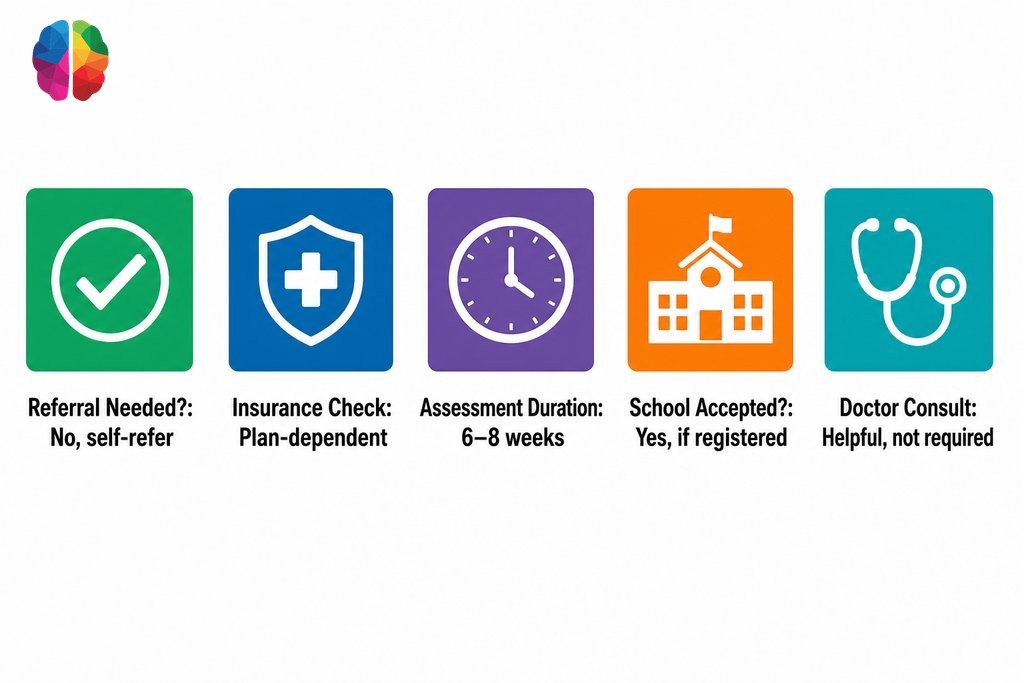
The direct testing portion takes four to six hours of one-on-one work. From intake to final report, the full process generally takes six to eight weeks. This is a timeline families must factor in when working toward admissions or placement decisions.
The resulting report does more than confirm or rule out a diagnosis. It builds a detailed learning profile that shows how a child processes information, where they are functioning relative to academic expectations, and what supports are most likely to help them succeed. Schools use these reports for placement decisions, IEP development, and accommodation planning. Post-secondary institutions such as UBC or SFU may also require a formal psychological assessment report to approve academic accommodations.
When Is a Doctor Referral Required for a Psychoeducational Assessment in BC?
A doctor referral is not always required, but there are specific situations where it matters.
Insurance Coverage
Some extended health benefit plans require a referral from a family physician or psychiatrist as a condition of coverage for a private psychoeducational assessment. Required documentation typically includes the referral letter, the registered psychologist's credentials, and a copy of the final report. Contact your insurer before booking to confirm exactly what your plan covers, as requirements vary considerably between providers. In this context, a physician referral does not change the clinical process, but it can determine whether costs are partially reimbursable.
Public School System
The publicly funded route through school districts does not always begin with a physician. As the Ontario Human Rights Commission's Right to Read Inquiry Report notes, referrals for school-aged children commonly originate from teachers, parents, or family doctors, and are often linked to reading difficulties, attention challenges, or a gap between effort and academic performance. In Vancouver and across British Columbia, wait times for publicly funded psychoeducational assessments can be substantial, which is a key reason many local families choose the private route instead.
Can You Get a Psychoeducational Assessment Without a Doctor Referral?
Yes. Private psychoeducational assessments in British Columbia do not require a doctor referral. Families in Vancouver can self-refer directly to a registered psychologist or clinic, and doing so does not reduce the clinical validity or school acceptability of the results.
What matters is that the assessment is conducted by a registered psychologist or psychological associate using standardized, evidence-based tools, and that the report meets the requirements of the school or programme involved. The referral source has no bearing on whether schools or post-secondary institutions will accept the findings.
Choosing the private route also gives families control over timing. When school placement deadlines are firm, waiting months for a publicly funded process to begin is rarely a realistic option. Families who self-refer privately can decide when the process starts, who conducts it, and how quickly the report is delivered, without compromising quality.

Why Talking to a Doctor Before Booking Can Still Help
Even when a referral is not required, consulting your family physician or paediatrician before booking can be a worthwhile step. A doctor can rule out vision or hearing problems that could affect test performance, identify sleep issues or health conditions that may influence results, share relevant medical history with the assessing psychologist, and flag signs of co-occurring conditions that may shape the scope of the assessment.
Providing the assessing psychologist with any relevant medical history or prior assessments gives them a fuller picture from the start, which can make the findings more accurate and more useful for planning. The value here is not in the referral itself, but in the communication between healthcare providers it can support.
What to Confirm Before Booking an Assessment
Asking the right questions before booking a psychoeducational assessment can prevent delays and misunderstandings later. Before committing, confirm the following:
- Registration: Is the psychologist registered with the College of Psychologists of British Columbia?
- Tools used: Which standardized instruments are included? Schools and post-secondary institutions expect recognised tools such as the WISC or WIAT series.
- Report format: Will the report be accepted by your child's school or the admissions programme you are targeting?
- Timeline: How long does the process take from intake to final written report, and can results be delivered before your deadline?
- Post-assessment support: Does the clinic offer a consultation to walk families through the results and next steps?
There are also red flags when choosing an assessment provider worth watching for, including vague answers about which tools are used, no post-assessment consultation offered, or reluctance to clarify the psychologist's registration status.
How All Brains Clinic Supports Vancouver Families Through the Assessment Process
All Brains Clinic in Vancouver uses a multidisciplinary model, where psychologists work alongside psychiatrists, speech-language pathologists, kinesiologists, and other specialists on each case. This means findings are informed by multiple professional perspectives, resulting in a report that is thorough and grounded in a broader understanding of how cognitive, developmental, and emotional factors interact in each child.
Every assessment at All Brains Clinic includes a full psychiatric evaluation covered by MSP, British Columbia's public health plan, which integrates physician involvement into the process. Following the assessment, families receive complimentary post-assessment support sessions to review results, ask questions, and receive a personalised plan. This step is what many Vancouver families find most valuable: it translates a detailed report into practical next steps, including how to present findings to the child's school, what accommodations to request, and what ongoing support might look like.
Should You Speak to a Doctor Before Deciding on a Referral Path?
In some cases, consulting a physician first is the right move. Consider this if your child has a complex medical history or prior diagnoses, shows signs of co-occurring conditions such as anxiety alongside learning difficulties or ADHD, or may need services beyond school accommodations, such as government disability programmes or specialised therapeutic supports. In these situations, a physician can help determine whether additional medical evaluation should happen alongside or before the psychoeducational process begins.
If you are unsure which referral pathway makes the most sense for your child, the most direct step is to reach out to All Brains Clinic for guidance. The team understands the referral landscape in British Columbia and can help you identify whether a doctor referral would benefit your specific situation before you invest time and money in a route that may not meet your goals. You do not need to have everything figured out before making contact. Reaching out early is one of the simplest ways to make sure your child gets the right assessment at the right time.
Frequently Asked Questions About Doctor Referrals for Psychoeducational Assessments
Do I need a doctor referral to book a private psychoeducational assessment in Vancouver?
No. Private psychoeducational assessments in British Columbia do not require a doctor referral. Families can self-refer directly to a registered psychologist or clinic. The absence of a referral does not affect the clinical validity of the assessment or whether schools and post-secondary institutions will accept the report.
Will my insurance cover a psychoeducational assessment without a doctor referral?
It depends on your extended health benefit plan. Some insurers require a physician or psychiatrist referral as a condition of reimbursement. Contact your insurer before booking to confirm what documentation is needed. Even if a referral is not clinically required, it may be worth obtaining one to satisfy your plan's coverage criteria.
How long does a psychoeducational assessment take from start to final report?
Direct testing typically takes four to six hours of one-on-one work with the child. The full process, from intake through scoring, interpretation, and written report, generally takes six to eight weeks. Families with firm school placement or accommodation deadlines should factor this timeline in when deciding when to book.
Will a school in Vancouver accept a privately conducted psychoeducational assessment?
Yes, provided the assessment was conducted by a psychologist registered with the College of Psychologists of British Columbia and used recognized standardized tools such as the WISC or WIAT series. The referral source does not affect a school's acceptance of the report.
What is the difference between a public school assessment and a private psychoeducational assessment in BC?
Public school assessments are funded by the school district but typically involve long wait times. Private assessments are paid for by families or partially covered by insurance, and offer faster access with greater flexibility over timing and report delivery. Both routes produce clinically valid results when conducted by a registered psychologist.
Should I consult my family doctor even if a referral is not required?
It can be helpful. A family physician or paediatrician can rule out vision, hearing, or health issues that might affect test performance, and share relevant medical history with the assessing psychologist. This can make the assessment more accurate and comprehensive, even when a formal referral is not required for booking.
Dr. Ali Eslami, Chief Editor
Dr. Ali Eslami is a child psychiatrist at BC Children’s Hospital and All Brains Clinic with a PhD from Brown University. With expertise in neurodevelopmental disorders, autism assessment, and AI research in mental health, he ensures every article meets the highest standards. His sharp editorial eye guarantees clarity, accuracy, and credibility in all our content.


